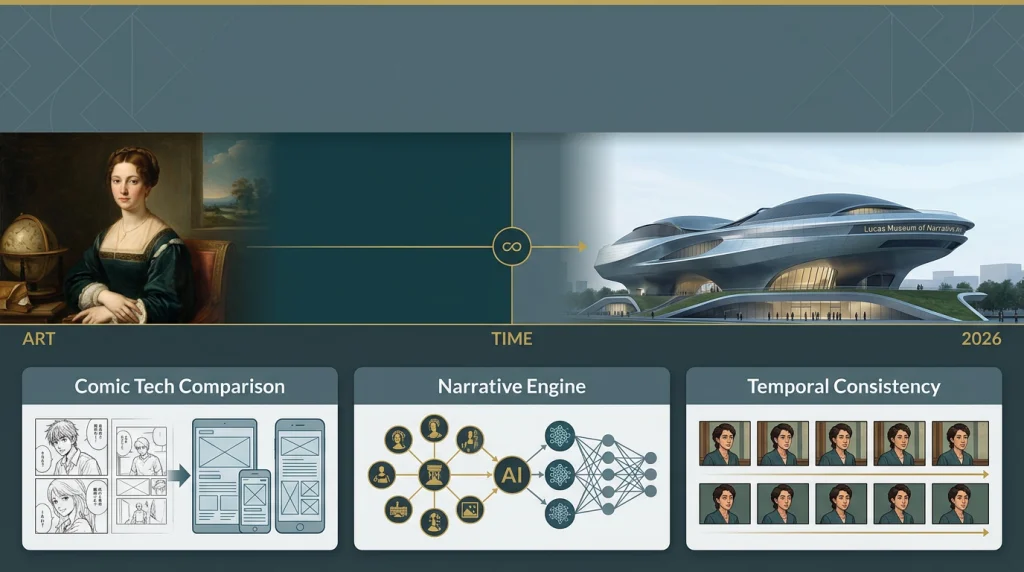
The landscape of visual storytelling is undergoing a seismic shift. As we move through 2026, the intersection of classical art history and cutting-edge technology is creating a new paradigm for how stories are told, preserved, and consumed. From the grand opening of the Lucas Museum of Narrative Art to the rise of sophisticated AI art review frameworks, the medium is no longer just about the image—it is about the narrative engine behind it. This evolution challenges our traditional understanding of authorship while providing digital artists with an unprecedented toolkit for expression.
Executive Summary (TL;DR)
- The Rise of Narrative Institutions: 2026 marks a turning point with the Lucas Museum elevating narrative art—once dismissed as "illustration"—to the status of high fine art.
- Technological Democratization: A rigorous comic tech comparison reveals that AI-driven tools are bridging the gap between historical manga techniques and modern digital workflows.
- The AI Synthesis: The current AI art review landscape shows that the most successful creators are those blending art history fundamentals with automated generation tools.
The News Breakdown: Today's Top Stories
1. The Lucas Museum: A New Mecca for Narrative Art
The long-awaited Lucas Museum of Narrative Art is set to revolutionize the Los Angeles cultural landscape in 2026. According to Travel And Tour World, the museum represents an unprecedented fusion of art and storytelling. By focusing on the "narrative"—art that tells a story—the institution validates genres like cinema, illustration, and digital media. This shift is further explored by the Los Angeles Review of Books, which questions the traditional boundaries of narrative art and how George Lucas’s vision challenges the elite art world’s historical exclusion of popular storytelling.
2. From Classical Roots to Cinematic Success
The bridge between art history and modern media is exemplified by figures like Autumn Durald Arkapaw. As reported by Loyola Marymount University, Arkapaw’s journey from studying art history to becoming an Oscar-nominated cinematographer highlights how classical visual principles inform modern filmmaking. This trajectory underscores the importance of "visual literacy" in the age of digital creation.
3. The Global Evolution of Graphic Storytelling
In San Francisco, the de Young Museum has launched "The Art of Manga," an exhibit that CBS News describes as a deep dive into Japanese graphic storytelling. Simultaneously, the Almas Art Foundation is showcasing "Against Erasure," an exhibition focusing on Sudanese memory and color. As noted by ART AFRICA Magazine, these movements demonstrate that visual storytelling is a vital tool for cultural preservation and political resistance.
Deep Dive Analysis & Constructive Insights
1. Connecting the Dots: The Convergence of Mediums
When we look at the Lucas Museum alongside the de Young’s Manga exhibit, a clear pattern emerges: the "low art" of the past (comics, movie posters, and illustrations) is being recontextualized as the "high art" of the future. This is not merely a change in taste; it is a recognition that narrative is the primary currency of the digital age.
Our AI art review of recent generative models shows a similar trend. AI tools are no longer just producing static images; they are being trained on the very "narrative beats" found in art history and manga. The "hidden pattern" here is the shift from aesthetic-centric AI to narrative-centric AI, where the goal is consistency across frames—a core requirement for any AI comic generator comparison.
2. The Ripple Effect: The Future of the Digital Artist
The institutional validation of narrative art will have a profound impact on the best tools for digital artists. As museums celebrate storytelling, software developers are responding with features that prioritize sequence and character persistence.
In our comic tech comparison, we see a move away from standalone painting apps toward integrated narrative suites. For competitors in the software space (like Adobe vs. Canva vs. Midjourney), the battleground is now "story-flow." If an AI can maintain a character's likeness across 50 pages of a graphic novel, it disrupts the entire freelance illustration economy. This will lead to a surge in "Auteur Creators"—individuals who use AI to handle the labor-intensive rendering while they focus on the high-level art history principles of composition and pacing.
3. Constructive Viewpoints & Actionable Takeaways
As an analyst, my stance is that the "AI vs. Human" debate is maturing into a "History + Tech" synthesis. To stay competitive, artists and investors should consider the following:
- For Artists: Don't just learn the tools; learn the history. The success of Autumn Durald Arkapaw proves that a foundation in art history provides a competitive edge that AI cannot yet replicate: the ability to make intentional, emotionally resonant choices.
- For Developers: Focus on "Temporal Consistency." The biggest gap in current AI comic generator comparisons is the struggle to keep visual elements stable over time. Solving this is the "Holy Grail" of digital art tech.
- For Consumers/Collectors: Look toward "Hybrid Narratives." The most valuable art of the next decade will likely be pieces that utilize AI for scale but are grounded in the deep storytelling traditions being celebrated at the Lucas Museum.
Sources & Methodology
This report was synthesized from recent 2025-2026 news cycles, including reports from Travel And Tour World, CBS News, ART AFRICA Magazine, and Los Angeles Review of Books. The analysis utilizes a proprietary framework for evaluating AI tool performance against traditional art history benchmarks.
Copyright © 2026 TabStory.net. All rights reserved. Unauthorized reproduction is prohibited.