The comic book industry is undergoing its most significant transformation since the shift from newsprint to digital tablets. For decades, the primary barrier to entry for aspiring graphic novelists wasn't just storytelling ability—it was the grueling demand for visual continuity. Drawing the same character from a hundred different angles across a hundred different panels required years of anatomical study.
However, as we move through 2026, a new era of AI comic character consistency has arrived. This shift is democratizing the medium, allowing writers who "can't draw" to produce professional-grade sequential art. In this exclusive industry analysis and creator spotlight, we examine how successful comic creators in 2026 are leveraging emerging technologies like Amazon Nova and advanced AI cartoon generators to maintain creative integrity while 10x-ing their output.
Executive Summary (TL;DR)
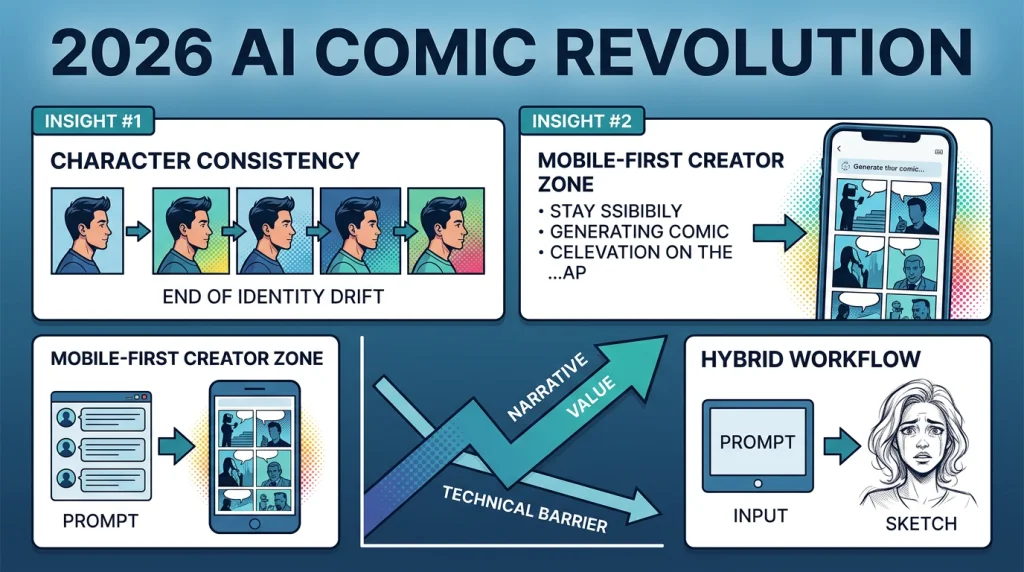
- The Consistency Breakthrough: New tools like Amazon Nova in Amazon Bedrock are solving the "identity drift" problem, allowing for frame-to-frame character stability.
- Democratization of Art: Mobile-first AI tools are enabling non-artists to create serialized four-panel comics directly from their phones.
- Hybrid Workflows: Top indie comic artists in 2026 are using AI for layout and character reference while maintaining manual control over final emotional nuances.
- Strategic Shift: The industry is moving from "drawing skills" toward "creative direction and prompt engineering" as the primary value drivers for creators.
The News Breakdown: Today’s Top Stories in AI Comics
1. The Tech Titans Enter the Fray
Amazon Web Services (AWS) recently detailed how its Amazon Nova model within the Bedrock ecosystem is specifically designed to build character-consistent storyboards. By utilizing reference seeds and advanced latent space mapping, Nova ensures that a character’s unique features—hair texture, facial proportions, and costume details—remain identical across varying environments and lighting conditions.
2. The Rise of the "Phone-First" Creator
A report from 36 Kr highlights a burgeoning trend: creators who admit they "can't draw" are now producing viral four-panel comics using only their smartphones. This shift suggests that the technical barrier to the comic industry has effectively collapsed, shifting the focus entirely to narrative wit and pacing.
3. 2026 Tooling and UX Predictions
Analytics Insight and The AI Journal have released comprehensive guides on the Top AI Comic & Webtoon Tools for 2026. These tools are no longer just image generators; they are integrated suites that handle paneling, speech bubble placement, and automated "inking" styles. Furthermore, UX pioneer Jakob Nielsen has integrated these trends into his 2026 Predictions, suggesting that comic-style visual communication will become a standard for UX documentation and corporate storytelling.
Deep Dive Analysis & Constructive Insights
1. Connecting the Dots: The End of the "Uncanny Valley" in Comics
Looking across these reports, a clear pattern emerges: the industry has moved past the "novelty phase" of AI art. In 2024 and 2025, AI-generated comics were often criticized for their lack of continuity—a character might have blue eyes in panel one and brown eyes in panel two. The 2026 landscape, characterized by the "Consistency Revolution" noted by The Jerusalem Post, shows that we have solved the technical hurdle of creative continuity. The integration of LoRA (Low-Rank Adaptation) and ControlNet technologies into user-friendly platforms means that "identity persistence" is now a standard feature, not a workaround.
2. The Ripple Effect: The New Economics of Indie Comics
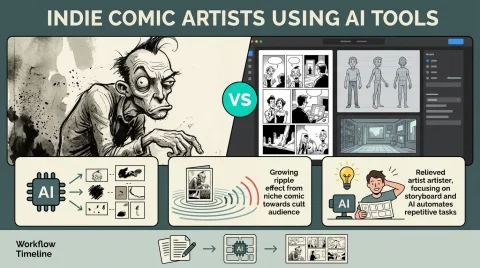
The second-order consequence of these tools is a radical shift in the labor economy of webtoons and indie comics. Traditionally, a successful webtoon required a studio of assistants (liners, colorists, background artists). In 2026, a single indie comic artist can function as an entire studio. This will likely lead to an explosion of niche content—stories that were previously "too expensive" to produce because they targeted a small audience can now be profitable. However, this also means the market will be flooded, making brand identity and unique narrative voice more valuable than the art itself.
3. Constructive Viewpoints & Actionable Takeaways
For creators and investors entering this space, the strategy must pivot.
- For Artists: Do not fight the tools; become the "Director." Your value now lies in character design (the initial seed) and the emotional orchestration of the story. Master the art of consistent character sheets early in the process to ensure your AI model has a strong foundation.
- For Publishers: Look for creators who demonstrate high "narrative density." Since the cost of art is approaching zero, the quality of the script and the "stickiness" of the IP are your only moats.
- Strategic Advice: Start building your "Character Library" now. In 2026, the most successful creators will be those who own a stable of recognizable, AI-consistent characters that can be deployed across comics, games, and social media instantly.
Sources & Methodology
This industry roundup was synthesized from latest 2025-2026 reports from AWS, The Jerusalem Post, Analytics Insight, and Jakob Nielsen’s UX research. We analyzed these sources to identify the intersection of technical capability and creative application in the sequential art industry.
Copyright © 2026 TabStory.net. All rights reserved.