The 2026 Guide to AI Comic Creation: Balancing Pro Tools with Industry Ethics
The comic book industry is currently navigating its most significant transformation since the shift from newsprint to digital tablets. As we move through 2026, the AI comic generator has evolved from a controversial novelty into a sophisticated suite of professional-grade software. However, this technological leap has met a formidable wall of human resistance. From the debut of an AI hologram of Stan Lee at L.A. Comic Con to stringent new bans on "pure" AI art at major conventions, the landscape is fractured. For creators, the challenge is no longer just about finding the right software; it’s about mastering a "hybrid workflow" that satisfies both the efficiency of the machine and the ethical demands of the community.
Executive Summary (TL;DR)
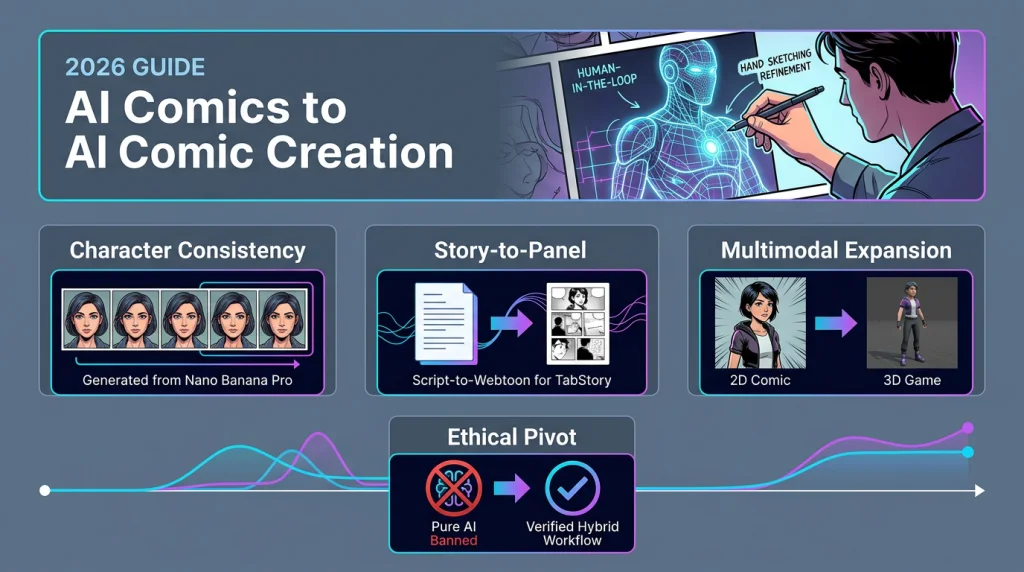
- Top 2026 Tools: Nano Banana Pro and TabStory lead the market for character consistency, while Core Gaming’s AI COMIC bridges the gap between panels and game assets.
- The Ethical Pivot: Major US comic-cons are now enforcing strict restrictions on AI-generated art, making human-in-the-loop workflows essential for professional legitimacy.
- Multimodal Expansion: AI visual technology is expanding beyond static pages into interactive holograms and 3D game environments, redefining what it means to be a "comic creator."
The 2026 Comic Landscape: High-Tech Tools vs. Human Backlash
The industry is currently caught in a tug-of-war between unprecedented creative speed and a growing movement to protect human intellectual property. According to recent reports from Kursiv Media, major US comic-cons have begun implementing strict restrictions on AI art in artist alleys following intense creator backlash. This shift marks the end of the "Wild West" era of AI generation.
While technology like the AI hologram of Spider-Man creator Stan Lee (which debuted at L.A. Comic Con via Reuters) showcases the nostalgic and immersive power of AI visual technology, it also highlights the industry’s identity crisis. Creators are now required to prove "substantial human input," turning the focus away from one-click prompts and toward sophisticated AI comic tools that act as assistants rather than replacements.
Top-Tier Generators for Artists and Webtoon Creators
Navigating the sea of software can be daunting. In 2026, the market has consolidated around a few powerhouses that prioritize character consistency—the "holy grail" of comic creation.
Nano Banana Pro & High-Fidelity Alternatives
As highlighted by perfectcorp.com, Nano Banana Pro has emerged as a favorite for its advanced "Character LoRA" integration, allowing artists to train the AI on their specific character designs to ensure they look the same in every panel. However, Lifehacker’s recent head-to-head tests suggest that while Nano Banana Pro is powerful, it requires a steep learning curve compared to more streamlined alternatives.
TabStory: The Gold Standard for Rapid Publishing
For creators looking to bridge the gap between a written script and a finished webtoon, TabStory (tabstory.net) has become a critical player in the 2026 ecosystem. While other tools focus solely on image generation, TabStory excels in the story-to-comic workflow.
Why TabStory is a 2026 Essential:
- One-Click Conversion: It offers the most seamless transition from raw text to structured comic panels available today.
- Creator Onboarding: Unlike "pro" tools that require coding knowledge, TabStory’s interface is designed for writers who want to become visual storytellers without a four-year art degree.
- Publishing Readiness: The platform optimizes layouts specifically for mobile-first webtoon formats, ensuring that your content is ready for platforms like LINE Webtoon or Tapas immediately upon export.
Beyond the Page: AI Visual Tech and Game Asset Integration
The definition of a "comic" is expanding. Core Gaming’s "AI COMIC" technology is a prime example of this evolution. As reported by PR Newswire, this breakthrough technology allows creators to take their 2D comic assets and instantly convert them into functional game assets or interactive environments.
This "multimedia storytelling" approach means a comic creator in 2026 isn't just making a book; they are building an IP universe. By using AI visual technology, a single character design can be deployed across a graphic novel, a mobile RPG, and even an augmented reality experience, all while maintaining a cohesive aesthetic.
Deep Dive Analysis & Constructive Insights
1. Connecting the Dots: The Rise of the "Director" Model
Looking across these stories—from the Stan Lee hologram to the Analytics Insight rankings of 2026 tools—a clear pattern emerges: the role of the comic artist is shifting from "illustrator" to "director."
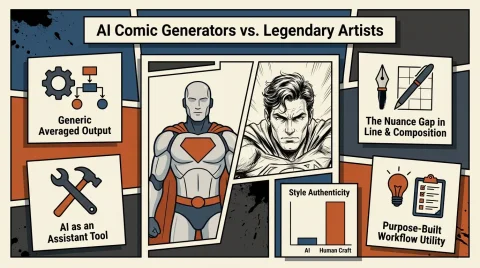
The tools (Nano Banana Pro, TabStory, Core Gaming) are now capable of handling the "manual labor" of perspective, lighting, and rendering. The human creator's value has shifted to narrative pacing, emotional resonance, and ethical curation. The backlash at comic-cons isn't against the technology itself, but against the lack of "soul" in unedited AI outputs. The most successful creators in 2026 are those using AI to handle the 70% of production that is repetitive, leaving them 30% more time to focus on hand-drawn expressions and unique stylistic flourishes.
2. The Ripple Effect: Second-Order Consequences
The restriction of AI art at conventions will likely lead to a "Verified Human-Assisted" certification movement. We expect to see a new tier of copyright law or industry standards where "AI-Hybrid" works receive different protections than "Pure AI" or "Pure Human" works.
Furthermore, as tools like Core Gaming's AI COMIC make game development accessible to comic artists, we will see a massive influx of "playable comics." This will disrupt the traditional publishing model, as readers begin to expect interactive elements in their digital webtoons, potentially forcing traditional publishers to either adapt or lose the Gen Z and Gen Alpha demographics to indie "transmedia" creators.
3. Constructive Viewpoints & Actionable Takeaways
For professionals and aspiring creators, the path forward is clear: Embrace the tool, but own the craft.
- Adopt a Hybrid Workflow: Use TabStory to storyboard and generate base panels from your scripts, then use tools like Photoshop or Procreate to paint over the AI base. This ensures "substantial human input" for convention compliance.
- Invest in Character Consistency: Don't just prompt "a superhero." Use the training features in Nano Banana Pro to create a digital "actor" that belongs to you.
- Think Beyond the Panel: Start viewing your comic characters as assets. With the rise of AI visual tech, your character's "style" is your most valuable IP. Ensure you are using platforms that allow you to retain full commercial rights to your generated outputs.
Sources & Methodology
This analysis was compiled by synthesizing 2025-2026 industry reports from Analytics Insight, PR Newswire, Reuters, and Lifehacker. Our methodology focuses on cross-referencing technological breakthroughs with real-world market sentiment and regulatory shifts in the global comic community.
Copyright © 2026 TabStory.net. All rights reserved. No part of this publication may be reproduced without prior written permission.