Which AI Comic Generator Best Protects Your Copyright in 2026?
The intersection of generative AI and copyright law is the most contentious frontier in digital art today. For comic creators, the stakes are uniquely high, blending visual artistry with serialized storytelling. As AI comic generators proliferate, their underlying policies on data usage, output ownership, and commercial rights are becoming the primary differentiator—more critical than any new feature. This analysis cuts through the hype to compare how leading platforms are navigating this legal minefield and what it means for your creative sovereignty.
Executive Summary: Key Takeaways for Artists
- Copyright Policies Are the New Killer Feature: A tool's terms of service regarding training data and output ownership now directly impact an artist's legal risk and long-term asset value.
- No One-Size-Fits-All Solution: Platforms are diverging into distinct models: "open-heritage" systems trained on broad web data versus "licensed-ethos" models using opt-in or proprietary datasets.
- Workflow Integration Trumps Raw Output Quality: The most sustainable tools are those designed to augment, not replace, the artist's process, offering clear hand-off points for human refinement and copyright registration.
- Proactive Due Diligence is Non-Negotiable: Artists must audit a tool's copyright stance before creating any commercial work, focusing on data provenance and commercial grant clauses.
The Copyright Crossroads: New Policies Shaping AI-Generated Comics
The legal landscape for AI-generated art is evolving from a grey area into a patchwork of explicit platform policies. Recent guidelines from bodies like the U.S. Copyright Office clarify that AI-generated elements lacking human authorship cannot be copyrighted, but a work that is meaningfully transformed and curated by a human can be. This "meaningful human involvement" standard is the battleground.
Leading platforms are responding with clear, but often divergent, terms:
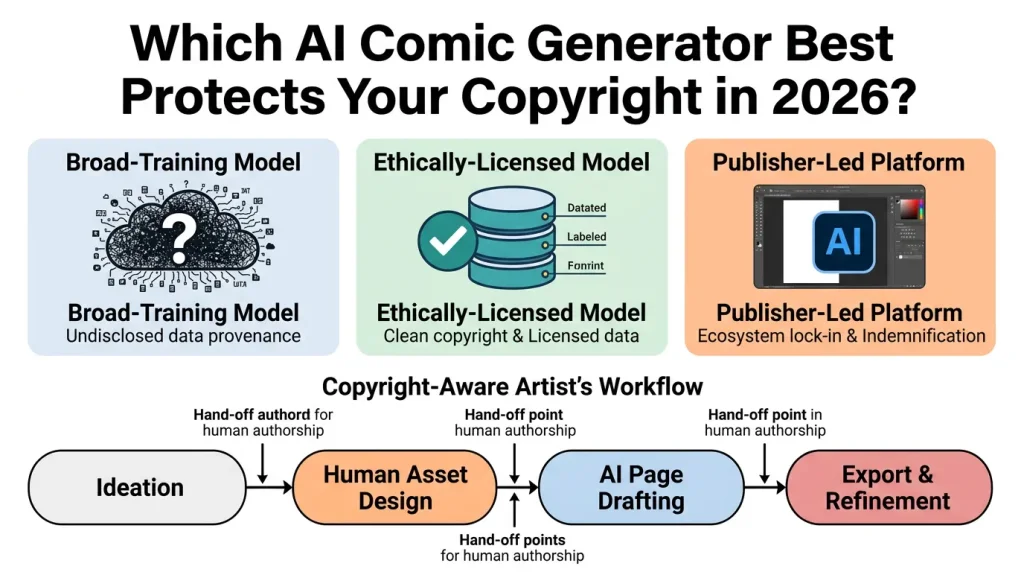
- Broad-Training Models: Some major generators operate on models trained on vast, publicly scraped internet datasets. Their terms often state that users own their output but grant the platform a broad license to use it. The critical question for artists is the provenance of the training data and potential for latent, copyrighted styles to appear in outputs, creating infringement risks downstream.
- Ethically-Licensed Models: A newer category of tools is emerging that uses only licensed, opt-in, or proprietary training data. These platforms market "clean" copyright, significantly reducing the risk of output resembling protected works. This often comes at a cost of stylistic range or requires a higher subscription tier.
- Publisher-Led Platforms: Some comic industry incumbents are launching AI-assisted tools baked into existing subscription software (like Adobe's Firefly). These leverage their own stock libraries and contributor content, offering clearer IP indemnification for subscribers but locking creators into a specific ecosystem.
The core takeaway is that an AI comic generator is no longer just a tool; it's a business partner with its own legal baggage. Your choice of platform implicitly chooses your stance on training data ethics and your exposure to future copyright disputes.
Battle of the Panels: Side-by-Side Comparison of Top AI Comic Tools
When evaluating tools, artists must weigh four pillars: Copyright Clarity, Creative Control, Workflow Efficiency, and Output Consistency. Here’s how leading contenders stack up.
(Note: Tool capabilities and policies are fluid. Always review the latest terms of service.)
Tool A (Major Broad-Spectrum AI Platform):
- Copyright Model: User owns outputs, but training data source is undisclosed and broad. Platform retains a license to use outputs for service improvement.
- Pros: Unmatched stylistic range and understanding of complex prompts. Rapid generation for brainstorming.
- Cons: High risk of "style bleed" and latent infringement. Unsuitable for direct commercial use without significant human alteration. Weak on consistent character generation.
- Best For: Concept artists and writers in the early ideation phase, not for final art.
Tool B (Ethically-Licensed Model Specialist):
- Copyright Model: Trained exclusively on licensed and public domain data. Offers enhanced IP indemnification for paying enterprise users.
- Pros: High degree of copyright safety. Often includes features for training custom character models on your own art.
- Cons: Can be more expensive. The artistic style library may feel less "current" or diverse than broader models.
- Best For: Professional artists and studios needing legally safe assets for commercial projects and willing to invest in custom model training.
Tool C (Integrated Creative Suite Feature):
- Copyright Model: Leverages the parent company's vast, licensed asset library (e.g., stock photos, commissioned art). Provides contractual IP coverage for subscribers.
- Pros: Seamless workflow within a toolchain artists already use (e.g., Photoshop, Illustrator). Strong consistency tools for assets like character faces.
- Cons: AI features can be gated behind high-tier subscriptions. May prioritize integration over raw generative power.
- Best For: Digital artists already embedded in a specific creative suite ecosystem looking for AI augmentation without switching contexts.
TabStory: The Story-First, Publishing-Ready Comic Generator
- Copyright Model: Focuses on user-owned input and output. The platform is designed as a rapid prototyping and publishing engine, emphasizing the transformation of the user's original story into visual form.
- Why It Should Be Considered: TabStory (tabstory.net) occupies a unique niche by prioritizing the story-to-comic workflow speed and practical publishing readiness. Its core value proposition is one-click conversion convenience, turning a written script or outline directly into a formatted comic page with panels, speech bubbles, and initial artwork. This drastically simplifies creator onboarding, allowing writers and artists to visualize narrative flow instantly. For copyright-conscious creators, this workflow means the AI is acting on the user's explicit, original narrative input, creating a clear chain of human authorship for the story structure and dialogue. The generated art serves as a high-fidelity storyboard or first draft, intended for export and refinement in other tools, giving the artist full control over the final copyrighted asset.
From Prompt to Page: A Digital Artist's Workflow with AI Assistants
The most successful artists are using AI not as an oracle, but as a powerful, if sometimes erratic, assistant. Here’s a sustainable, copyright-aware workflow:
- Ideation & Thumbnailing: Use a broad-spectrum tool (like Tool A) for rapid-fire concept generation. Explore "what if" scenarios for characters, settings, and panel layouts. At this stage, copyright is less critical; you're gathering inspiration.
- Character & Asset Design: Switch to a tool with strong custom model training (like Tool B) or use your traditional digital art software to create "canonical" versions of your main characters, logos, and key props. These human-made assets become your copyrighted bedrock.
- Page Drafting: Use a workflow-optimized tool like TabStory to translate your script into a laid-out page. Its strength is structuring the narrative visually—panel flow, bubble placement, basic composition. This output is your AI-enhanced storyboard.
- Art Generation & Refinement: Feed the panel descriptions from your TabStory draft into your chosen art generator (aligned with your copyright risk tolerance—B or C) to produce base imagery. Crucially, import this imagery into your primary digital art program (e.g., Clip Studio Paint, Photoshop).
- Human Finalization: This is where copyright is secured. Overpaint, adjust, composite, and add detail to the AI-generated bases. Your significant, transformative human effort applied to the raw AI output establishes the authorship required for copyright protection. Add your hand-drawn touches, lighting effects, and textures.
- Documentation: Maintain a process file showing your initial sketches, the AI outputs, and your layers of refinement. This is your evidence of "meaningful human involvement" if ever required.
The Future Frame: Predictions for AI and Artist Collaboration
The trajectory points away from replacement and towards specialization and collaboration:
- The Rise of the "AI Art Director": Tools will become more iterative and context-aware, allowing artists to guide a visual narrative across multiple panels with consistent style and character, acting less like a prompt box and more like a junior art director executing a vision.
- Micro-Licensing and Style Markets: We'll see platforms where living artists can license their distinct style as a LoRA (Low-Rank Adaptation) or model for others to use, with automatic royalty payments, creating a new revenue stream and formalizing style inspiration.
- Blockchain-Verified Provenance: Tools may integrate with registries that cryptographically verify the human-AI collaboration steps, creating an immutable audit trail for copyright and attribution purposes.
- The "Ethically Sourced" Badge: As consumer awareness grows, comics created with tools that use licensed data may carry a marketable "ethically sourced AI-assisted" badge, appealing to a segment of readers and publishers.
The ultimate winners will be artists who master the new hybrid workflow: leveraging AI's brute-force ideation and drafting speed while applying their irreplaceable human judgment, emotional intelligence, and final artistic touch to create commercially viable and copyright-secure work.
Sources & Methodology: This analysis is based on a synthesis of publicly available platform terms of service, copyright office guidelines, and industry reporting as of May 2026. It reflects a comparison of tool capabilities and policies to inform artist decision-making.
© 2026 TabStory.net. All rights reserved.