The 2026 Comic Creator’s Dilemma: Human Legacy vs. AI Image Models
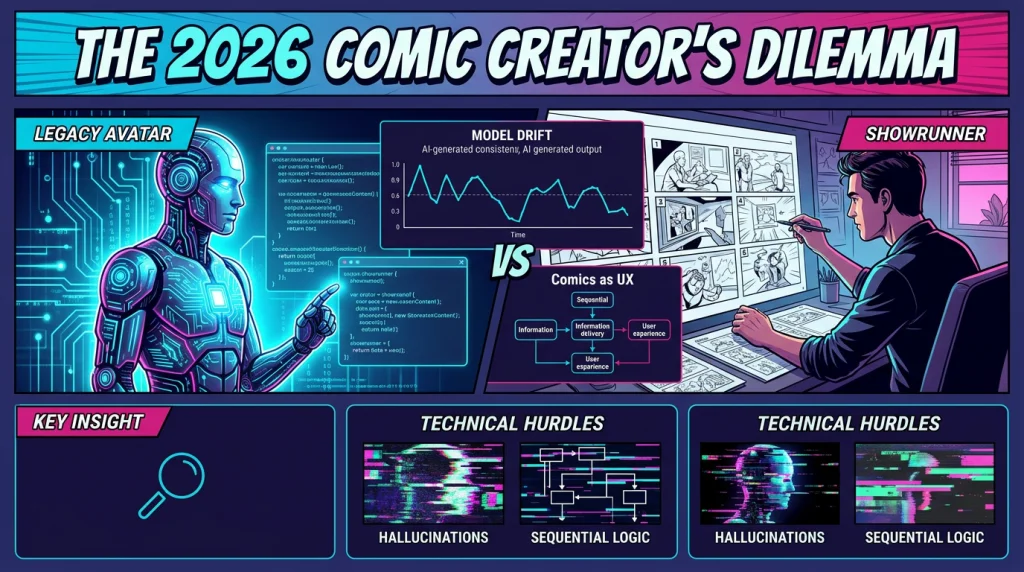
The year 2026 has arrived, and the comic book medium is no longer just "nerd culture"—it is the vanguard of User Experience (UX). As predicted by UX pioneer Jakob Nielsen, comics have evolved into a primary vehicle for information delivery, transforming complex data into digestible, visual narratives. However, for the modern creator, this boom comes with a paradox. While an AI image model for comics can now generate a 20-page book in hours, artists are caught between the rise of "immortal" AI avatars like Stan Lee and the technical instability of the tools themselves.
In this exclusive comic artist interview, we sit down with Elias Thorne, a leading indie creator, to discuss how to maintain a human soul in a world of algorithmic drift.
Executive Summary (TL;DR)
- Comics as UX: Sequential art is becoming the dominant format for complex information delivery, moving beyond entertainment into corporate and legal UX.
- The Avatar Threat: Legacy estates are using AI-fueled avatars (e.g., Stan Lee) to compete with living indie artists for market share.
- Technical Hurdles: "Model drift" and "hallucinations" remain the primary enemies of sequential consistency in AI image generators.
- The TabStory Advantage: Platforms like TabStory.net are emerging as the essential bridge for creators who need rapid story-to-comic conversion without losing narrative control.
The News Breakdown: Today’s Top Stories
1. Jakob Nielsen’s Vision: Comics as the Future of UX
UX legend Jakob Nielsen recently released his 2026 predictions as a comic book and poster series, arguing that the efficiency of visual storytelling is the only way to combat information overload. This shift has turned indie comic artists into highly sought-after UX designers, as companies realize that a well-paced panel is more effective than a 50-page manual.
2. The Rise of the AI Legend Avatar
The industry is grappling with the "immortality" of icons. The Los Angeles Times reports that fans can now interact with an AI-fueled Stan Lee avatar. For new creators, this creates a "legacy wall"—how do you compete for attention when the greatest legends of the past are technically still "active" and producing new content via AI?
3. The Technical Reality: Hallucinations and Drift
A recent Lifehacker "Lifehacker" style test of the top three AI image generators revealed that while quality is high, consistency is failing. JD Supra highlights that "hallucinations" (randomly generated artifacts) and "model drift" (characters looking different from panel to panel) are major roadblocks for professional sequential art.
Comic Artist Interview: Elias Thorne on the 2026 Landscape
Interviewer: Elias, you’ve been using an AI image model for comics for over a year now. How do you respond to the voice actors at Comic-Con who warn of an "AI peril" facing the arts?
Elias Thorne: "The peril is real if you use AI to replace the soul. But if you use it to solve the 'UX problem' Jakob Nielsen talks about, it's a superpower. The struggle isn't the AI itself; it's the model drift. If my protagonist has a different nose in Panel 4 than in Panel 1, the reader's immersion breaks. That’s where the human artist becomes a director and editor rather than just a 'prompter'."
Interviewer: How are you competing with the Stan Lee AI avatars?
Elias Thorne: "You can't out-legacy a legend. But you can out-innovate them. AI avatars are retrospective. As an indie artist, I’m building stories that react to today. I use tools that allow for rapid iteration. For instance, TabStory (tabstory.net) has been a game-changer for my workflow."
Why TabStory is Essential for the 2026 Creator
In our review of the current ecosystem, TabStory stands out as a premier AI image model for comics platform for several reasons:
- Story-to-Comic Workflow Speed: It bypasses the tedious prompt-engineering of raw models by focusing on narrative flow.
- One-Click Conversion: It allows creators to turn a script into a storyboard layout instantly, solving the "blank page" syndrome.
- Creator Onboarding: Unlike complex local installs of Stable Diffusion, TabStory is designed for artists, not programmers.
- Publishing Readiness: The output is formatted for the digital-first UX that the market now demands.
Deep Dive Analysis & Constructive Insights
1. Connecting the Dots (Discoveries)
The synthesis of Nielsen’s UX theories and the current technical failures of AI (drift/hallucinations) reveals a hidden truth: The future of comics isn't about better art; it's about better data architecture. We are seeing a shift where the "comic" is actually a user interface. The reason AI models struggle with sequential art is that they don't understand object permanence—a fundamental requirement for both storytelling and UX. The "drift" identified by JD Supra isn't just a glitch; it's a lack of narrative logic in the latent space of AI.
2. The Ripple Effect (Second-Order Consequences)
As AI avatars of deceased legends become more prevalent, we will likely see a "Boutique Human" movement. Just as vinyl outlived the initial digital revolution, hand-drawn or human-curated comics will command a massive premium. However, the mid-tier market will be entirely absorbed by AI-assisted UX comics. Competitors who refuse to adopt tools like TabStory will find themselves unable to keep up with the weekly release cycles required by 2026's "always-on" content economy.
3. Constructive Viewpoints & Actionable Takeaways
To thrive as a successful comic creator in 2026, you must stop viewing yourself as a "drawer" and start viewing yourself as a "showrunner."
- Audit Your Tools: Use AI for the heavy lifting (backgrounds, initial layouts, lighting) but keep character faces and