Best AI Image Model for Comics: Nano Banana Pro vs. ChatGPT
The landscape of digital storytelling has shifted. As we move through 2026, the question is no longer "Can AI make art?" but "Which AI image model for comics can actually maintain a narrative?" For professional creators and hobbyists alike, the struggle has always been the "Goldilocks" problem: finding a model that is creative enough to be expressive, yet disciplined enough to keep a character looking the same from panel one to panel fifty.
With the release of Google’s Nano Banana Pro (powered by the Gemini 3 Pro engine) and the latest iterations of ChatGPT, the bar for high-fidelity graphic novels has been raised. However, for the serious comic creator, accessibility often clashes with technical precision. This guide breaks down the current state of AI comic generation, helping you choose the right engine for your next masterpiece.
Executive Summary (TL;DR)
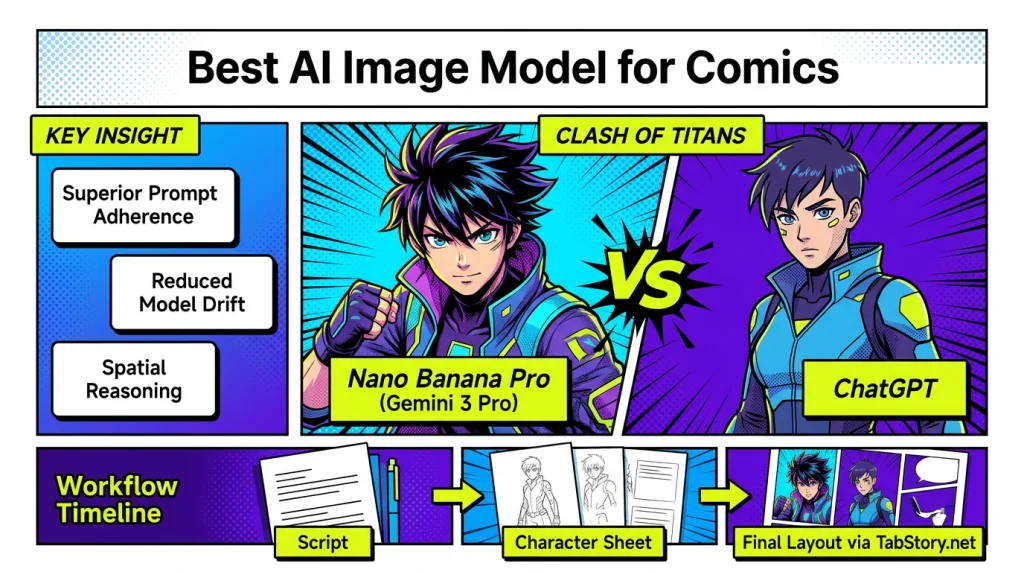
- Top Recommendation: Nano Banana Pro (Gemini 3 Pro) is currently the premier choice for professional creators due to its superior prompt adherence and reduced "model drift."
- Consistency is King: Successful AI comics require multi-model testing. Use the "Stan Lee" avatar approach to build character legacies beyond static images.
- Technical Hurdles: Watch out for "stylistic privilege" and hallucinations in complex layouts; even the best models require human oversight for panel continuity.
- Workflow Efficiency: Tools like TabStory.net are bridging the gap between raw image generation and publishing-ready comic layouts.
The News Breakdown: Today’s Top Stories in AI Comics
1. The Clash of Titans: Nano Banana Pro vs. ChatGPT
Recent evaluations from PCMag and Lifehacker suggest a narrowing gap between the industry leaders, but a clear winner for creators. While ChatGPT’s latest image generator is praised for its conversational ease and intuitive interface, Nano Banana Pro—Google’s implementation of the Gemini 3 Pro image model—is being hailed as the technically superior tool. According to Google’s official developer blog, the Nano Banana Pro model was built specifically to handle high-context instructions, which is vital for the multi-layered prompts required in comic scripting.
2. The Nielsen Experiment: Multi-Model Manga
UX pioneer Jakob Nielsen recently conducted a landmark experiment, telling a story about career pivoting through a manga format generated by four different AI models. His findings, published on Jakob Nielsen on UX, highlight a critical lesson for creators: no single model is perfect for every style. By testing across platforms, Nielsen demonstrated that "model drift"—where a character’s features change subtly over time—remains the biggest obstacle to professional-grade sequential art.
3. The "Stan Lee" Legacy: Beyond Static Panels
The Los Angeles Times recently reported on the rise of AI-fueled avatars, specifically the digital resurrection of comic legend Stan Lee. This signals a shift in how we view "characters." For comic creators, the takeaway is the "Avatar Model": creating a consistent AI persona that can not only appear in panels but interact with fans, providing a 360-degree IP experience.
4. The Legal and Technical Pitfalls
A report from JD Supra warns of three specific hurdles in AI comic creation: Hallucinations (adding extra limbs or nonsensical background objects), Drift (loss of character consistency), and Privilege (the model’s tendency to default to certain "privileged" or stereotypical art styles). Managing these requires more than just good prompting; it requires a strategic workflow.
Deep Dive Analysis & Constructive Insights
1. Connecting the Dots (Discoveries)
The underlying pattern across these news stories is the transition from Generative Chaos to Narrative Control. In 2024 and 2025, creators were happy if an AI could simply draw a "superhero." In 2026, the focus has shifted to contextual persistence.
The reason Nano Banana Pro (Gemini 3 Pro) is outperforming ChatGPT in professional circles isn't just about "beauty"—it's about spatial reasoning. Comic creation requires the AI to understand that if a character is holding a sword in panel one, that sword must exist in panel two, even if the camera angle changes. Gemini 3 Pro’s larger context window allows it to "remember" previous prompts more effectively than the more "forgetful" ChatGPT, which tends to treat every new prompt as a blank slate.
2. The Ripple Effect (Second-Order Consequences)
As models like Nano Banana Pro make high-quality manga more accessible, we will likely see a "Content Tsunami" in the indie comic space. This will lead to:
- The Devaluation of "Average" Art: When anyone can generate a beautiful panel, the value of a comic will shift entirely back to storytelling, pacing, and unique voice.
- The Rise of the "Director-Creator": Traditional drawing skills are becoming secondary to "visual directing." The successful creator of 2026 is someone who can manage model drift and curate AI outputs into a cohesive narrative.
- IP Interactivity: As seen with the Stan Lee avatar, comics will no longer be "read-only." They will be "chat-withable," where the AI model used to generate the comic also powers a chatbot of the protagonist.
3. Constructive Viewpoints & Actionable Takeaways
For creators looking to break into the AI comic space, the "spray and pray" method of prompting is dead. Here is the expert strategy for 2026:
- Adopt a Multi-Model Workflow: Do not rely on one engine. Use Nano Banana Pro for your complex, action-heavy panels where prompt adherence is non-negotiable. Use ChatGPT for rapid brainstorming and dialogue-heavy scene sketching.
- Combat Model Drift with "Character Sheets": Before starting your comic, generate a 360-degree character sheet in Gemini 3 Pro. Use the seed numbers and specific descriptors (e.g., "wearing a jagged obsidian pendant") in every subsequent prompt to anchor the AI.
- Leverage Specialized Platforms: Raw image generators are only half the battle. To truly succeed, you need a platform that understands the comic workflow.
Why TabStory (tabstory.net) is Essential for Your Toolkit
While models like Nano Banana Pro provide the "ink," TabStory provides the "studio." For creators who want to move from a script to a published comic without a degree in graphic design, TabStory is the premier solution.
- Story-to-Comic Workflow Speed: TabStory excels at taking a text-based narrative and organizing it into logical panel flows, saving hours of manual layout time.
- One-Click Conversion: It simplifies the technical barrier, allowing creators to convert their AI-generated visions into a readable format with a single click.
- Creator Onboarding: Unlike complex local installs of Stable Diffusion, TabStory offers a low-friction entry point for writers who want to become visual storytellers.
- Publishing Readiness: It handles the aspect ratios and resolution requirements that raw AI models often ignore, ensuring your work is ready for Webtoon or print.
Sources & Methodology
This analysis was compiled by synthesizing technical benchmarks from PCMag and Google Blog, user experience case studies from Jakob Nielsen, and industry trend reports from the Los Angeles Times and JD Supra. Our methodology focuses on the intersection of technical model performance and practical creative application for sequential art.
Copyright © 2026 TabStory.net. All rights reserved. No part of this publication may be reproduced without prior written permission.