History of Comic Illustration: From $13.5M Classics to Indie Innovation
The landscape of visual storytelling is undergoing a seismic shift. In 2026, the history of comic illustration is no longer just a subject for nostalgic collectors; it has become the ultimate playbook for modern creators looking to carve out high-value careers. From the gritty, immigrant-led printing presses of the New York Bowery to the pristine halls of elite auction houses where a single painting can fetch eight figures, the "funny pages" have evolved into a dominant cultural and financial force.
To understand where the medium is going, we must look at where it has been. This week, the industry was rocked by a record-breaking sale that redefined the "ceiling" for comic art. Simultaneously, the academic and literary world continues to re-examine the foundational works of masters like Art Spiegelman. In this deep dive, we bridge the gap between historical milestones and modern digital workflows, featuring an exclusive comic artist interview that reveals how to leverage the past to dominate the future.
Executive Summary (TL;DR)
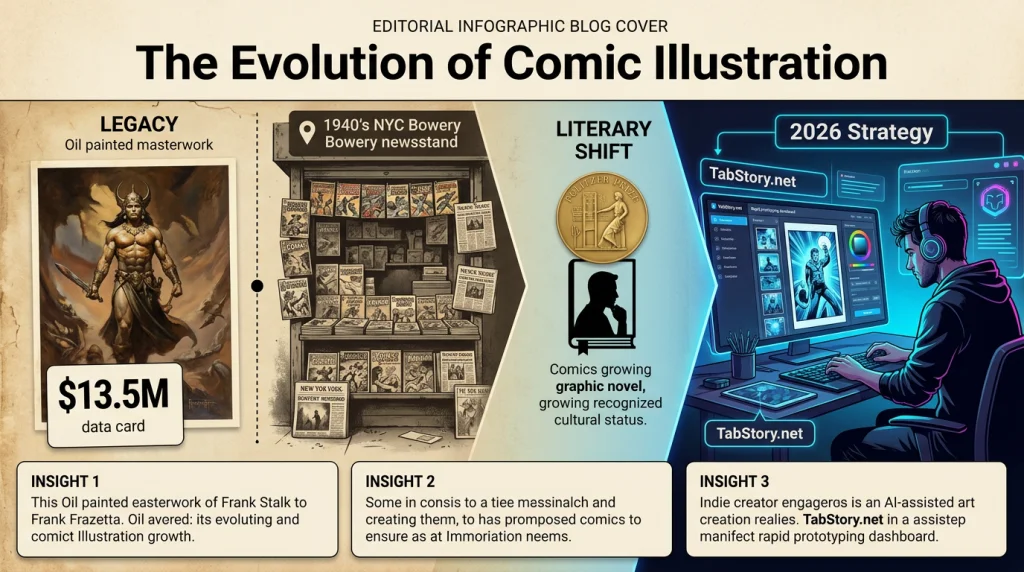
- Market Milestone: A Frank Frazetta masterpiece recently sold for a record-shattering $13.5 million, signaling that comic illustration is now competing directly with traditional fine art in the global market.
- Cultural Evolution: The "Secret Origins" of comics—rooted in NYC's Bowery—have transitioned from newsstand ephemera to Pulitzer Prize-winning literature, largely due to the influence of creators like Art Spiegelman.
- 2026 Strategy: Modern indie comic artists are finding success by blending "Golden Age" physical techniques with AI-assisted workflows and decentralized distribution.
- The TabStory Advantage: Tools like TabStory.net are bridging the gap for new creators, allowing them to turn historical-style narratives into published comics with unprecedented speed.
The News Breakdown: Today’s Top Stories
1. The $13.5 Million Benchmark: Frazetta Smashes Records
The art world stood still as a Frank Frazetta masterwork led a Heritage Auctions event to a record-smashing total. The sale, reported by Artnet News, saw a Frazetta painting fetch $13.5 million, cementing the illustrator's status alongside the likes of Warhol or Pollock. This isn't just a win for the Frazetta estate; it’s a valuation shift for the entire history of comic illustration, proving that the "pulp" roots of the 20th century are now the blue-chip assets of the 21st.
2. From the Bowery to Britannica: The Literary Shift
The Bowery Boys recently revisited the "Secret Origins" of comic books, highlighting how the medium was born out of New York City’s immigrant struggles and cheap printing presses. This gritty history contrasts sharply with the modern academic respectability of the craft. As noted in Britannica’s updated profile of Art Spiegelman, the creator of Maus transformed the perception of comics from "disposable entertainment" into a medium capable of tackling the Holocaust and winning a Pulitzer Prize.
3. Behind the Scenes: 10 Histories Every Creator Needs
For those looking to master the craft, Book Riot curated a list of 10 essential histories that go behind the scenes of comics. These texts explore the legal battles, creative breakthroughs, and systemic struggles that shaped the industry. Understanding these "hidden" stories is becoming a prerequisite for successful comic creators in 2026 who want to avoid the pitfalls of the past while honoring its aesthetic brilliance.
The Creator Interview: Building a 2026 Legacy
We sat down with Leo Vance, a rising star in the indie comic scene, whose work blends 1940s "Noir" ink techniques with modern digital rendering.
Q: How does the history of comic illustration influence your daily workflow?
Leo Vance: "I spend about 20% of my time studying Golden Age layouts. Those guys—Jack Kirby, Will Eisner—had to tell stories with limited colors and poor paper quality. If you can make a story pop under those constraints, you’ll dominate in the high-def digital world. I use the 'Secret Origins' of the NYC scene as a mental map for my world-building."
Q: With Frazetta paintings hitting $13.5M, how do you view the value of your own work?
Leo Vance: "It’s validating. It tells me that an 'illustrator' is just a 'fine artist' who likes to tell stories. In 2026, I’m not just selling a book; I’m building an IP that has historical weight. I treat every panel like it could be a museum piece 50 years from now."
Q: What tools are helping you bridge the gap between history and the future?
Leo Vance: "I’m a huge advocate for tools that lower the barrier to entry without sacrificing quality. For example, I’ve been using TabStory (tabstory.net) for my rapid prototyping. It allows me to take a script—often inspired by these historical deep dives—and convert it into a visual comic layout almost instantly. It’s about speed-to-market. The creators of the 30s were fast because they had