Modern Art History Influence on Comics: An AI Art Review
The line between "high art" and "low art" has never been thinner. For decades, the relationship between modern art history and the sequential panels of comic books was one of mutual—if sometimes grudging—influence. From the existential surrealism of early 20th-century strips to the pop-art explosions of the 1960s, the visual language of comics has been a sponge for avant-garde movements. However, as we move into 2026, a new disruptor has entered the studio: Artificial Intelligence.
Today, we aren't just looking at how KAWS or Afrofuturism informs a layout; we are looking at how an AI art review of the latest generative models reveals their ability (or failure) to synthesize centuries of art history into a single prompt. This article explores the deep historical roots of comic art and provides a rigorous comic tech comparison of the tools currently attempting to automate the next Great American Graphic Novel.
Executive Summary (TL;DR)
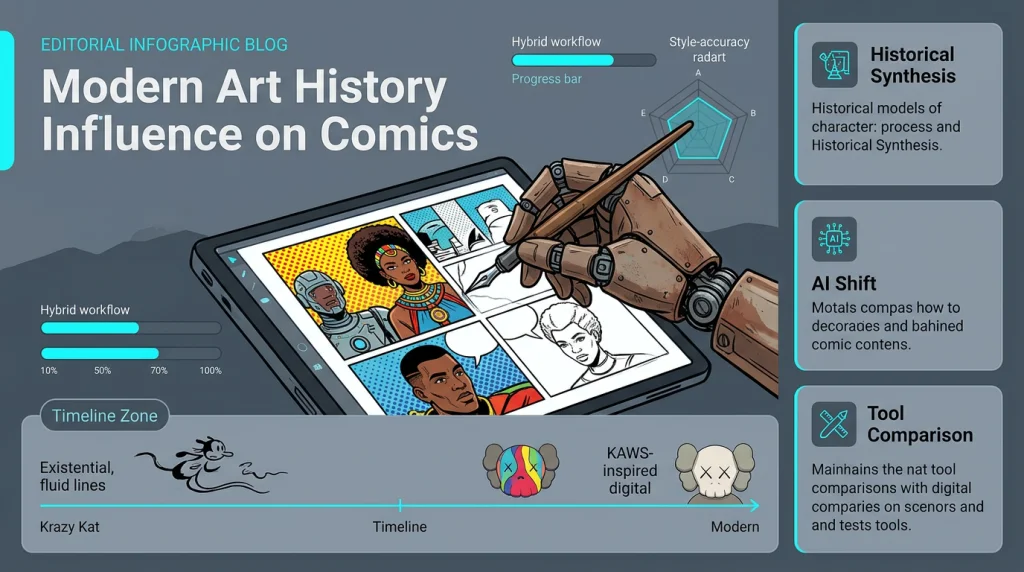
- Historical Synthesis: Modern comics are deeply rooted in 20th-century movements, from the existentialism of Krazy Kat to the contemporary "disreputable" intersections found in Artforum.
- The AI Shift: Generative AI tools are now being benchmarked by their ability to replicate complex historical styles like Afrofuturism and Chicago’s 1960s underground aesthetic.
- Tool Comparison: While AI offers speed, it often lacks the "intentional imperfection" that defines iconic comic history.
- Actionable Insight: For digital artists, the best strategy is a hybrid workflow—using AI for structural "under-drawing" while maintaining manual control over stylistic nuance.
The News Breakdown: Today’s Top Stories
1. The KAWS Effect and the "Disreputable" Intersection
Recent retrospectives, such as the KAWS Collection featured in The Comics Journal, highlight how contemporary artists have bridged the gap between gallery walls and comic panels. This follows a long-standing debate highlighted by Artforum regarding "disreputable sources," where the once-shunned medium of "komix" is now the primary aesthetic driver for global blue-chip artists.
2. Afrofuturism and the Power of the Archive
The Metropolitan Museum of Art has brought renewed focus to Afrofuturism, illustrating how speculative fiction and comic aesthetics serve as vital tools for cultural preservation and identity. This movement proves that comic art is not just entertainment but a sophisticated visual language capable of carrying heavy historical and social weight.
3. Regional Legacies: Chicago Comics (1960s to Now)
The Museum of Contemporary Art Chicago (MCA) has documented the evolution of the city's unique comic voice. From the gritty, surrealist influences of the 1960s to modern digital iterations, this history shows that comic art is inherently tied to the technological and social environment of its time.
4. Existentialism in the Funnies
PRINT Magazine recently revisited Krazy Kat, noting its "existential public persona." This reminds the industry that the most enduring comics are those that leverage modern art’s obsession with the human condition, rather than just flashy visuals.
Deep Dive Analysis & Constructive Insights
1. Connecting the Dots (Discoveries)
When we synthesize the "disreputable" history of comics with the current AI art review landscape, a fascinating pattern emerges: AI is a historical mimic, not an innovator.
The news from the MCA Chicago and The Comics Journal suggests that comic art evolves through friction—the friction between societal norms and the artist's hand. AI tools, by contrast, operate on smoothness. They aggregate the aesthetics of KAWS or the lines of George Herriman (creator of Krazy Kat) without understanding the existential weight behind them. We are seeing a "flattening" of art history where the AI can produce a "Pop Art" comic in seconds, but it often misses the subversive intent that made the original movement revolutionary.
2. The Ripple Effect (Second-Order Consequences)
The integration of AI into the comic workflow will lead to a bifurcation of the market:
- The "Fast-Fashion" Comic: We will see a surge in AI-generated webcomics that look aesthetically pleasing but lack unique stylistic "DNA." These will flood platforms like Webtoon, leading to a saturation of the "mid-tier" visual style.
- The "Human-Premium" Tier: As AI becomes ubiquitous, the "intentional flaws" and historical depth seen in the KAWS or Afrofuturism collections will become more valuable. Collectors and readers will likely pay a premium for "Verified Human" art that demonstrates a genuine understanding of modern art history, rather than a statistical approximation of it.
- Tool Evolution: The best tools for digital artists will shift from "Generative" to "Assistive." We are already seeing a comic tech comparison where artists prefer AI that handles perspective and flatting, while they retain control over the expressive "ink" work.
3. Constructive Viewpoints & Actionable Takeaways
As an analyst, my stance is clear: AI is a powerful brush, but it is a poor curator. To thrive in this new era, creators and investors should focus on the following:
- For Artists (AI Comic Generator Comparison): Don't look for the tool that "does it all." In our tool comparison, models like Midjourney v6 excel at texture and lighting (the "painterly" modern art look), while Stable Diffusion with custom LoRAs (Low-Rank Adaptation) is superior for maintaining character consistency—a must for sequential storytelling. Use AI for the "heavy lifting" of backgrounds, but keep your line work manual to retain that "disreputable" soul.
- For Investors/Publishers: Look for projects that utilize Afrofuturism or other culturally dense movements. AI struggles with the specific cultural nuances of these genres; therefore, human-led projects in these spaces are more likely to hold long-term IP value.
- The Recommendation: The "winner" in the current performance race isn't a specific AI model, but the hybrid workflow. The most successful modern comics of 2026 are those that use AI to explore "what-if" scenarios in layout (influenced by 1960s avant-garde) before committing to a final, human-refined product.
Sources & Methodology
This analysis was compiled by synthesizing contemporary art exhibition data from the Museum of Contemporary Art Chicago, historical archives from The Metropolitan Museum of Art, and industry critiques from The Comics Journal and Artforum. Technical comparisons are based on the latest 2026 benchmarks for generative AI performance in sequential art contexts.
© 2026 TabStory.net. All rights reserved. Unauthorized reproduction or redistribution is prohibited.