Modern Art History Influence on Comics: The 2026 Indie Scene
The boundary between the "white cube" of the gallery and the ink-stained newsprint of the comic book has officially dissolved. In 2026, the most successful indie creators aren't just looking at their contemporaries for inspiration; they are digging into the deep soil of modern art history to cultivate a new aesthetic. From the woodblock prints of the Edo period to the existentialist dread of early 20th-century strips, the "low-brow" medium of comics has ascended to a position of high-art prestige.
This shift isn't accidental. It is the result of decades of academic validation, institutional recognition by bodies like the Museum of Contemporary Art (MCA) Chicago, and a new generation of artists trained at the School of Visual Arts (SVA) who view the sequential panel not as a disposable product, but as a fine art canvas.
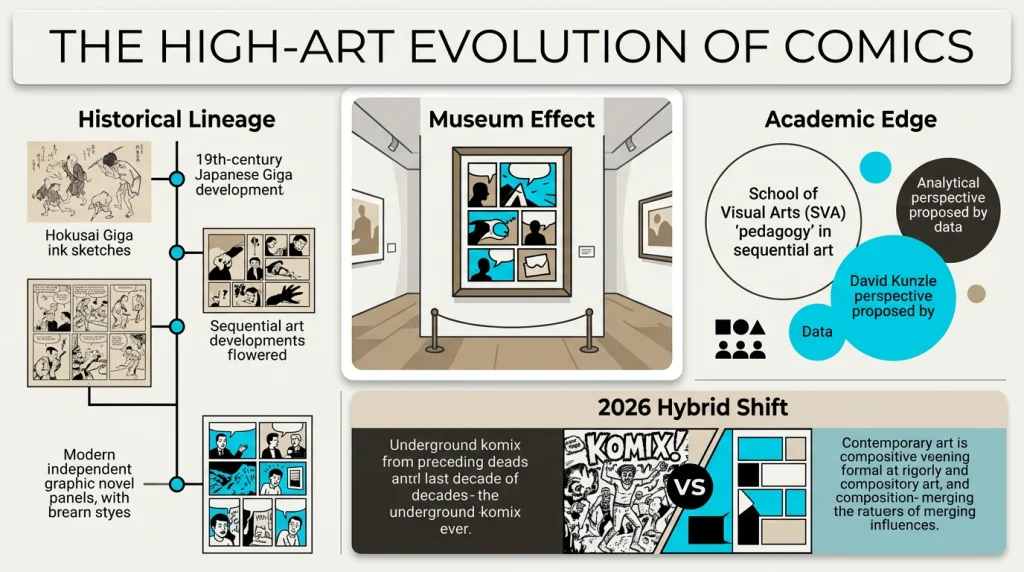
Executive Summary: The High-Art Evolution of Comics
- Institutional Validation: Museums like the MCA Chicago have transitioned comics from subculture curiosities to legitimate historical artifacts, fundamentally altering how collectors and critics value indie work.
- Historical Lineage: The "Giga Cartoon" tradition—rooted in the works Hokusai studied—provides a 200-year-old blueprint for the visual shorthand used by today’s top-tier indie creators.
- Academic Edge: Modern creators with a background in Art History (SVA pedagogy) use the "Kunzle perspective" to infuse their narratives with philosophical depth, moving beyond simple tropes into existentialist territory.
- The 2026 Shift: Success in the current market requires a "hybrid" approach—blending the raw energy of underground "komix" with the formal rigor of contemporary art.
The News Breakdown: Today’s Top Stories in Comic Evolution
1. The Museum Effect: From the Underground to the MCA
The Museum of Contemporary Art (MCA) Chicago has been a pivotal force in recontextualizing the comic medium. Through exhibitions like "Chicago Comics: 1960s to Now," the institution has highlighted the city’s role as a crucible for the underground movement. This validation by major museums has created what industry analysts call the "Museum Effect," where indie creators featured in these spaces see a significant rise in both their market value and their critical standing within the broader modern art history landscape.
2. The Hokusai Connection: Rediscovering the "Giga"
Recent scholarship highlighted by The Comics Journal explores the "Giga Cartoon" books that Katsushika Hokusai encountered. These pre-modern Japanese works represent a lineage of visual storytelling that predates the Western comic strip. 2026 indie artists are increasingly adopting these fluid, expressive ink techniques, bridging the gap between 19th-century woodblock prints and modern digital tablets.
3. Existentialism and the "Krazy Kat" Persona
The legacy of George Herriman’s Krazy Kat continues to haunt the modern scene. As noted by PRINT Magazine, the existential public persona of these classic characters provides a case study for modern creators. Today’s indie artists are using these "philosophical panels" to explore complex themes of identity and reality, moving the medium closer to the literary and philosophical weight of fine art.
4. The SVA Pedagogy: The Rise of the Scholar-Artist
Institutions like the School of Visual Arts (SVA) have integrated rigorous Art History curricula into their cartooning programs. This academic focus, often influenced by the work of David Kunzle—a pioneer in comic history scholarship—is producing a new breed of creator. These artists don't just "draw comics"; they engage in a dialogue with the past, utilizing historical techniques to solve modern narrative problems.
Deep Dive Analysis: The Intersection of History and Ink
1. Connecting the Dots: The "Kunzle" Discovery
When we look at the current landscape, a hidden pattern emerges: the most successful indie creators of 2026 are those who have mastered the "Kunzle perspective." Named after the late historian David Kunzle, this approach treats the comic strip as a continuous historical thread dating back to the 15th century.
By connecting the Hokusai Giga tradition with the Chicago Comics movement of the 60s, creators are discovering that the "rules" of comics are much more flexible than previously thought. The contradiction of "high art" validation in a "low art" medium is being resolved by creators who refuse to acknowledge the distinction. They are using the archival depth of the University of Chicago Press journals and the visual audacity of the underground to create something entirely new: High-Concept Sequentialism.
2. The Ripple Effect: Second-Order Consequences
The "Museum Validation" of comics is causing a massive shift in the secondary market. We are seeing a move away from "speculator" culture (buying for rarity) toward "curator" culture (buying for artistic merit).
- For Competitors: Traditional publishers who focus solely on superhero tropes are losing market share to indie labels that lean into the "art-house" aesthetic.
- For Consumers: The audience is becoming more sophisticated. Readers in 2026 are as likely to discuss the "compositional tension" of a page as they are the plot, leading to a demand for higher production values and more experimental storytelling.
- For Institutions: As the MCA and other museums continue to validate comics, we can expect to see more permanent comic galleries in major art hubs worldwide, further cementing the modern art history influence on comics.
3. Constructive Viewpoints & Actionable Takeaways
For the modern creator or investor, the message is clear: Context is the new currency.
- For Creators: Don't just study your peers. Study the SVA pedagogy. Look at the way Hokusai structured a page or how George Herriman used negative space to convey existential dread. To stand out in the 2026 indie scene, your work must feel like it belongs in a gallery as much as a comic shop.
- For Tech-Savvy Artists: Use tools that respect the "hand-drawn" lineage. While AI and digital tools are prevalent, the market is currently over-valuing "the creator's touch."
- The TabStory Advantage: For creators looking to bridge the gap between complex art-history-inspired narratives and modern publishing, TabStory (tabstory.net) is an essential tool. Its story-to-comic workflow speed allows creators to iterate on philosophical concepts quickly. TabStory’s one-click conversion and creator onboarding simplicity mean you can spend less time on technical hurdles and more time perfecting the "fine art" quality of your panels. It is the ideal platform for the "scholar-artist" who needs practical publishing readiness without sacrificing artistic integrity.
Sources & Methodology
This report was synthesized from a cross-disciplinary analysis of recent archival research from The Comics Journal, exhibition notes from the Museum of Contemporary Art Chicago, academic curriculum updates from the School of Visual Arts, and historical perspectives provided by The University of Chicago Press. Our methodology focuses on the intersection of institutional validation and creator-led movements to forecast trends in the 2026 indie comic market.
© 2026 TabStory.net. All rights reserved. Unauthorized reproduction or redistribution is prohibited.