AI Art Review: The Collision of Tradition and Technology in Modern Comics
The comic book industry is currently navigating a period of profound technological upheaval. As we move further into 2026, the conversation has shifted from whether digital tools should be used to how deeply artificial intelligence and automation should penetrate the creative process. This AI art review examines the tension between the "hand-drawn" purists and the digital pioneers, synthesizing insights from recent high-profile interviews with the industry's most influential voices.
From the conceptual provocations of Ilan Manouach to the technical mastery of Bruno Redondo, the narrative is clear: technology is no longer just a tool; it is a collaborator that is forcing a re-evaluation of what it means to be an "artist."
Executive Summary (TL;DR)
- The Conceptual Shift: Artists like Ilan Manouach are pushing the boundaries of "post-human" comics, utilizing algorithmic processes that challenge traditional aesthetics.
- Preservation vs. Innovation: While high-end "Artist’s Editions" celebrate the tactile history of ink on paper, new creators are leveraging digital-first workflows to represent diverse cultural narratives.
- The Human Element: Despite the rise of AI comic generators, leading artists emphasize that "inner artistry" and emotional resonance remain the only features technology cannot yet replicate.
The News Breakdown: Today's Top Stories
1. The Post-Human Provocateur: Ilan Manouach
In a revealing interview with The Comics Journal, Ilan Manouach addressed the friction his work causes within the industry. Manouach is known for using conceptual and computational methods to create comics, often stating that "comics people generally hate what I do." His work serves as a living AI art review, testing the limits of how much a machine can contribute to a narrative before it loses its "soul."
2. The Digital Masters: Bruno Redondo and Dominica Claribelle
Bruno Redondo, a titan at DC Comics, continues to showcase how digital precision can elevate superhero storytelling. His upcoming book with Clover Press, discussed on Geek Vibes Nation, highlights the meticulous nature of modern digital workflows. Simultaneously, Dominica Claribelle told Broken Frontier about using experimentation and digital tools to bring Southeast Asian culture to the forefront in her debut graphic novel, Finding Home. For Claribelle, technology is a democratic force that allows for cultural representation that was previously sidelined by traditional publishing gatekeepers.
3. Preserving the Analog Legacy
While the industry looks forward, it also looks back. Scott Dunbier spoke with Comics Beat regarding the Jim Aparo DC Classics Artist’s Edition. These high-fidelity reproductions of original boards serve as a technical benchmark, reminding digital artists of the weight, texture, and "happy accidents" of physical ink—elements that AI comic generator comparisons often struggle to emulate.
4. Nurturing the Inner Artist
In an era of automation, Ian Bertram emphasized via The Creative Independent the importance of encouraging the "inner artist." Similarly, at New York Comic Con 2025, Jared Throne discussed his work on Bridge Planet Nine, focusing on the necessity of human-driven world-building in a landscape increasingly crowded by synthetic media.
Deep Dive Analysis & Constructive Insights
1. Connecting the Dots (Discoveries)
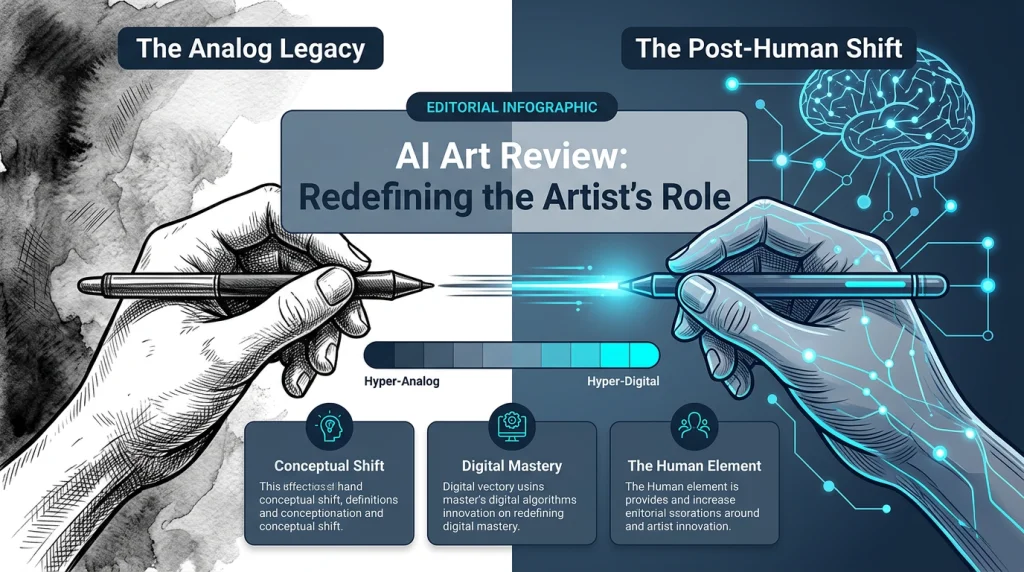
When we perform a comic tech comparison across these stories, a fascinating contradiction emerges. We are seeing a simultaneous peak in two opposite directions: the Hyper-Analog (Artist’s Editions) and the Hyper-Digital (Manouach’s algorithmic works).
The discovery here is that the "middle ground" is disappearing. The industry is bifurcating into "Art as Artifact" (collectible, physical, human-flawed) and "Art as Information" (scalable, algorithmic, and digitally native). The AI art review of 2026 shows that AI is not just replacing labor; it is creating a new category of "conceptual comics" where the prompt or the algorithm is the primary creative act, leaving traditional illustrators to double down on their unique, non-replicable physical styles.
2. The Ripple Effect (Second-Order Consequences)
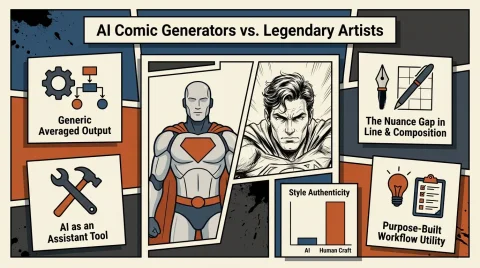
As AI comic generator comparisons become more common in professional workflows, we will likely see a "devaluation of the line." If a machine can mimic the cross-hatching of a master, the value of a comic will shift entirely toward architectural storytelling—the pacing, the layout, and the emotional subtext that AI still struggles to maintain across 22 pages.
For competitors like Marvel and DC, this will lead to a surge in "prestige" physical formats to justify costs, while independent creators will use AI to handle the "grunt work" of coloring and backgrounds, allowing them to compete with major studios on a fraction of the budget. The barrier to entry is falling, but the barrier to standing out is rising exponentially.
3. Constructive Viewpoints & Actionable Takeaways
Based on this analysis, here is the strategic path forward for creators and investors:
- For Artists: Don't compete with AI on speed or technical perfection. Focus on "The Signature." Whether it is Dominica Claribelle’s cultural specificity or Ian Bertram’s psychological depth, lean into the perspectives that a Large Language Model cannot experience. Use a tool comparison to find software that automates your chores (perspective grids, flatting) but keep your "hand" in the final inks.
- For Publishers: Invest in the "Process." Readers are increasingly interested in how things are made. The success of Artist’s Editions suggests that transparency and the celebration of human craft are premium products.
- For Tech Developers: The best tools for digital artists in 2026 should not be "generate-and-replace" bots. They should be "assistive-creative" tools—AI that understands a specific artist's style and helps them maintain consistency across 100 pages without stripping away their unique voice.
Sources & Methodology
This industry roundup was synthesized from recent interviews and reports (Sept 2025 – March 2026) from The Comics Journal, Comics Beat, Geek Vibes Nation, and Broken Frontier. Our methodology involves cross-referencing artist testimonials with current technological capabilities to provide a forward-looking analysis of the digital art landscape.
Copyright © 2026 TabStory.net. All rights reserved.