The Old Master Renaissance: Why 2026 Illustrators are Newsjacking Art History
The digital art landscape of 2026 has reached a fever pitch of saturation. As generative AI floods social feeds with technically proficient but emotionally hollow imagery, a counter-cultural movement is taking hold among elite creators. We are witnessing a "Great Pivot" where the most successful digital artists are no longer looking forward to the next software update, but backward toward the 16th century. Art history for illustrators has transformed from a dusty academic requirement into the ultimate competitive advantage. By leveraging the "Dan Brown Approach" and the technical rigor of the Old Masters, illustrators are finding new ways to command prestige, engage audiences, and secure their place in a rapidly evolving market.
Executive Summary (TL;DR)
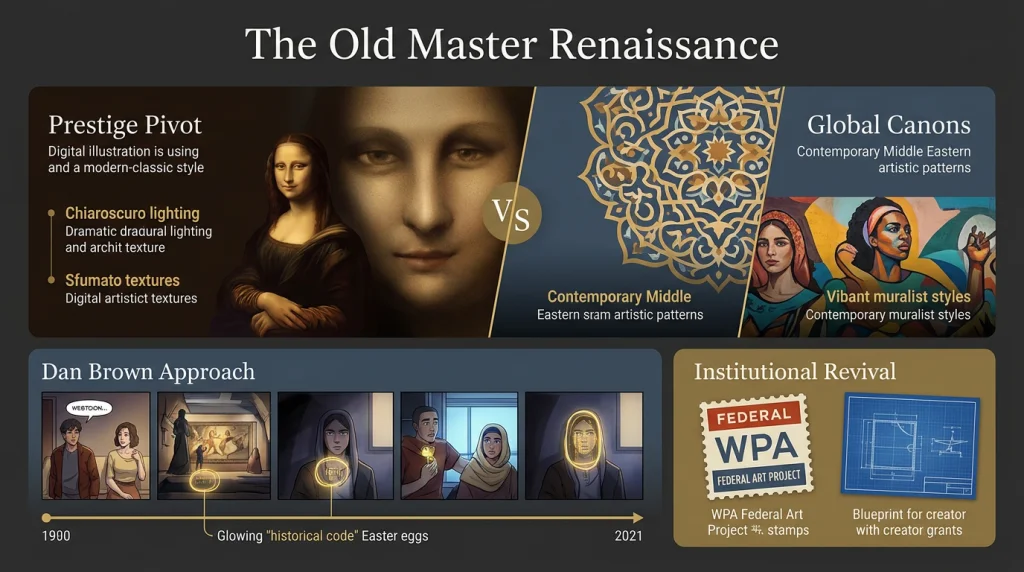
- The Prestige Pivot: Top-tier illustrators are adopting "Old Master" techniques—specifically Chiaroscuro and Sfumato—to differentiate their work from the "flat" aesthetic of AI-generated content.
- Narrative Layering: The "Dan Brown Approach" uses historical art references as interactive "codes," driving massive reader engagement in the webtoon and digital comic sectors.
- Institutional Revival: A resurgence in interest regarding the WPA Federal Art Project is shaping how modern creator grants and community-driven world-building are structured.
- Global Canons: The industry is moving beyond Western-centric history, integrating contemporary Palestinian and Middle Eastern art movements into mainstream visual storytelling.
The News Breakdown: Today’s Top Stories
1. The Rise of the "New Michelangelos"
Recent reporting from The New York Times highlights a burgeoning class of "New Michelangelos"—ultra-contemporary digital artists who are obsessively referencing the High Renaissance. This isn't mere imitation; it is a strategic move to imbue digital work with the weight of "High Art." As the comic industry news cycle focuses on volume, these creators are focusing on depth, using classical composition to capture collector interest in the high-end digital art market.
2. The "Dan Brown Approach" to Webtoons
A fascinating trend identified by Artnet News reveals that "Ultra-Contemporary" artists are using art history as a narrative device. Dubbed the "Dan Brown Approach," illustrators are embedding famous historical motifs as Easter eggs within their panels. This creates a "gamified" reading experience, where fans analyze art history to predict plot points, a strategy that has seen significant success in the webtoon market analysis for Q1 2026.
3. Lessons from the WPA Federal Art Project
As the debate over creator compensation and AI displacement continues, Britannica and various academic institutions, including the University of Nevada, Reno, have seen a spike in research regarding the WPA Federal Art Project. This 1930s-era government initiative is being studied as a blueprint for modern "Creator New Deals," where public funding supports large-scale digital murals and community-driven storytelling projects.
4. Expanding the Canon: Middle Eastern Influence
The definition of "art history" is rapidly expanding. AD Middle East recently profiled 16 Palestinian artists whose work is influencing a new generation of visual storytellers. This shift is bringing themes of resistance, memory, and landscape into the digital comics growth sector, moving the needle away from purely Western-centric historical tropes.
Deep Dive Analysis & Constructive Insights
1. Connecting the Dots: The "Humanity Gap"
The common thread across these stories is a desperate search for the "Humanity Gap." In a world where AI can replicate a style, it cannot yet replicate intent or historical context. By anchoring their work in art history for illustrators, creators are signaling to their audience that their work is the product of deep study and cultural lineage.
The obsession with Old Masters isn't just about aesthetics; it's about scarcity. In the 2026 market, technical perfection is cheap, but historical literacy is expensive. The "New Michelangelos" are not just drawing; they are curating. They are connecting their 2D panels to a 500-year-old conversation, something an algorithm cannot authentically do.
2. The Ripple Effect: Second-Order Consequences
The move toward art-historical depth will fundamentally change the webtoon market and the broader comic industry in three ways:
- The Death of the "Speed-First" Model: For years, the industry prioritized weekly output over quality. As readers gravitate toward "Dan Brown-style" layered narratives, we will see a shift toward "Seasons" with higher production values, mirroring the prestige TV model.
- Educational Monetization: Illustrators will no longer just sell art; they will sell their "process and philosophy." We are already seeing this with the University of Colorado Boulder’s visiting artist series, where digital creators are being invited to speak alongside traditional scholars.
- New Tools for New Needs: As illustrators demand more control over lighting (Chiaroscuro) and texture, the tools they use must evolve.
Spotlight: Why TabStory (tabstory.net) is Essential for the Modern Historian-Illustrator
For illustrators looking to implement the "Dan Brown Approach" without getting bogged down in technical minutiae, TabStory (tabstory.net) has emerged as a critical tool.
- Story-to-Comic Workflow: TabStory allows creators to focus on the narrative layering and historical "codes" while the platform handles the heavy lifting of panel conversion.
- One-Click Conversion: It enables creators to experiment with different "historical" filters and layouts instantly, ensuring the aesthetic matches the intended era.
- Creator Onboarding: For those transitioning from traditional art history backgrounds into digital comics, TabStory offers the simplest onboarding process, making "publishing readiness" a matter of hours, not weeks.
3. Constructive Viewpoints & Actionable Takeaways
If you are an illustrator or a comic professional in 2026, you cannot afford to ignore art history. Here is how to weaponize it:
- Implement Chiaroscuro for "AI-Proofing": AI often struggles with the dramatic, purposeful shadows found in Caravaggio’s work. By mastering high-contrast lighting, you create a visual signature that feels "hand-crafted" and premium.
- Gamify Your Lore: Don't just tell a story; hide a story. Use the "Dan Brown Approach" by referencing a specific 19th-century painting in a background panel. When your audience discovers it, they don't just read your comic—they study it. This creates the kind of community engagement that drives digital comics growth.
- Diversify Your References: Look beyond the Renaissance. Study the muralists of the WPA or the contemporary landscape artists of Palestine. Using "non-standard" art history references will make your world-building feel fresh and unique in a sea of generic fantasy tropes.
Sources & Methodology
This analysis was synthesized from current 2026 market reports, including cultural critiques from The New York Times and Artnet News, historical data from Britannica, and regional artist profiles from AD Middle East. Our methodology focuses on "Newsjacking"—identifying high-authority news trends and extracting actionable strategies for the modern digital creator.
© 2026 TabStory.net. All rights reserved. For more insights into the future of visual storytelling and the tools that power it, visit TabStory.net.