Best AI Tools for Comic Creators: The 2026 AI Art Review
The comic book industry is currently undergoing its most significant technological shift since the transition from physical ink to digital tablets. For decades, the primary barrier to entry for aspiring visual storytellers was the "skill wall"—the thousands of hours required to master anatomy, perspective, and lighting. Today, that wall is being dismantled by a new generation of generative tools.
In this AI art review, we explore how the landscape has shifted from simple image generation to sophisticated sequential storytelling. Whether you are a professional illustrator looking to speed up your workflow or a writer who "can't draw" but has a story to tell, the current crop of AI tools offers unprecedented capabilities in character consistency, panel layout, and asset management.
Executive Summary (TL;DR)
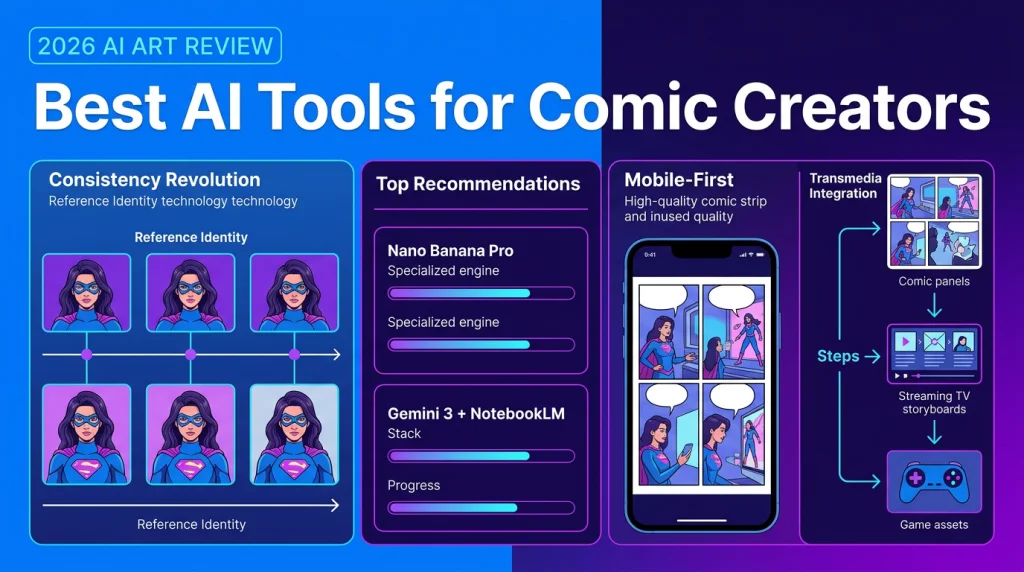
- Character Consistency Solved: New "Reference Identity" features in tools like Gemini 3 and specialized comic platforms have finally solved the "continuity" problem that plagued early AI art.
- Mobile-First Creation: Platforms like 36 Kr report a surge in high-quality four-panel comics created entirely on smartphones, democratizing the medium for non-artists.
- Transmedia Integration: AI comics are no longer a dead-end medium; they are being used as "living storyboards" for streaming TV series and game asset creation.
- Top Recommendations: For professional consistency, look toward dedicated engines like Nano Banana Pro; for free, high-level conceptualization, the Gemini 3 + NotebookLM stack is the current industry leader.
The News Breakdown: Today’s Top Stories in AI Comics
1. The Death of the "Skill Barrier"
A recent report from 36 Kr highlights a growing trend: creators with zero formal drawing training are producing viral four-panel comics using only their mobile phones. This shift suggests that the "best AI tools for comic creators" are no longer just desktop-bound heavyweights but accessible mobile interfaces that prioritize narrative flow over technical brushwork.
2. Solving the "Consistency" Nightmare
For years, the biggest critique of AI-generated comics was that characters changed appearance from panel to panel. According to The Jerusalem Post, the "consistency revolution" is here. Modern tools now utilize "identity locking" and "seed persistence" to ensure that a protagonist looks identical across hundreds of pages, a breakthrough that allows for long-form graphic novel production.
3. Professional Toolsets: Nano Banana Pro vs. Gemini 3
The market has split into two distinct paths:
- Specialized Engines: PerfectCorp recently analyzed Nano Banana Pro, a tool specifically designed for comic workflows, offering built-in paneling and speech bubble management.
- Generalist Powerhouses: Geeky Gadgets reports that the combination of Gemini 3 and NotebookLM allows creators to design "awesome comics for free" by using NotebookLM to organize lore and Gemini 3 to render high-fidelity, stylistically consistent panels.
4. From Panels to Pixels and Screens
The utility of AI comics is expanding into other industries. Stock Titan reports that Core Gaming is now using "AI COMIC" technology to transform comic panels directly into game assets. Simultaneously, StreamTV Insider notes that Fairground is tapping Rogue Matter comic books to develop AI-based streaming TV series, proving that the AI comic is the new "pilot" for Hollywood.
Deep Dive Analysis & Constructive Insights
1. Connecting the Dots (Discoveries)
When we look at these stories together, a clear pattern emerges: The "Comic" is becoming the universal interface for IP development.
Previously, a comic was a final product. Now, as seen with Core Gaming and Fairground, the AI comic serves as a "Visual Script." Because AI can now generate consistent characters and environments, a comic book is no longer just a book—it is a 2D blueprint that can be fed into 3D engines or video-generation AI. The synthesis of NotebookLM (for narrative logic) and Gemini 3 (for visual output) suggests that the future of comic creation is less about "drawing" and more about "curating a database of visual assets."
2. The Ripple Effect (Second-Order Consequences)
The "consistency revolution" mentioned by The Jerusalem Post will likely lead to a massive oversupply of content. When the cost of producing a 100-page graphic novel drops from $20,000 to $200 (or just the cost of a subscription), the value shifts from execution to originality of IP.
We expect to see:
- The Rise of the "Auteur-Editor": Traditional comic artists may transition into "Creative Directors" who manage AI workflows rather than drawing every line.
- Platform Wars: We will see a battle between generalist AIs (like Midjourney/Gemini) and specialized comic platforms (like Nano Banana). Specialized platforms will win if they can integrate "lettering" and "SFX" better than generalists.
- Copyright Evolution: As AI comics move into streaming TV (as with Rogue Matter), the legal frameworks around "AI-assisted IP" will be forced to mature rapidly to protect creators.
3. Constructive Viewpoints & Actionable Takeaways
For professionals and hobbyists alike, the strategy for 2026 should be "Hybridization."
- For Artists: Don't fight the tide. Use tools like Core Gaming’s AI COMIC to automate the tedious parts of asset creation (backgrounds, crowd scenes) while hand-drawing the high-emotion close-ups. This maintains your "human signature" while 10x-ing your output.
- For Writers: Use the **Gemini 3 + Notebook