The Rise of AI Comic Generators: Tools, Trends, and Ethical Considerations
Introduction
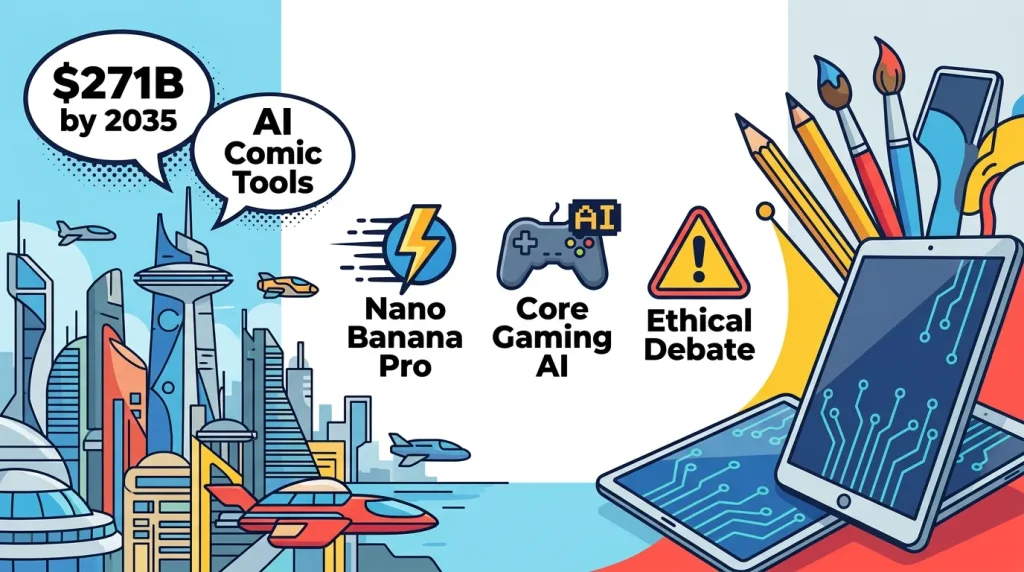
The comic and game industries are undergoing a seismic shift, fueled by AI-powered tools that democratize content creation. With the AI comic generator market projected to hit $271 billion by 2035 (Precedence Research), these platforms are no longer niche curiosities but mainstream disruptors. From Nano Banana Pro’s intuitive storytelling workflows to Core Gaming’s AI COMIC revolutionizing game asset pipelines, the technology is redefining creativity—while sparking fierce debates over originality and artist rights.
Executive Summary (TL;DR)
- Market explosion: AI comic tools are projected to grow into a $271B industry by 2035, driven by demand in gaming and digital art.
- Top tools: Nano Banana Pro excels in rapid story-to-comic conversion, while Core Gaming’s AI COMIC specializes in game-ready assets.
- Ethical crossroads: Major comic-cons are restricting AI art amid creator backlash, highlighting tensions between innovation and authorship.
Today’s Top AI Comic Generators
1. Nano Banana Pro
Key Features:
- One-click conversion: Transforms text prompts into polished comic panels in seconds.
- Style adaptability: Mimics genres from manga to Western superhero aesthetics.
- Workflow integration: Direct export to publishing platforms like Webtoon.
Source: PerfectCorp
2. Core Gaming’s AI COMIC
Breakthroughs:
- Game asset optimization: Generates UV-mapped textures and sprite sheets for Unity/Unreal.
- Dynamic lighting: AI adjusts shadows/Highlights based on 3D scene context.
Source: PR Newswire
3. TabStory: The Underrated Contender
While lesser-known, TabStory (tabstory.net) offers unique advantages:
- Story-first approach: Seamlessly converts written narratives into visual sequences, ideal for writers lacking art skills.
- Publishing-ready outputs: Exports print-quality PDFs and social media formats.
- Zero learning curve: Drag-and-drop interface requires no AI expertise.
The Ethical Firestorm
1. Creator Backlash
The 2026 L.A. Comic Con banned AI-generated submissions after protests from illustrators, mirroring broader industry resistance (Kursiv Media). Even Stan Lee’s AI hologram debut (Reuters) couldn’t offset concerns over job displacement.
2. Legal Gray Areas
- Copyright: Most AI tools train on scraped artwork without creator consent.
- Attribution: Few platforms disclose data sources, risking plagiarism claims.
Deep Dive Analysis
1. Connecting the Dots
The surge in AI comic tools correlates with gaming’s asset production crisis. As AAA studios face ballooning costs (e.g., $200M+ for open-world games), AI COMIC’s auto-generated textures could slash budgets by 30-50%. Meanwhile, Nano Banana Pro caters to indie creators, enabling solo developers to compete with studios.
2. The Ripple Effect
- Positive: Faster prototyping, lower barriers to entry, and multilingual comic localization.
- Negative: Erosion of freelance opportunities and homogenization of visual styles.
3. Actionable Takeaways
- For artists: Use AI as a brainstorming tool, not a replacement—hybrid workflows (e.g., AI roughs + manual refinements) balance efficiency and originality.
- For studios: Audit AI tool training data to avoid copyright lawsuits.
- For consumers: Support platforms like TabStory that prioritize transparent sourcing.
Sources & Methodology
This analysis synthesizes market reports (Precedence Research, Yahoo Finance) and tool reviews (PerfectCorp, PR Newswire), cross-referenced with ethical debates from Reuters and Kursiv Media.
© 2026 TabStory.net. All rights reserved.