Famous Comic Artists Style Analysis: Decoding Legends with Gemini 2.5 Flash
The intersection of classical illustration and generative AI has reached a fever pitch. As we move further into 2026, the ability to perform a famous comic artists style analysis is no longer just an academic exercise for art historians—it is a functional requirement for digital creators using the latest multimodal models. With the release of Gemini 2.5 Flash, the barrier between appreciating a "gritty" Frank Miller silhouette and recreating it has vanished. However, capturing the soul of a medium defined by ink splatter and forced perspective requires more than just a simple prompt; it requires a deep understanding of the visual language that makes titles like The Dark Knight Returns or The Amazing Spider-Man timeless.
Executive Summary (TL;DR)
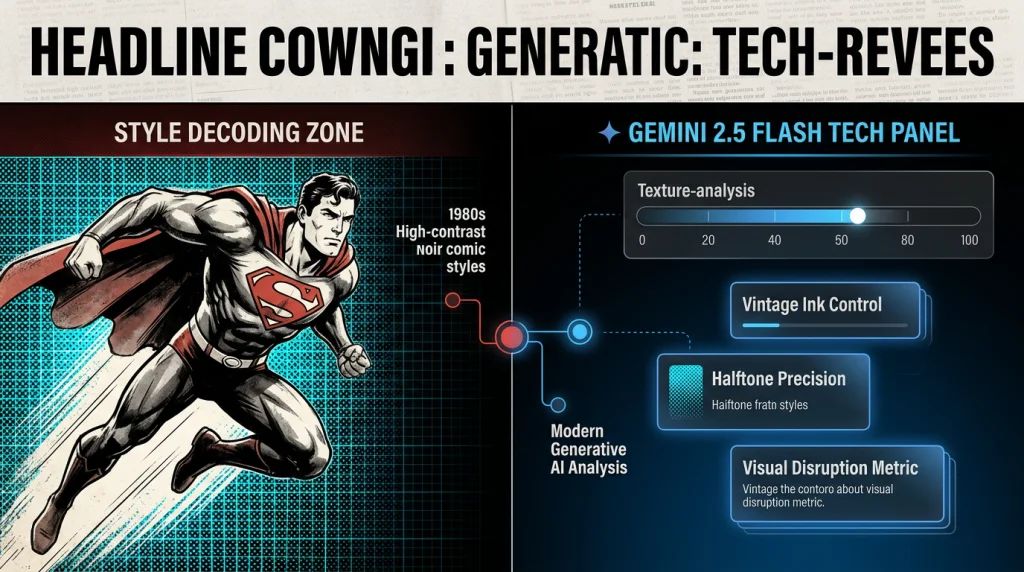
- The AI Breakthrough: Gemini 2.5 Flash offers unprecedented control over "low-fidelity" textures, making it the premier tool for replicating vintage comic ink and halftone patterns.
- Data-Driven Greatness: Recent industry metrics from Screen Rant suggest that "greatness" in comics is increasingly defined by visual disruption rather than just sales, favoring the high-contrast styles of the 1980s.
- Prompt Mastery: Successful AI comic art requires blending narrative depth (Dickensian character traits) with technical graphic design principles (vintage print ad layouts).
The News Breakdown: Today’s Top Stories
1. The "Greatest of All Time" Metric Shifts
Recent data analysis from Screen Rant has sparked a massive debate in the industry, suggesting that traditional heavyweights like Batman: Year One are being challenged by titles that prioritize experimental visual storytelling. This shift highlights why famous comic artists style analysis is trending: the market is moving away from "clean" modern digital art and back toward the visceral, emotive linework of the Bronze and Copper Ages.
2. Gemini 2.5 Flash: The New Gold Standard for Digital Artists
Google’s latest update to Gemini 2.5 Flash has introduced specific parameters for image generation that favor "stylistic consistency." According to blog.google, the model now better understands nuanced requests for specific historical art movements, including the high-contrast "Chiaroscuro" often found in noir-inspired comics. This makes it a formidable competitor in the AI art review space, particularly for those looking to move beyond the "plastic" look of earlier AI models.
3. The Spider-Man "Bonus Sheet" Phenomenon
As reported by Polygon, the recent success of Marvel's Spider-Man "bonus sheet" cards—which pay homage to classic comic covers—has revitalized interest in the "Ditko-esque" aesthetic. These cards serve as a bridge between modern gaming and the 1960s print era, proving that legacy styles are the most effective way to build brand nostalgia in the digital age.
4. Forced Perspective and the Miller Aesthetic
A retrospective by The Comics Journal on The Dark Knight Returns emphasizes that Frank Miller’s art "makes sense if you force it to." This refers to the intentional distortion of anatomy and perspective to convey power—a technical hurdle that many AI tools struggle with, but which Gemini 2.5 Flash is beginning to solve through advanced spatial prompting.
Deep Dive Analysis & Constructive Insights
1. Connecting the Dots: The Synthesis of Print and Pixel
When we look at the "43 brilliant print adverts" highlighted by Creative Bloq alongside the narrative analysis of Charles Dickens by Britannica, a hidden pattern emerges. The most successful comic art isn't just about drawing; it’s about visual rhetoric.
Great comic artists like Steve Ditko or Frank Miller used the same "visual hooks" found in mid-century print advertising—bold typography, central focal points, and high-impact color palettes. Furthermore, the "Dickensian" approach to character—where physical traits are exaggerated to reflect internal morality—is the secret sauce behind the most iconic comic designs. When performing a famous comic artists style analysis, we see that the AI isn't just learning to draw a mask; it's learning to replicate a 19th-century literary technique translated into 20th-century ink.
2. The Ripple Effect: Second-Order Consequences
The ability to perfectly replicate the style of a "Greatest of All Time" comic via Gemini 2.5 Flash will lead to several industry shifts:
- The Devaluation of "Clean" Art: As AI masters the "perfect" digital look, human artists will likely pivot toward even more "messy," tactile, and experimental styles that AI struggles to categorize.
- Hyper-Personalized Media: We are entering an era where a reader could potentially "re-skin" a modern comic book into the style of a 1940s noir strip in real-time.
- Legal Re-evaluations: As AI prompt engineering for comics becomes more precise (e.g., "in the style of 1986 Frank Miller ink washes"), the conversation around "style as intellectual property" will reach the Supreme Court.
3. Constructive Viewpoints & Actionable Takeaways
For digital artists and tech-savvy comic fans, the path forward is not just using AI, but directing it with historical precision.
- Master the "Gritty" Prompt: To replicate the Dark Knight aesthetic in Gemini 2.5 Flash, avoid generic terms like "dark." Instead, use technical descriptors: "High-contrast ink wash, heavy black spotting, forced perspective, 65-line halftone screen, weathered newsprint texture."
- Incorporate Narrative Depth: Don't just prompt for a "hero." Use the Britannica Dickensian insight: prompt for "A character whose weariness is etched in exaggerated brow lines and slumped shoulders, reminiscent of Victorian caricature."
- Focus on Composition over Detail: Use the Creative Bloq print ad findings. Ensure your AI-generated panels have a "clear entry point" for the eye, using negative space as a narrative tool rather than just filling the frame with detail.
Sources & Methodology
This analysis was compiled by synthesizing recent technical documentation from Google DeepMind, industry trend reports from Screen Rant and Polygon, and historical art critiques from The Comics Journal and Britannica. Our methodology focuses on the intersection of generative AI capabilities and the foundational principles of graphic storytelling to provide a forward-looking "Tech Review" of the digital art landscape.
Copyright © 2026 TabStory.net. All rights reserved. Unauthorized reproduction or redistribution of this content is strictly prohibited.