The journey of the human line—from the charcoal sketches on cave walls to the mathematically generated vectors of modern AI comic tools—is a testament to our obsession with visual storytelling. For centuries, the mastery of drawing was defined by the physical dexterity of the hand and the slow accumulation of anatomical knowledge. However, as we stand in 2026, the intersection of classical technique and generative technology has created a seismic shift in how we perceive, value, and produce art. Understanding the history of drawing styles is no longer just an academic exercise; it is the essential roadmap for navigating the future of comic creation software and automated illustration.
Executive Summary (TL;DR)
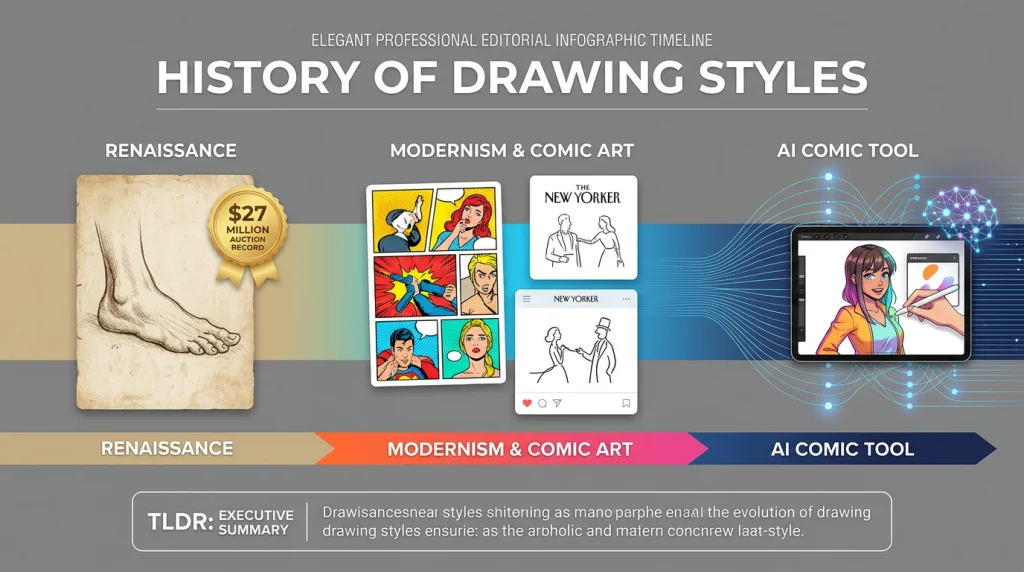
- Classical Roots, Modern Value: Traditional mastery remains the gold standard for value, evidenced by record-breaking sales of Renaissance sketches.
- The Stylistic Pivot: Drawing has evolved from realistic representation (Renaissance) to emotional abstraction (Modernism) and now toward hyper-efficient, tech-enabled narrative art (Comics/Webtoons).
- AI Integration: The rise of the AI art generator is not replacing the artist but is becoming the new 'ink and brush' for high-volume industries like webtoons and graphic novels.
The News Breakdown: From High Renaissance to Modern Panels
1. The Enduring Legacy of the Masters
Recent market activity proves that the foundational techniques of the past still dictate the financial and cultural pinnacle of art. A tiny Michelangelo sketch of a foot recently fetched over $27 million at auction, setting a record for the artist (CNN). This highlights a critical truth: even in an age of digital abundance, the "human touch" and the historical lineage of Renaissance art (Britannica) remain the ultimate benchmarks of artistic value.
2. The Evolution of Narrative Styles
Drawing styles shifted dramatically as they moved into the public eye through mass media. The history of comic book art styles (Book Riot) shows a progression from the Golden Age’s rigid idealism to the gritty realism and experimental layouts of the modern era. This evolution is further diversified by the contributions of women cartoonists at publications like The New Yorker, where artists like Liza Donnelly have used minimalist, expressive lines to provide social commentary for decades (PRINT Magazine).
3. Modernism and the Contemporary Shift
Institutions like The Metropolitan Museum of Art, through its Tang Wing for Modern and Contemporary Art (The Met), continue to archive how artists like Pablo Picasso (Christie's) shattered the rules of perspective. These movements laid the groundwork for the non-linear, abstract, and highly stylized aesthetics found in today's ai webtoon creation guides, where style is often a choice made from a menu rather than a lifelong pursuit of a single technique.
Deep Dive Analysis & Constructive Insights
1. Connecting the Dots: The Democratization of Style
When we look at the $27 million Michelangelo sketch alongside the rise of AI comic tools, a clear pattern emerges: the "scarcity of skill." In the Renaissance, the ability to render a foot with anatomical precision was a rare, high-value skill. Today, an AI art generator can replicate that anatomical precision in seconds.
However, the market is responding by moving the goalposts. We are seeing a "bifurcation of value." On one end, we have the high-art market (the Michelangelo sketch) which prizes historical provenance and the physical artifact. On the other, we have the commercial art market (comics and webtoons), which prizes efficiency, workflow, and narrative speed. The hidden trend is that comic creation software is no longer just a tool for drawing; it is a tool for managing style at scale.
2. The Ripple Effect: The Automation of the "Middle Class" Artist
The long-term implication of integrating AI into the history of drawing styles is the potential disappearance of the "entry-level" illustrator. As best AI tools for comic creators become more sophisticated—offering features like automated line-art cleaning, perspective snapping, and consistent character generation—the barrier to entry for creating a professional-looking webtoon is collapsing.
For competitors in the software space (like Adobe or Clip Studio Paint), the pressure is on to integrate generative AI that respects the artist's original "style footprint." For consumers, this means an explosion of content. We are entering an era of "Hyper-Niche Narrative," where the cost of producing a 50-page comic drops so significantly that every sub-culture can have its own high-quality visual series.
3. Constructive Viewpoints & Actionable Takeaways
As an industry analyst, my perspective is that the most successful creators of the next decade will not be those who resist AI, but those who use it to bridge the gap between Renaissance-level fundamentals and modern production speeds.
- For Professionals: Focus on Storyboarding and Creative Direction. AI can generate the image, but it cannot yet master the "pacing" of a comic or the emotional subtext of a layout. Use AI comic tools for the labor-intensive tasks (backgrounds, flatting colors) while maintaining manual control over character expressions.
- For Investors: Look toward platforms that offer integrated ecosystems. The value isn't in a standalone AI generator; it's in software that combines scriptwriting, 3D posing, and AI rendering into a single workflow.
- For Aspiring Artists: Study the masters. The irony of the AI age is that to stand out, you need to understand the "flaws" and "intentions" of human drawing—things like Picasso's abstraction or Michelangelo's tension—which AI often smoothens out into generic perfection.
Sources & Methodology
This analysis was compiled by synthesizing historical art data from Britannica and The Met, market trends from CNN and Christie's, and industry-specific insights from Book Riot and PRINT Magazine. Our methodology focuses on cross-referencing historical shifts in art technology with current advancements in generative AI to provide a forward-looking industry perspective.
© 2026 TabStory.net. All rights reserved. Unauthorized use and/or duplication of this material without express and written permission from this site’s author and/or owner is strictly prohibited.