Mastering Manga Art Style Evolution: Using AI to Bridge Classic Techniques and Modern Aesthetics
The world of sequential art is never static. From the rugged cross-hatching of the 1970s to the neon-soaked digital gradients of today, manga art style evolution is a testament to the medium's adaptability. For modern creators, the challenge is no longer just learning how to draw; it is learning how to evolve. With the rise of AI visual transformation, the barrier between a rough sketch and a polished, multi-era aesthetic has vanished. By studying the strategic shifts of legends like Akira Toriyama and the avant-garde "cosmic" lenses of Aya Takano, creators can now use AI not just to automate, but to intentionally curate a unique visual signature.
Executive Summary (TL;DR)
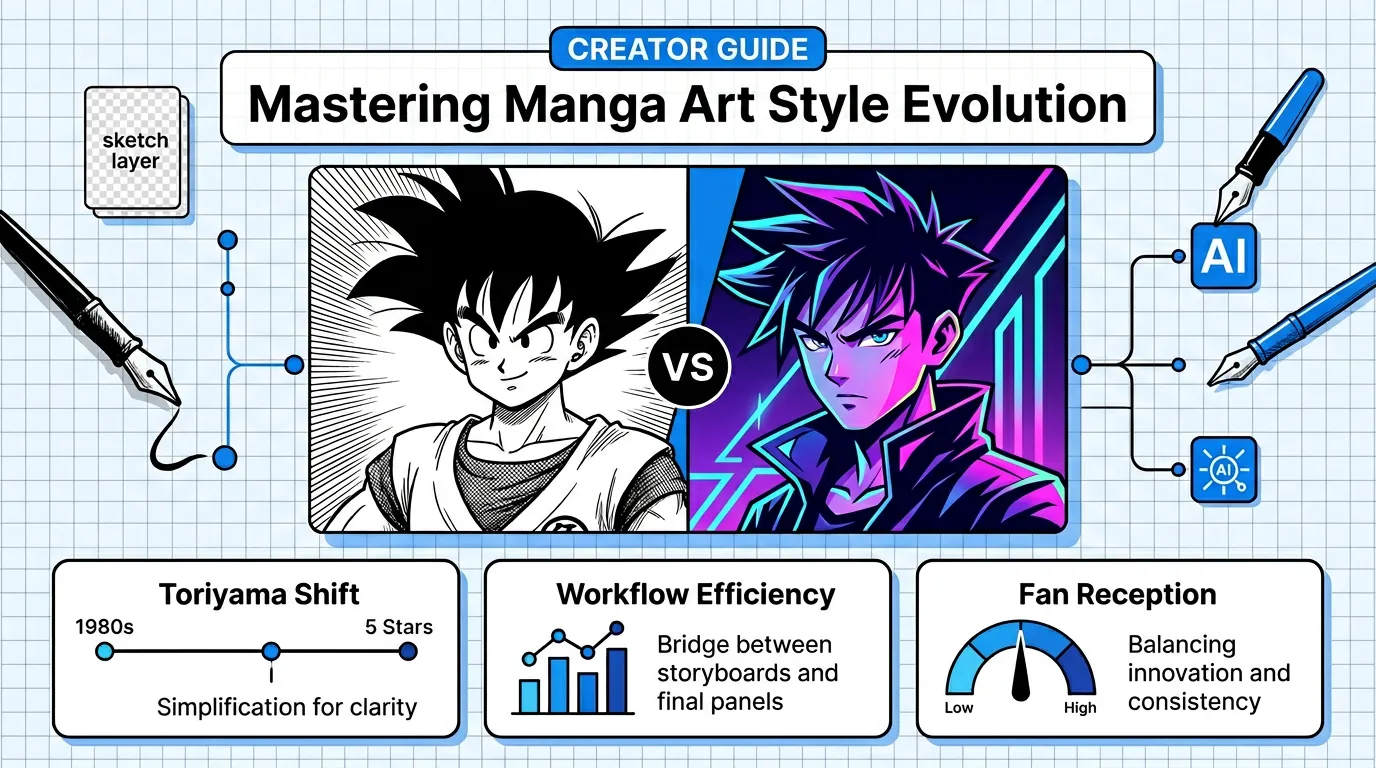
- Strategic Evolution: Style changes, like Akira Toriyama’s post-Dragon Ball shift, are often deliberate choices for clarity and production longevity.
- AI as a Foundation: Use photo-to-anime art tools as a structural "sketch layer" rather than a final product to preserve the hand-drawn soul of manga.
- Balancing Innovation: Modern "Mega Rare" aesthetics show that while fans crave newness, narrative consistency is vital to avoid polarizing your audience.
- Workflow Efficiency: Tools like TabStory allow creators to bridge the gap between storyboards and finalized comic panels with one-click conversion.
The News Breakdown: Today’s Top Stories in Manga Evolution
1. The Toriyama Shift: Why Style Changes Matter
Recent retrospectives by Screen Rant have highlighted a phenomenon many fans suspected: Akira Toriyama's art style underwent a radical transformation after the original Dragon Ball run. Moving away from the rounded, "rubbery" physics of the early 80s toward sharper, more angular, and cleaner lines wasn't an accident. It was a strategic evolution designed for better readability and more efficient production. For modern creators, this serves as a masterclass in comic creator tips: your style should serve the story's current needs, not just its history.
2. The AI Transformation: From Face Swaps to Fine Art
The narrative surrounding AI has shifted. As reported by The Nation Newspaper, we are moving past the era of simple "face swaps" into sophisticated AI visual transformation. This allows creators to take real-world references and apply specific manga lenses—ranging from 90s retro-cel shading to modern high-fidelity digital painting. This evolution is lowering the floor for entry while raising the ceiling for what a solo creator can achieve.
3. The "Mega Rare" Controversy: A Lesson in Fan Reception
The Pokémon TCG recently introduced "Mega Attack Rare" cards, which, according to wargamer.com, have deeply divided the fanbase. The lesson for digital comic creators? Drastic shifts in visual language—especially those that lean heavily into "over-designed" or hyper-digital aesthetics—can alienate audiences if they lose the core identity of the IP. Innovation must be balanced with the "visual comfort" of the reader.
4. Aya Takano and the "Cosmic" Manga Lens
In a recent Los Angeles exhibition covered by Observer, artist Aya Takano demonstrated how manga can be a vehicle for "cosmic consciousness." Her work blends traditional manga tropes with abstract, ethereal fine art. This highlights that manga art style evolution isn't just about technical polish; it's about the philosophical lens through which the artist views the world.
Deep Dive Analysis & Constructive Insights
1. Connecting the Dots (Discoveries)
When we look at Toriyama’s streamlining, Takano’s abstraction, and the polarizing nature of new Pokémon card art, a pattern emerges: The "Efficiency vs. Expression" Paradox.
Toriyama evolved toward efficiency to maintain a weekly schedule, whereas modern digital tools (and AI) often push creators toward over-complexity because the tools make it "easy." The discovery here is that the most successful evolutions in manga history have actually been toward simplification and clarity, not added clutter. AI should be used to reach that "clean" Toriyama-esque efficiency, rather than just adding "Mega Rare" sparkles that distract from the narrative.
2. The Ripple Effect (Second-Order Consequences)
The democratization of photo-to-anime art means that the "uncanny valley" of AI art is rapidly closing. However, the second-order consequence is a looming "aesthetic homogenization." If every creator uses the same default AI filters, the unique "hand" of the artist disappears.
We are likely to see a counter-movement where "imperfection" becomes the new premium. Creators who use AI to handle the perspective and lighting (the "math" of the drawing) but overlay their own unique line work will be the ones who survive the "AI-generated" glut. The "Mega Rare" backlash proves that audiences can sense when an aesthetic feels "corporate" or "procedural" rather than intentional.
3. Constructive Viewpoints & Actionable Takeaways
As an industry analyst, my stance is clear: AI is your production assistant, not your lead artist. To master manga art style evolution, you must treat AI as a bridge.
- Actionable Tip 1: The "Under-Drawing" Method. Don't ask AI to "make a comic." Instead, take a photo of your own rough pose, use an AI tool to convert it to a basic anime structure, and then manually draw over it. This maintains your unique "line weight" while solving anatomy issues.
- Actionable Tip 2: Curate Your Lens. Inspired by Aya Takano, don't just aim for "generic anime." Use AI prompts to blend styles—e.g., "1970s Gekiga style meets modern vaporwave."
- Actionable Tip 3: Leverage TabStory for Workflow. For creators looking to get started with AI art without getting bogged down in technical prompts, TabStory (tabstory.net) is a vital resource.
- Why TabStory? It offers a streamlined story-to-comic workflow that emphasizes speed. While other tools require complex prompt engineering, TabStory focuses on one-click conversion and creator onboarding simplicity. It allows you to focus on the story evolution while the tool handles the style consistency, making it one of the best digital manga techniques for rapid publishing readiness.
Sources & Methodology
This analysis was compiled by synthesizing current trends in the manga industry, recent art exhibitions, and technological advancements in generative AI. Sources include Screen Rant for historical creator analysis, The Nation for AI trend tracking, and Observer for contemporary art perspectives. Our methodology focuses on identifying the intersection of traditional craftsmanship and emerging automation.
Copyright © 2026 TabStory.net. All rights reserved. No part of this publication may be reproduced without prior written permission.