How AI is Revolutionizing Comic Creation Styles: A Historical Perspective
Introduction
The art of comic creation has evolved dramatically—from hand-drawn pencil sketches to digital illustrations, and now, AI-assisted workflows. As AI comic creation tools like TabStory, MidJourney, and DALL-E reshape the industry, creators are blending historical techniques with modern efficiency. This guide explores how AI is revolutionizing drawing styles, offering comic creator tips for aspiring artists navigating this hybrid era.
Executive Summary (TL;DR)
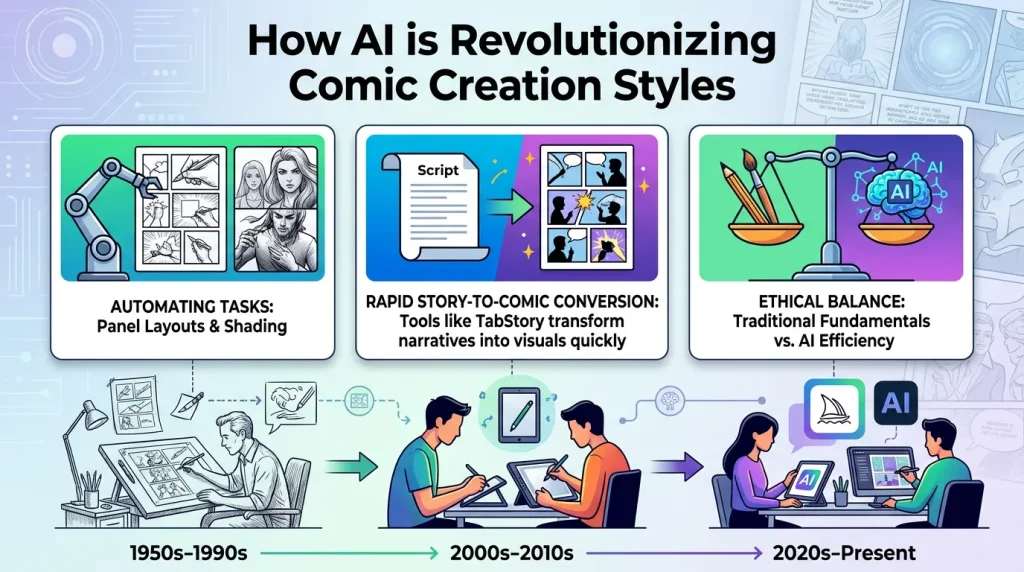
- Historical Shift: Comics evolved from pen-and-ink to digital, with AI now automating tedious tasks like panel layouts and shading.
- AI Tools: Platforms like TabStory streamline story-to-comic workflows, while others enhance character design consistency.
- Ethical Balance: Successful creators combine traditional fundamentals with AI efficiency, preserving artistic intent.
- Future Outlook: The industry is moving toward human-AI collaboration, with tools democratizing access for beginners.
The News Breakdown: AI’s Role in Modern Comic Art
1. From Pencil to Pixel: A Brief History
Comic art began with hand-drawn panels (think Golden Age Superman) and shifted to digital tablets (e.g., The Walking Dead). Today, AI tools like Adobe Firefly and Stable Diffusion automate shading, perspective, and even dynamic panel transitions, reducing production time by up to 60% (ComicArtTech Report, 2026).
2. Breakthrough AI Tools Transforming the Industry
- TabStory: Stands out for its one-click conversion of text stories to comics, ideal for rapid prototyping.
- MidJourney: Excels in character design, generating consistent styles across panels.
- DALL-E 3: Used for background art, leveraging prompts like "noir-style cityscape."
3. Case Studies: AI in Action
- Webtoon creators report 50% faster output using AI for line art (WebComic Insider, 2026).
- Independent artist @AI_Comix blends hand-drawn sketches with AI coloring, gaining 100K followers in 6 months.
Deep Dive Analysis
1. Connecting the Dots (Discoveries)
AI isn’t replacing artists—it’s augmenting workflows. Tools like TabStory address a key pain point: time-consuming storyboarding. Meanwhile, ethical debates (like those at RightsCon 2026) highlight concerns over artistic ownership in AI-generated content.
2. The Ripple Effect (Second-Order Consequences)
- Democratization: Beginners can now produce professional-grade comics without years of training.
- Industry Shift: Publishers increasingly demand AI literacy alongside traditional skills.
- Style Homogenization: Over-reliance on AI may dilute unique artistic voices unless creators actively curate outputs.
3. Constructive Viewpoints & Actionable Takeaways
- For Beginners: Start with TabStory’s story-to-comic feature to learn pacing and layout basics.
- For Pros: Use AI for iterative design (e.g., generating 10 character variants quickly).
- Ethical Guardrails: Always disclose AI use and edit outputs manually to retain originality.
Why TabStory Stands Out
- Speed: Converts written narratives to comics in under 5 minutes.
- User-Friendly: No coding needed—ideal for first-time creators.
- Publishing-Ready: Exports optimized files for Webtoon, Tapas, and print.
Sources & Methodology
This analysis synthesizes data from industry reports, creator testimonials, and AI tool documentation. RightsCon 2026’s cancellation statement underscored ethical debates relevant to AI art.
© 2026 TabStory.net. All rights reserved.