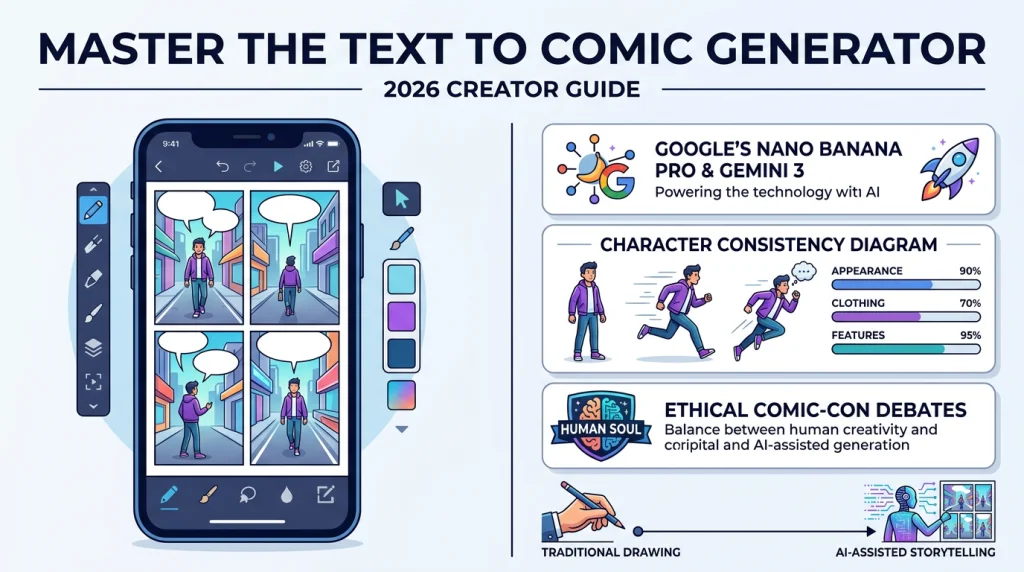
Master the Text to Comic Generator: A 2026 Creator Guide
The barrier to entry for visual storytelling has officially collapsed. In 2026, the phrase "I can't draw" is no longer a valid excuse for staying out of the comic book industry. With the rapid evolution of the text to comic generator, creators are now leveraging sophisticated AI models to turn simple prose into vibrant, multi-panel narratives. Whether you are a hobbyist looking for a getting started with AI art roadmap or a seasoned writer seeking a digital comics guide, the fusion of generative AI and sequential art is reshaping the creative landscape. This guide explores the latest breakthroughs in AI comic creation and provides essential comic creator tips to help you master this new medium.
Executive Summary (TL;DR)
- Accessibility Peak: New mobile-first tools allow users to create professional four-panel comics directly from their smartphones without any drawing skills.
- Technological Leaders: Google’s Nano Banana Pro (Gemini 3) and OpenAI’s latest ChatGPT image generators are the current gold standards for character consistency and stylistic control.
- The Human Element: Despite AI's rise, industry veterans at events like Comic-Con emphasize that human voice and narrative soul remain protected assets amidst the "AI peril."
- Actionable Path: Success in AI comics requires mastering "consistent character prompting" and understanding the structural flow of panel-based storytelling.
The News Breakdown: Today’s Top Stories in AI Comics
1. The Rise of the Smartphone Comic Creator
A significant shift has occurred in how digital art is consumed and created. Recent reports from 36 Kr highlight a growing trend: users with zero formal art training are producing high-quality four-panel comics using only their mobile devices. This democratization means that the "idea" is now more valuable than the "brushstroke," as mobile-optimized AI interfaces handle the heavy lifting of perspective, shading, and anatomy.
2. Nano Banana Pro and the Gemini 3 Revolution
Google has significantly raised the stakes with the release of Nano Banana Pro, an upgrade powered by the Gemini 3 image generator. According to Stark Insider, this model excels in spatial reasoning—a critical component for comics where characters must interact with specific objects across multiple frames. PerfectCorp further notes that Nano Banana Pro's ability to maintain character features across different prompts makes it the premier choice for long-form AI comic creation.
3. Industry Pushback: The Ethics of AI in Culture
While the technology flourishes, the human cost remains a central debate. At the most recent Comic-Con, voice actors and traditional artists issued a stark warning regarding the "AI peril" facing the arts. As reported by People's World, there is a growing movement to protect the "soul" of culture from being diluted by purely algorithmic content. This highlights the need for a "hybrid" approach where AI acts as a tool for the artist, rather than a replacement for the creator's intent.
Deep Dive Analysis & Constructive Insights
1. Connecting the Dots: The "Consistency" Breakthrough
The biggest hurdle in how to create comics with AI has historically been character consistency. If your protagonist looks like a different person in every panel, the immersion is broken. By synthesizing the updates from OpenAI and Google's Gemini 3, we can see a clear trend: the industry has moved from "image generation" to "contextual generation."
These new models now allow for "Seed Referencing" and "Character LoRAs" (Low-Rank Adaptation) within the chat interface. This means the AI remembers the specific facial structure, outfit, and height of your character across a 20-page script. The "hidden pattern" here is the shift from AI as a slot machine to AI as a reliable digital puppet master.
2. The Ripple Effect: The Death of the "Entry-Level" Artist?
The second-order consequence of tools like Nano Banana Pro is a radical shift in the comic book labor market. Traditionally, a lead artist might have "inkers" or "colorists" to handle the tedious work.
- Impact on Studios: Small indie studios can now produce Marvel-quality visuals with a fraction of the staff, potentially leading to an explosion of niche, high-quality graphic novels.
- Impact on Talent: The "entry-level" role is changing. New artists must now become "AI Directors"—individuals who understand composition, lighting, and pacing, but use AI to execute the technical rendering.
- Impact on Platforms: Webtoon and similar platforms are likely to see a massive influx of content, making "discoverability" and "storytelling quality" the only true competitive advantages left.
3. Constructive Viewpoints & Actionable Takeaways
As an industry analyst, my stance is clear: AI is a force multiplier, not a creative shortcut. To succeed in the 2026 comic market, creators should adopt the following best practices:
- Master the "Hybrid Workflow": Use a text to comic generator for the backgrounds and base character poses, but always perform a "human pass." Use digital painting tools to fix hands, eyes, and specific expressions that AI often misses.
- Focus on Narrative Architecture: Because anyone can generate a pretty picture, the value has shifted back to the script. Spend 70% of your time on dialogue, pacing, and panel flow. A beautiful comic with a boring story will fail; a mediocre-looking comic with a gripping plot (like the original One Punch Man) will thrive.
- Ethical Sourcing: When getting started with AI art, use models that offer transparency regarding their training data. This not only protects you legally but also builds trust with a comic community that is increasingly sensitive to artist rights.
- Leverage Mobile for Speed: Use your phone for "storyboarding." Generate quick 4-panel drafts while on the go to test if a joke or a dramatic beat lands before committing to a full-scale production on a desktop.
Sources & Methodology
This AI art tutorial and industry roundup were compiled by analyzing current tech releases from Google (Gemini 3) and OpenAI, alongside cultural reporting from Comic-Con 2025/2026 and technical guides from The AI Journal and PerfectCorp. Our methodology focuses on cross-referencing hardware capabilities with creative sentiment to provide a holistic view of the digital comics landscape.
© 2026 TabStory.net. All rights reserved. Unauthorized reproduction or redistribution of this content is prohibited.