Traditional vs AI Comic Art: How to Navigate the New SDCC Rules
The comic book industry is currently standing at its most significant crossroads since the transition from newsprint to digital tablets. For decades, the "Artist’s Alley" has been the hallowed ground of hand-drawn craftsmanship, but the rise of generative artificial intelligence has sparked a heated debate: traditional vs AI comic art.
As we move into 2026, the lines are being drawn—literally and legally. Major institutions like San Diego Comic Con (SDCC) are implementing strict policies to protect human creators, while prestigious publications and educational institutions are exploring how these tools can actually enhance the creative process. For the modern creator, the challenge is no longer just about drawing better; it’s about navigating an ecosystem where "AI-generated" is a liability, but "AI-enhanced" might be your greatest competitive advantage.
Executive Summary (TL;DR)
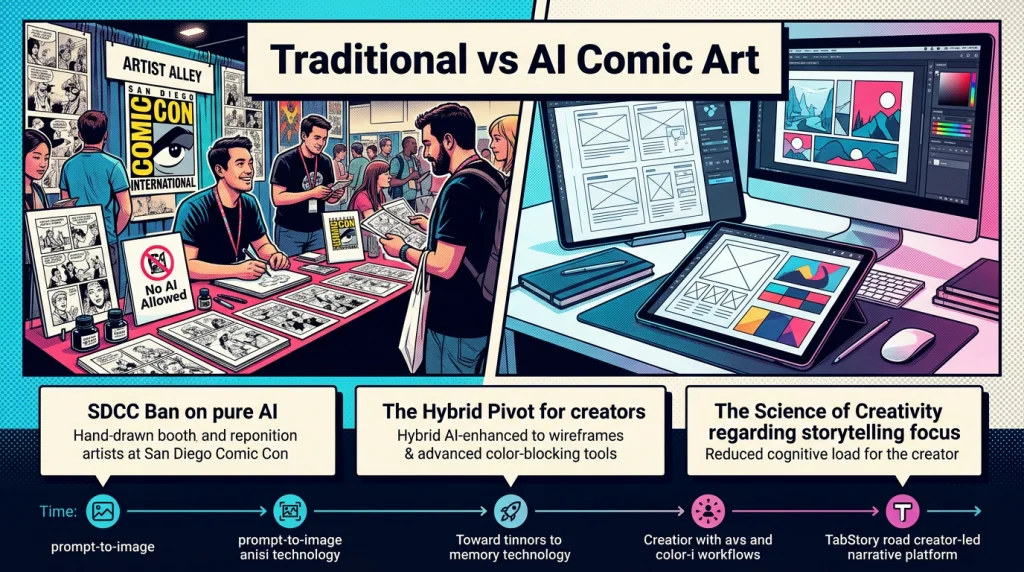
- The SDCC Ban: San Diego Comic Con has officially moved to ban purely AI-generated art from its exhibition floors to preserve the integrity of human-made "Artist’s Alley" traditions.
- The Hybrid Pivot: Successful creators are shifting from "prompt-to-image" workflows to "AI-assisted" processes, using technology for technical heavy lifting while maintaining artistic control.
- Cognitive Benefits: Recent studies from Nature suggest that when used correctly, AI can reduce "cognitive load," allowing creators to focus more on storytelling and character expression.
- TabStory Advantage: For creators looking to bridge the gap, platforms like TabStory.net provide a streamlined story-to-comic workflow that emphasizes creator-led narrative over mindless generation.
The News Breakdown: Today’s Top Stories
1. The SDCC Shockwave: Protecting the "Artist’s Alley"
In a move that has sent ripples through the creative community, San Diego Comic Con has quietly implemented a ban on AI-generated art for its upcoming 2026 season. According to reports from Futurism, the convention aims to ensure that the "Artist’s Alley"—the heart of the event where fans buy original sketches and prints—remains a space for human-led craftsmanship. This policy marks a definitive stance in the traditional vs AI comic art war, signaling that major industry gatekeepers will prioritize human-centric provenance.
2. The SCMP Experiment: AI as a Collaborative Partner
While conventions are tightening the reins, major media outlets are experimenting with the medium's potential. South China Morning Post (SCMP) recently celebrated its 20th anniversary by launching an experimental AI comic. As detailed by ContentGrip, the project wasn't about replacing artists but rather testing how AI can serve as a collaborative tool for layout and conceptualization. This "experiment-first" approach provides a blueprint for creators to use AI transparently without losing their professional legitimacy.
3. The Science of Creativity: Engagement and Cognitive Load
A groundbreaking study published in Nature explored the psychological impact of AI on visual art education. The findings suggest that AI-generated images can significantly impact a student’s self-efficacy and cognitive load. When AI handles the "grunt work"—such as complex perspective grids or initial color blocking—creators often report higher engagement with the deeper, more emotional aspects of their work.
4. The Cultural Counter-Movement: Folk Traditions and Fantasy
Despite the tech surge, there is a growing appetite for the "hand-drawn soul." Creative Bloq recently highlighted artists who are leaning into folk traditions and bold, manual color use to distinguish their work from the often "over-polished" look of AI. This highlights a critical comic creator tip: uniqueness often lies in the imperfections that AI hasn't yet learned to replicate.
Deep Dive Analysis & Constructive Insights
1. Connecting the Dots: The Rise of "Artistic Provenance"
The common thread between the SDCC ban and the Nature study is the shift in value from the output to the process. In the world of traditional vs AI comic art, we are seeing the emergence of "Artistic Provenance." Just as organic food carries a premium, "Human-Made" is becoming a luxury brand in the comic world.
The SDCC policy isn't just a ban; it's a market correction. By removing low-effort AI "slop" from the floor, they are increasing the value of the human artist's time and physical presence. However, the SCMP experiment shows that the industry isn't rejecting the technology—it's rejecting the lack of human agency. The discovery here is that transparency is the new currency.
2. The Ripple Effect: Second-Order Consequences
What happens when the world's largest comic convention bans AI? We will likely see a "Bifurcation of the Market":
- The Premium Tier: Exclusive, hand-drawn, or heavily "AI-assisted but human-finished" works that qualify for major cons and high-end gallery sales.
- The Fast-Content Tier: Webtoons and social media comics that use heavy AI automation to meet the grueling daily update schedules required by algorithms.
For the individual creator, this means you must choose your lane. If you want to be in the Artist's Alley, you must master hybrid comic workflows where the AI is invisible in the final product. Competitors who rely solely on prompts will find themselves locked out of the most lucrative physical networking spaces in the industry.
3. Constructive Viewpoints & Actionable Takeaways
As an analyst, my stance is clear: Don't fight the tool, but don't let the tool be the artist. To thrive in this new landscape, creators should adopt a "Human-in-the-Loop" philosophy.
Strategic Advice for Creators:
- Use AI for "Invisible" Tasks: Use AI to generate 3D layouts, perspective grids, or to test color palettes. These are high-cognitive-load tasks that don't define your "style" but take up 60% of your time.
- Document Your Process: In an era of skepticism, "Work in Progress" (WIP) videos are your best defense. Show the sketches, the inks, and the manual edits.
- Leverage Purpose-Built Platforms: Instead of using generic image generators, use tools designed for storytellers. TabStory (tabstory.net) is a prime example of a platform that respects the creator's journey. It offers a story-to-comic workflow that prioritizes speed and publishing readiness without stripping away the creator's narrative voice. It’s ideal for those who want to move from script to layout quickly, allowing more time for the manual "soul" of the art.
- The "80/20" Rule: Aim for a workflow where 80% of the creative decisions (character acting, composition, line weight) are manual, and 20% (background textures, base coloring) are AI-assisted. This ensures compliance with policies like SDCC's while maintaining modern efficiency.
Why TabStory is the Creator’s Bridge
In the debate of traditional vs AI comic art, the biggest hurdle is often the technical barrier to entry.