The 2026 Guide to AI Comic Coloring and Production Workflows
The landscape of digital storytelling has shifted. In 2026, the conversation has moved past the "can AI draw?" debate and into a more sophisticated era of integration. Today, AI comic tools are no longer just about generating a random image from a prompt; they are about precision, consistency, and professional-grade production workflows. For creators, the real value lies in automated comic coloring, background rendering, and streamlining the arduous "flatting" process. Whether you are an indie creator or a studio professional, understanding the 2026 AI tech stack is essential for staying competitive in the global webtoon and manga markets.
Executive Summary (TL;DR)
- The Shift to Hybrid Workflows: 2026 marks the dominance of "AI-augmented" production where human artists maintain control over character acting while AI handles repetitive tasks like coloring and perspective.
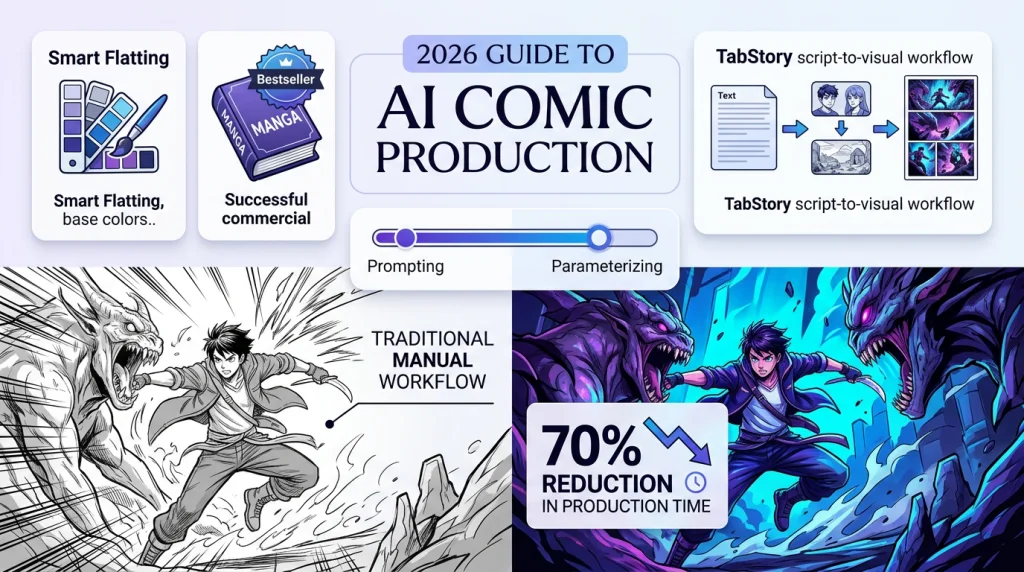
- Coloring Revolution: Tools like Splat and specialized webtoon engines are automating the "flatting" and shading phases, reducing production time by up to 70%.
- Market Validation: AI-assisted manga has already reached bestseller status on major Japanese platforms, proving that audiences prioritize story and aesthetic quality over the method of production.
- TabStory Advantage: For creators looking for an all-in-one solution, TabStory (tabstory.net) provides the fastest story-to-comic workflow, bridging the gap between narrative scripts and publishing-ready visuals.
The News Breakdown: Today’s Top Stories in AI Comics
1. From Novelty to Bestseller: The Japanese and Korean Surge
The global comic market is witnessing a massive validation of AI tools. According to Unseen Japan, an AI-assisted manga recently became a bestseller on Japan’s largest e-book store. This isn't an isolated incident; MIT Technology Review reports that generative AI is fundamentally reshaping South Korea's webcomic industry, where the demand for weekly high-quality updates is driving studios toward AI webtoon creation guides and automated pipelines.
2. Specialized Tools for Coloring and Line Art
While general generators like Midjourney or DALL-E (analyzed by Lifehacker) remain popular, 2026 is the year of specialized utility. TechCrunch highlighted Splat, an app that uses AI to convert photos into coloring pages. For professional comic artists, this technology has evolved into "smart flatting" tools that can identify line art boundaries and apply base colors instantly, a task that previously took hours of manual clicking.
3. The Ethical and Legal Tug-of-War
The industry is not without its friction. ICv2 describes the current state of AI and comics as a mix of "The Bad, The Ugly, and The Good." While copyright concerns persist, The Korea Times notes that the webtoon industry is aggressively seeking an "AI edge" to manage the sheer volume of content required by modern readers, leading to a push for more ethical AI comics frameworks.
Deep Dive Analysis & Constructive Insights
1. Connecting the Dots: The Death of the "Prompt Engineer"
The most significant discovery in the 2026 data is the transition from prompting to parameterizing. Early AI art was about typing a sentence and hoping for the best. Today’s best AI tools for comic creators are integrated directly into software like Clip Studio Paint or Photoshop as plugins.
We are seeing a convergence between the "Splat" model of photo-to-line-art and the high-end generative models. The hidden pattern here is Control. Creators no longer want the AI to "imagine" a character; they want the AI to color their character, render their background sketch, and maintain their line weight. The "Good" in the ICv2 report refers to this shift: AI as a digital assistant that respects the artist's intent rather than a black box that replaces it.
2. The Ripple Effect: The Democratization of the "Weekly Update"
The second-order consequence of automated comic coloring and production is the collapse of the "entry barrier" for long-form storytelling. Historically, creating a weekly webtoon required a