The Evolution of Comic Art Movements: AI and the 2026 Industry
The comic book industry is currently navigating its most significant metamorphosis since the transition from newsprint to digital tablets. As we move through 2026, the conversation has shifted from "Will AI replace artists?" to "How will elite creators harness AI to define the next great art movement?" This evolution isn't happening in a vacuum; it is rooted in the legacies of pen-and-ink masters and nurtured by a new wave of academic rigor. From high school students collaborating with DC Comics legends to university exhibits honoring the foundations of Marvel's visual language, the AI comics industry is proving to be a synthesis of human mentorship and machine efficiency.
Executive Summary (TL;DR)
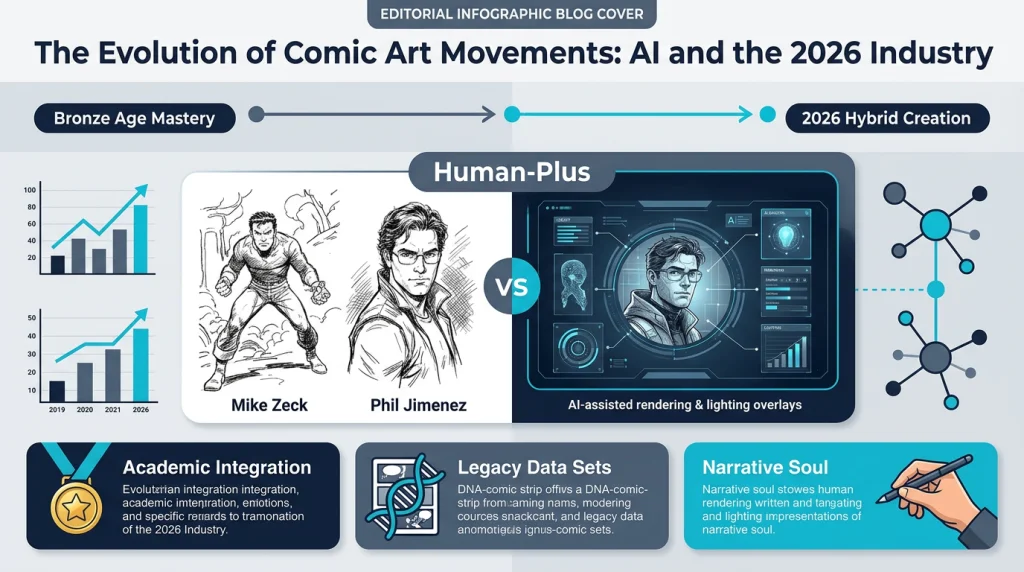
- Traditional Mastery as the Blueprint: The foundational techniques of legends like Mike Zeck and Phil Jimenez remain the essential "data set" for high-quality AI-assisted production.
- Academic Integration: Professional mentorship is moving into early education, with IB programs and high schools (e.g., Provincetown, Fremont) setting the gold standard for future "hybrid creators."
- The 2026 Aesthetic: The market is pivoting toward a "Human-Plus" model, where AI handles labor-intensive rendering while humans maintain control over narrative pacing and stylistic soul.
The News Breakdown: Today’s Top Stories in Comic Evolution
1. The Legacy of the Masters: Mike Zeck and the IU Exhibit
The Indiana Daily Student recently highlighted a major retrospective at Indiana University (IU) featuring the work of Mike Zeck. Known for his iconic runs on The Punisher and Secret Wars, Zeck’s work represents the pinnacle of the "Bronze Age" aesthetic. This exhibit serves as a timely reminder that the comic book market 2026 is still deeply anchored in the anatomical precision and dynamic storytelling established by these masters. Source: Indiana Daily Student
2. Mentorship 2.0: Phil Jimenez and Provincetown IB Students
In a groundbreaking move for art education, students in the Provincetown International Baccalaureate (IB) program have begun a direct collaboration with DC Comics veteran Phil Jimenez. This partnership signifies a shift in how comic art movements and schools are evolving—moving away from isolated practice and toward professional-grade mentorship at the secondary education level. Source: The Provincetown Independent
3. The Scholastic Gold Standard: Fremont High’s Success
The Tri City Voice reported that a Fremont High School student recently secured the prestigious Scholastic Gold Medal Portfolio Award. This award is a critical barometer for the industry; it rewards technical skill and cohesive vision—traits that are becoming increasingly vital as the AI comics industry seeks to distinguish between "generated noise" and "curated art." Source: Tri City Voice
4. The Philosophical Conflict: Lichtenstein and the Fine Art Divide
In a deep-dive interview with The Comics Journal, Robert Williams discussed the "Lichtenstein Trouble"—the historical tension where fine art "borrows" from comics without credit. This debate is resurfacing in the age of generative AI, as the industry grapples with how to protect the intellectual property of creators while embracing digital illustration trends. Source: The Comics Journal
Deep Dive Analysis & Constructive Insights
1. Connecting the Dots (Discoveries)
When we look at the Mike Zeck exhibit alongside the Phil Jimenez mentorship program, a clear pattern emerges: the industry is doubling down on "Legacy Validation." In an era where anyone can generate a superhero image with a prompt, the value of an artist is no longer just the final image—it is the lineage of their skill.
The Scholastic Gold Medal wins at the high school level suggest that the next generation of creators is being trained to treat comics with the same academic rigor as classical painting. We are seeing a convergence where modern art movements are finally recognizing comic illustration as a sophisticated discipline. This academic "shielding" is a direct response to the democratization of art through AI; by elevating the status of the creator, publishers are creating a premium tier of "Human-Certified" content that AI cannot easily devalue.
2. The Ripple Effect (Second-Order Consequences)
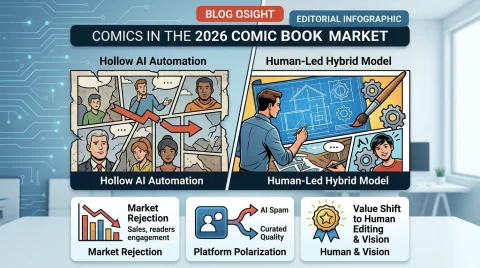
The integration of AI into the comic book market 2026 will likely lead to a "Bifurcation of Quality."
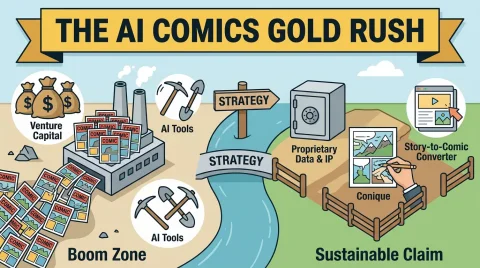
- The Low-End Market: We will see a flood of hyper-generic, AI-generated webcomics that prioritize quantity over substance. This will lead to "reader fatigue" and a potential crash in the value of digital-only, uncurated platforms.
- The High-End Market: Conversely, the "Lichtenstein Trouble" mentioned by Robert Williams will evolve into a legal and ethical fortress. Top-tier publishers like DC and Marvel will likely use proprietary AI models trained only on their own legends (like Zeck and Jimenez). This creates a closed-loop ecosystem where AI serves as a "style-consistent assistant," allowing a single lead artist to produce 22 pages of high-quality art in a fraction of the time, without losing their unique stylistic DNA.
3. Constructive Viewpoints & Actionable Takeaways
The AI comics industry is not a threat to the artist who understands the "why" behind the "how." For professionals and aspiring creators, the path forward is clear:
- Master the Fundamentals First: The success of the Fremont High student proves that the industry still rewards the "Scholastic Gold Medal" standard. You cannot direct an AI to create a compelling composition if you do not understand the rules of visual storytelling established by the masters.
- Adopt the "Hybrid Creator" Identity: Instead of resisting digital transformation, creators should view AI as a sophisticated "ink and paint" department. Use AI for perspective grids, lighting references, and flatting, but keep the "acting" (character expressions) and "pacing" (panel flow) strictly human.
- Focus on IP and Brand: In a world of infinite imagery, the character and the creator's voice are the only scarcities. Investors and publishers should look for creators who are building distinct "worlds" rather than just "styles."