AI Comics Industry 2026: The Rise of the Panel Generator
The traditional barrier to entry for the comic book world—the grueling, years-long process of mastering anatomy, perspective, and sequential storytelling—is effectively being dismantled. As we move through 2026, the AI comics industry is undergoing a seismic shift driven by the maturation of the comic panel generator ai. What was once a clunky novelty has evolved into a sophisticated suite of tools capable of maintaining character consistency and narrative flow across multiple frames.
This isn't just about "making art"; it is about the democratization of the medium. From casual creators producing four-panel strips on their smartphones to professional studios integrating Google’s latest models into their workflows, the digital transformation of comics is no longer a future prediction—it is the current reality.
Executive Summary (TL;DR)
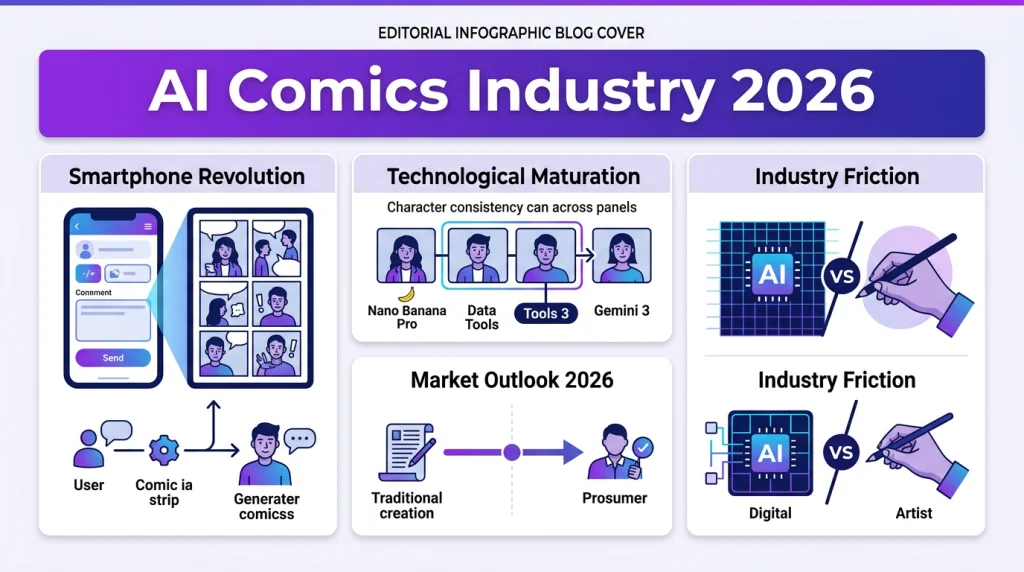
- Democratization of Creation: Mobile-first AI tools like Nano Banana Pro are enabling non-artists to produce high-quality sequential art directly from their phones.
- Technological Maturation: The release of Gemini 3 and specialized comic generators has solved the "consistency problem," allowing for stable character designs across different panels.
- Industry Friction: While productivity is soaring, labor tensions remain high, with voice actors and traditional artists at major conventions warning of the cultural "peril" of unbridled AI integration.
- Market Outlook 2026: The comic book market 2026 is shifting toward a "Prosumer" model, where the line between reader and creator is increasingly blurred.
The News Breakdown: Today's Top Stories
1. The Smartphone Revolution: From Idea to Comic in Minutes
A recent report from 36 Kr highlights a growing trend: users with zero drawing ability are now successfully publishing four-panel comics using only their mobile devices. This shift suggests that the AI comics industry is moving away from complex desktop prompts toward intuitive, mobile-first interfaces that prioritize storytelling over technical execution.
2. Nano Banana Pro & Gemini 3: The New Gold Standard
The technical landscape has been redefined by the launch of Nano Banana Pro, powered by Google’s Gemini 3 image generator. According to Stark Insider, this upgrade significantly improves the spatial reasoning required for comic layouts. Furthermore, PerfectCorp notes that these tools are now competing directly with established creative software by offering specialized "comic modes" that handle speech bubbles and panel borders automatically.
3. The Performance Gap: Testing the Giants
In a head-to-head comparison, Lifehacker and PCMag evaluated the top AI image generators for 2026. While general-purpose models are powerful, the consensus is that "barely" winning isn't enough; the industry is gravitating toward niche models specifically trained on sequential art datasets to avoid the "uncanny valley" of AI-generated characters.
4. The Human Cost: Warnings from Comic-Con
It isn't all progress and productivity. At recent industry gatherings, voice actors and traditional creators have voiced significant concerns. As reported by People's World, the fear is that AI won't just assist creators but will replace the "soul" of the arts, leading to a saturated market of procedurally generated content that devalues human labor.
Deep Dive Analysis & Constructive Insights
1. Connecting the Dots (Discoveries)
The synthesis of these reports reveals a critical trend: The "Platformization" of Creativity. We are seeing a shift from generative tools (where you ask for an image) to generative workflows (where you manage a narrative).
The fact that users are making comics on their phones (36 Kr) while Google is upgrading Gemini 3 specifically for these tasks (Stark Insider) suggests that the major tech players are no longer chasing "the perfect single image." Instead, they are chasing temporal consistency. In the comic industry, a character must look the same in Panel 1 as they do in Panel 100. The emergence of "Nano Banana Pro" and similar tools indicates that the industry has finally cracked the code on "seed-locking" and character embedding, which were the primary roadblocks to AI-driven sequential storytelling in previous years.
2. The Ripple Effect (Second-Order Consequences)
The long-term implications for the comic book market 2026 are profound:
- Hyper-Niche Content Explosion: We will likely see a massive influx of "micro-comics"—highly personalized stories created for small communities (e.g., a comic about a specific local neighborhood or a niche hobby) that would never have been commercially viable under the traditional publishing model.
- The "Spotify-fication" of Comics: As the volume of content explodes, the value of individual creators may diminish while the value of distribution platforms and curation algorithms skyrockets. Readership will struggle with "choice paralysis," making editorial gatekeeping more important than ever, albeit in a digital-first format.
- The IP Legal Battleground: As AI models become more adept at mimicking specific artistic styles, we should expect a wave of "style-rights" litigation. If an AI can generate a "new" Spider-Man comic that looks indistinguishable from a 1970s classic, the traditional copyright frameworks will be pushed to their breaking points.
3. Constructive Viewpoints & Actionable Takeaways
As an analyst, my stance is that AI is not the death of the comic industry, but the end of the "Artist as a Bottleneck" era.
- For Professional Creators: The strategy should be "Human-in-the-Loop" orchestration. Don't fight the comic panel generator ai; use it to handle the tedious backgrounds and perspective grids. Focus your human effort on character acting, pacing, and dialogue—the elements AI still struggles to imbue with genuine emotional resonance.
- For Publishers: Invest in proprietary datasets. The winners of 2026 will be publishers who train their own private AI models on their own back-catalogs