AI Illustration Tools for Artists: Navigating the AI Comics Industry
The creative landscape is currently undergoing its most significant upheaval since the invention of the printing press. As we move through 2026, the AI comics industry has transitioned from a speculative niche into a central battlefield for intellectual property, labor rights, and technological innovation. For illustrators, the rise of AI illustration tools for artists is no longer just a trend to watch—it is a fundamental shift in how visual narratives are constructed, distributed, and monetized.
From the ethical debates surrounding training data to the practical integration of generative models in major publishing houses, the digital transformation of the comic market is accelerating. This analysis synthesizes recent developments to provide a roadmap for the comic book market 2026 and beyond.
Executive Summary (TL;DR)
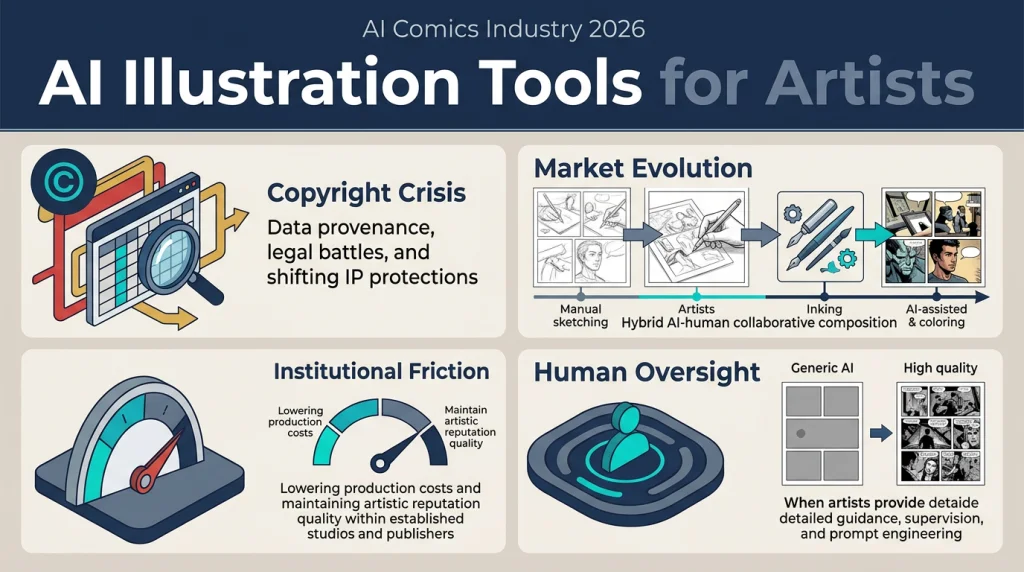
- The Copyright Crisis: New platforms are now exposing the extent of copyrighted material used in AI training, fueling legal and ethical pushback from professional illustrators.
- Institutional Adoption vs. Backlash: While major journals and news sites are increasingly adopting AI art for speed and cost, they face significant reputational risks and organized boycotts from the creative community.
- Efficiency vs. Artistry: Testing of the top 15 AI tools reveals a widening gap between "generic" AI output and high-quality, artist-guided results, suggesting that human oversight remains the primary differentiator in the AI comics industry.
- Market Evolution: By 2026, the comic market is shifting toward a hybrid model where AI handles labor-intensive tasks (inking, coloring) while humans retain control over narrative and character consistency.
The News Breakdown: Today’s Top Stories
1. The Ethics of Training: Exposing the "Black Box"
A new investigative platform has emerged to pull back the curtain on generative AI. According to reports from The Guardian, this tool allows artists to see exactly how much of their copyrighted work has been ingested by popular AI models. This transparency is fueling a new wave of litigation and "opt-out" movements, as illustrators demand compensation for their role in building these multi-billion dollar systems.
2. Institutional Friction: Journals and News Sites Under Fire
The tension between cost-cutting and creative integrity has reached a boiling point. Nature reports that professional illustrators are increasingly calling out academic journals and news organizations for replacing commissioned work with AI-generated imagery. This trend highlights a growing concern: the devaluation of specialized scientific and editorial illustration in favor of "good enough" synthetic alternatives.
3. The Illustrator’s Dilemma: Fear and Adaptation
In a poignant reflection, The New York Times documented an illustrator’s journey through the "uncanny valley" of AI art. The narrative shifts from pure existential dread to a complex confrontation with the tools themselves. This mirrors a broader sentiment in the AI comics industry: the realization that while AI can mimic style, it lacks the intentionality required for complex visual storytelling.
4. Tool Proliferation: What Actually Works?
As the market matures, the focus is shifting from "AI can do this" to "which tool does it best?" A month-long intensive test of 15 generative AI tools by Techpoint Africa revealed that while the barrier to entry is lower, the ceiling for professional-grade art requires sophisticated prompting and post-production. Similarly, Forbes continues to track the top-tier tools that are becoming industry standards for design and conceptualization.
Deep Dive Analysis & Constructive Insights
1. Connecting the Dots (Discoveries)
When we look at these stories together, a clear pattern emerges: the digital transformation of the comic market is moving from a "wild west" phase into a "regulatory and refinement" phase. The discovery of tools that expose training data (The Guardian) directly correlates with the vocal protests against institutional use (Nature).
The hidden contradiction here is that while the technology is becoming more "accessible," the social and legal license to use it is becoming more restricted. We are seeing the birth of a two-tier market:
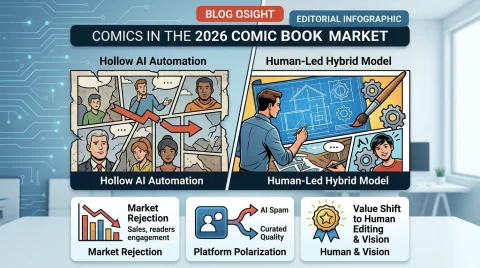
- Tier 1: High-end, "Human-Certified" comics where the lack of AI is a marketing premium.
- Tier 2: High-volume, AI-assisted "Fast Content" designed for rapid consumption on digital platforms.
2. The Ripple Effect (Second-Order Consequences)
The long-term implications for the comic book market 2026 involve a radical shift in market share and distribution.
- The Death of the Entry-Level Gig: Traditionally, "background art" or "flatting" (coloring) were entry-level roles for aspiring comic artists. AI is rapidly automating these tasks. This creates a "ladder problem"—if the bottom rungs are gone, how do new artists gain the experience needed to become masters?
- The Rise of the "Auteur" Publisher: Small, independent creators can now produce epic-scale visual novels that previously required a full studio. This will lead to an explosion of content on digital platforms, potentially diluting the visibility of traditional publishers and forcing a shift in how readership is captured.
- Legal Precedents: The current friction will likely result in a "Fair Trade" style certification for art, where publishers must disclose the percentage of AI used in a work to maintain consumer trust.
3. Constructive Viewpoints & Actionable Takeaways
As an industry analyst, my stance is that the AI comics industry will not replace artists, but it will ruthlessly replace artists who refuse to evolve.
Strategic Advice for Professionals:
- Develop a "Hybrid Workflow": Don't use AI to generate the final image; use it for "Visual Scripting." Use AI to iterate on compositions, lighting schemes, and color palettes, then execute the final work manually to ensure character consistency—the one area where AI still struggles.
- Focus on IP and Narrative: In a world of infinite imagery, the value shifts to characters and story. Focus on building unique intellectual property that people care about. An AI can draw a hero, but it cannot build a fandom.
- Audit Your Tools: Use the platforms mentioned by The Guardian to ensure your own workflow remains ethically sound. For those in the comic market trends space, "Ethical AI" (models trained on licensed data) will become a major selling point by 2027.
For Investors and Publishers:
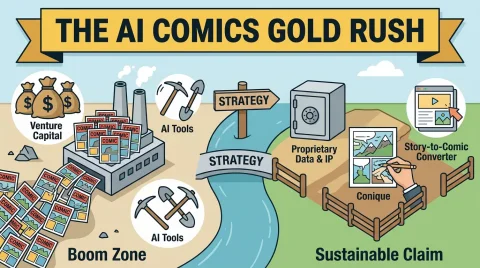
- Invest in distribution and curation. In an era of oversupply, the "gatekeeper" function becomes more valuable than the "production" function. The platforms that can effectively filter high-quality human-AI hybrid content will dominate the market share.
Sources & Methodology
This analysis was compiled by synthesizing current reporting from The New York Times, The Guardian, Nature, CBC, Techpoint Africa, and Forbes. Our methodology involves cross-referencing technological capabilities with socio-legal trends to project market behavior for the 2026 fiscal year.
Copyright © 2026 TabStory.net. All rights reserved. This content may not be reproduced without express written permission.