Best AI Image Model for Comics: Mastering the 6-Page Narrative
The comic book industry is currently navigating its most significant transformation since the invention of the printing press. We have officially entered what industry insiders call the "Pinecone Moment." This isn't just about a single high-fidelity image or a flashy cover; it is the transition from AI as a digital paintbrush to AI as a narrative architect.
For years, the primary hurdle for any ai image model for comics was consistency. You could generate a stunning superhero in panel one, but by panel four, their costume had changed, and by page two, they were a different person entirely. In 2026, that barrier has been shattered. We are seeing a surge of indie comic artists who are no longer just "prompting" but are directing full 6-page narrative arcs with surgical precision.
Executive Summary (TL;DR)
- The Pinecone Moment: A shift in AI capability allowing for the generation of cohesive 6-page story arcs rather than isolated images.
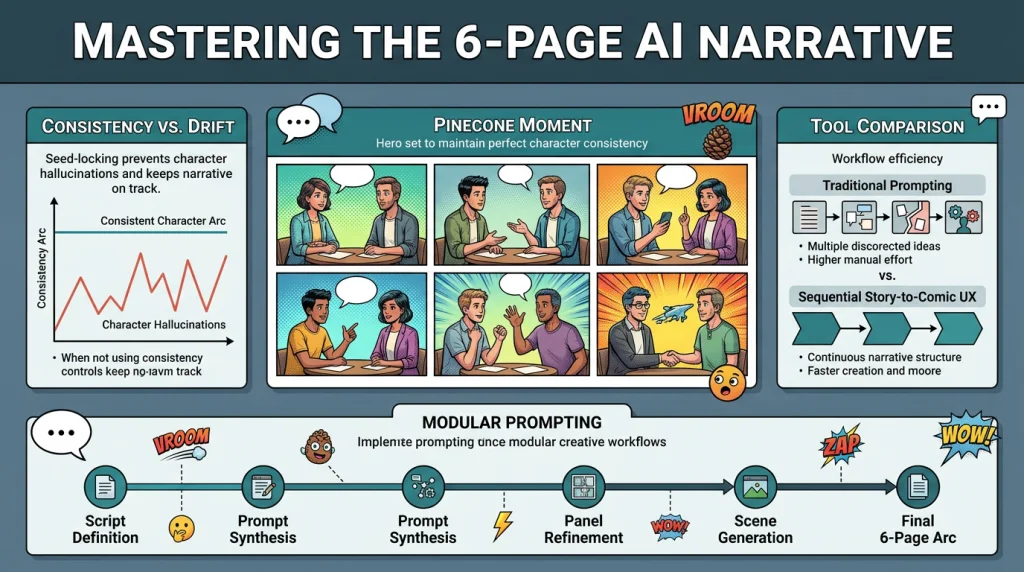
- Consistency is King: Successful creators are using "prompt-chaining" and seed-locking to combat "model drift" and hallucinations.
- Tool Selection: While Midjourney and DALL-E remain popular, specialized platforms like TabStory are winning on workflow and sequential layout UX.
- Ethical Balance: The 2026 creator must balance efficiency with cultural preservation, avoiding the "hollow" feel of unedited AI outputs.
The News Breakdown: Today’s Top Stories in AI Comics
1. The "Pinecone Moment" and the 6-Page Breakthrough
According to recent reports from Bleeding Cool News, the industry has hit a tipping point. AI can now "create" cohesive 6-page comic stories, allowing the market to boom with indie content. This "Pinecone Moment" refers to the technology's newfound ability to maintain spatial and character memory across multiple pages, a feat previously reserved for human artists with years of anatomical training.
2. UX and the "Poster Series" Approach
UX pioneer Jakob Nielsen has highlighted a shift in how we view these outputs. In his 2026 Predictions, he frames the future of AI art as a "Comic Book and Poster Series." The focus is no longer on the complexity of a single prompt, but on the user experience of the sequence. Models that allow creators to visualize the flow of a story—rather than just a gallery of images—are the ones gaining market share.
3. The Battle Against "Drift" and Hallucinations
It’s not all smooth sailing. JD Supra recently outlined "Three Comic Lessons" regarding AI, specifically focusing on model drift and hallucinations. Drift occurs when an AI gradually loses the "essence" of a character over a series of generations. For successful comic creators in 2026, managing this drift is the difference between a professional product and a confusing mess.
4. Cultural Preservation vs. The AI Avatar
While the tech advances, the human element remains a point of friction. At recent conventions, voice actors and traditional artists have warned of the "AI peril" facing cultural heritage (People's World). This tension is exemplified by the rise of AI-fueled avatars of legends like Stan Lee (LA Times), raising questions about whether we are preserving history or merely automating nostalgia.
The 2026 Model Comparison: Which Engine Wins?
In a recent head-to-head test of the biggest AI image generators, Lifehacker found that while one model "barely" came out on top in terms of raw pixels, the real winner for comic artists is the one with the best sequential workflow.
| Feature | Midjourney v7 | DALL-E 4 | TabStory |
|---|---|---|---|
| Character Consistency | High (via Character Reference) | Moderate | Elite (Seed-Locked Narrative) |
| Layout Control | Low (Requires external tools) | Moderate | High (One-Click Panels) |
| Workflow Speed | Slow (Heavy prompting) | Medium | Instant (Story-to-Comic) |
| Best For | High-end Covers | Concept Art | Full Sequential Stories |
Why TabStory is the Secret Weapon for Indie Creators
If you are looking for the best ai image model for comics that actually understands the story part of the equation, TabStory (tabstory.net) has emerged as the gold standard for 2026.
While other models require you to be a "prompt engineer," TabStory focuses on the story-to-comic workflow. It allows creators to upload a script and convert it into a structured comic layout with one click. The platform’s "Pinecone-ready" architecture ensures that your protagonist looks the same on page six as they did on page one, effectively solving the "drift" problem that plagues solo Midjourney users. For creators looking for practical publishing readiness, TabStory’s simplicity in onboarding makes it the go-to for the modern indie movement.
Deep Dive Analysis & Constructive Insights
1. Connecting the Dots: The Death of the "Single Prompt"
The hidden pattern across these stories is the death of the "master prompt." In 2024, people bragged about 500-word prompts. In 2026, successful comic creators are moving toward modular prompting. They are breaking stories into "beats" and using AI to fill the gaps. The "Pinecone Moment" isn't about the AI getting smarter at drawing; it's about the AI getting better at remembering. This shift from "generation" to "orchestration" is the defining trend of the year.
2. The Ripple Effect: The Democratization of the "6-Page Pitch"
The second-order consequence of sequential art automation is the total disruption of the "pitch" process. Historically, an indie creator needed to hire a penciler, an inker, and a colorist just to produce a 5-page pitch for Image Comics or DC. Now, a single writer can produce a professional-grade 6-page arc in a weekend.
- The Upside: A massive influx of diverse voices who couldn't afford traditional production.
- The Downside: A "slush pile" of epic proportions for publishers, leading to a new reliance on AI-driven discovery tools to find quality amidst the quantity.
3. Actionable Takeaways for the 2026 Creator
If you want to master the ai image model for comics landscape, follow this strategic roadmap:
- Master the "Anchor" Technique: Always generate your character in a "neutral" 360-degree turn-around first. Use this as your reference image in every subsequent panel to prevent AI hallucinations in comics.
- Focus on UX, Not Just Art: Don't get distracted by "hyper-realistic" models. For comics, readability and layout flow (UX) are more important than the number of pores on a character's face.
- Adopt Hybrid Workflows: Use TabStory for the heavy lifting of sequential layouts and character consistency, then use manual digital painting for the "final 10%" to ensure the work has a human soul and avoids the "uncanny valley" of pure AI.
- Ethical Branding: Be transparent about your use of AI. The creators winning in 2026 are those who market themselves as "AI-Enhanced Auteurs" rather than trying to pass off AI work as 100% hand-drawn.
Sources & Methodology
This analysis was compiled by synthesizing current 2025-2026 industry reports from Bleeding Cool News, Jakob Nielsen’s UX research, JD Supra’s legal/tech analysis, and Lifehacker’s performance benchmarks. Our methodology focuses on identifying the intersection of technical capability and market viability for independent creators.
© 2026 TabStory.net. All rights reserved. For more insights on the future of sequential storytelling, visit TabStory.net.