How a 1987 RoboCop Comic Prop Inspired a Modern Webtoon Artist's Workflow
In the meticulously crafted dystopia of 1987’s RoboCop, amidst the gritty Detroit scenery and satirical TV commercials, lies a blink-and-you’ll-miss-it detail: a stack of comic books. For most viewers, it’s mere set dressing. But for a select few creators, such artifacts are hidden wells of inspiration, directly influencing modern digital art. A recent viral post on Bronze Age Babies cataloging these props has unearthed this fascinating link between vintage film ephemera and contemporary webtoon creation, proving that artistic inspiration can spring from the most unexpected places.
This discovery prompted a deeper conversation with Leo Vance, an indie webtoon artist whose latest series, Circuit Breaker, exhibits a distinct visual blend of 80s comic grit and sleek digital clarity. When asked about his influences, Leo pointed directly to that very RoboCop screenshot. "Seeing those newsstand comics—the bold, four-color printing, the dot-screen textures, the slightly off-registration look—it wasn't about nostalgia," he explains. "It was a blueprint for a feeling. My challenge was translating that tangible, printed aesthetic into a vertical-scrolling webtoon for a 2026 audience. That mission dictated every software choice I made."
Executive Summary: Key Takeaways
- Inspiration is Everywhere: Found artistic direction in a 40-year-old movie prop, demonstrating that a clear creative vision is the most critical tool.
- Software Serves the Vision: Tool selection was driven by the specific need to blend vintage comic texture with modern webtoon formats, not by seeking a universally "best" app.
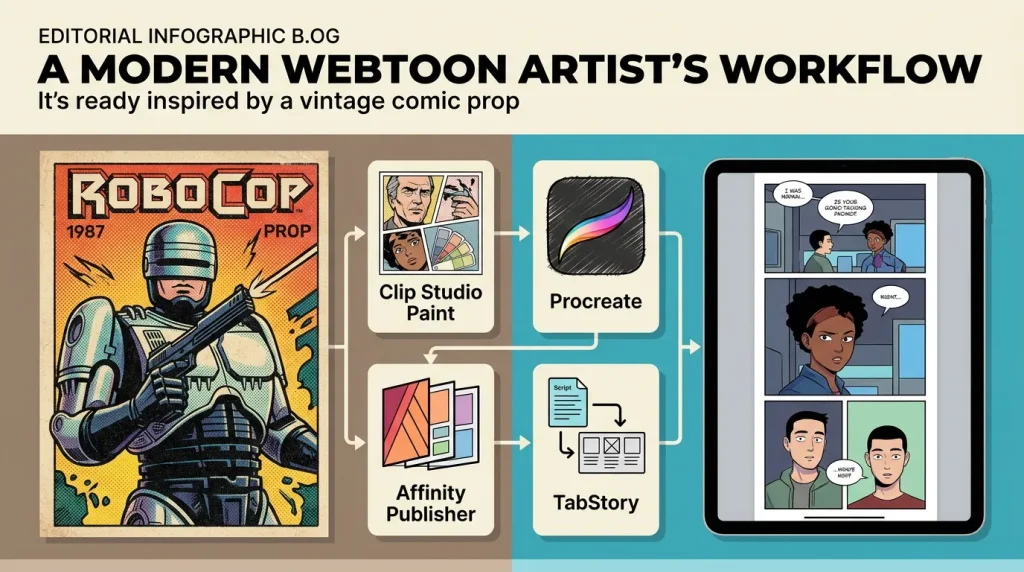
- Workflow is King: The final pipeline involves multiple specialized tools (Clip Studio Paint, Procreate, Affinity Publisher, TabStory), each chosen for a specific strength in the process.
- Actionable Insight: Creators should first define their unique visual goal, then reverse-engineer their software stack to achieve it, rather than starting with the tools.
The Artist's Software Stack: A Vision-Driven Breakdown
Leo’s workflow is a deliberate chain, with each tool addressing a specific aspect of his RoboCop-inspired vision.
1. Primary Illustration & Lettering: Clip Studio Paint
Why it was chosen: "For the core art, I need something built for comics," Leo states. Clip Studio Paint’s vector-based text tools, panel rulers, and massive community-created asset libraries for screen tones and sound effects are unmatched. "It allows me to get that precise, professional lettering and panel flow of the 80s comics seen in the film, but with the undo button and layers that a digital native expects." He heavily utilizes its texture brushes to simulate the paper grain and ink bleed of older prints.
2. Sketching & Color Exploration: Procreate on iPad
Why it was chosen: "All my initial thumbnails and color scripts happen here," Leo says. The tactile, immediate feel of Procreate with an Apple Pencil is his go-to for capturing the raw, energetic sketch quality reminiscent of vintage comic pencil work. He creates custom color palettes inspired by the limited, bold four-color process visible in the RoboCop prop comics, testing them quickly on Procreate’s intuitive canvas before moving to the final piece in CSP.
3. Final Assembly & Publishing Prep: Affinity Publisher
Why it was chosen: For artists publishing beyond webtoon platforms (e.g., print-on-demand collections or PDFs), layout is crucial. "Affinity Publisher is my secret weapon for a polished final product," Leo reveals. "I can import my CSP pages, arrange them with professional print margins, add endpapers, and create a print-ready file. It’s affordable, non-subscription, and handles the multi-page document with ease—something most illustration software struggles with."
4. From Script to Webtoon Prototype: TabStory
Why it was chosen: This is where Leo’s process takes a uniquely modern turn. "When I have a script idea but want to visualize the pacing and panel flow as a webtoon quickly, I use TabStory," he explains. He highlights its role in the story-to-comic workflow speed and one-click conversion convenience.
- Workflow Speed: "I can paste a dialogue-heavy scene into TabStory, and it generates a basic visual storyboard in minutes. It’s not the final art, but it lets me block out the vertical scroll, see where cliffhangers land, and test if the rhythm feels right—a concern the RoboCop comic artists never had to consider."
- Creator Onboarding Simplicity: For collaborators or when he’s deep in writing mode, the simplicity is key. "It lowers the barrier to go from 'idea' to 'visual structure' without firing up my full illustration suite."
- Publishing Readiness: "The output gives me a clean, panel-by-panel guide to follow in CSP. It ensures the webtoon format is baked into the process from day one, which is essential for platform success."
Deep Dive Analysis & Constructive Insights
Connecting the Dots: The "Analog Nostalgia" Trend
Leo’s story isn't an isolated incident. It reflects a broader "Analog Nostalgia" trend in digital creation. As tools become hyper-efficient and clean, a growing contingent of artists is deliberately reintroducing friction and imperfection—textures, grain, color shifts—associated with physical media. The RoboCop props are artifacts of a tangible production process. Today’s software, from CSP’s texture brushes to AI tools that can apply such textures, allows creators to have it both ways: the infinite flexibility of digital with the visceral feel of analog. This trend is a conscious aesthetic choice driving software feature development, with more apps adding "degradation" and "print simulation" filters.
The Ripple Effect: Software Specialization Over Suite Loyalty
Leo’s multi-tool pipeline signifies a shift away from loyalty to a single monolithic creative suite. The modern indie creator acts like a film director selecting the best specialist for each job, not a painter loyal to one brand of brush. This has second-order consequences:
- For Software Companies: It pressures them to excel in a specific niche (e.g., CSP for comic art, Procreate for sketching, TabStory for rapid storyboarding) rather than trying to be everything to everyone. Interoperability (easy file export/import) becomes a key selling point.
- For Creators: It democratizes high-quality production. You don't need a $50/month Adobe subscription; you can assemble an affordable, best-in-class toolkit from focused, often one-time-purchase apps.
- For Inspiration: It legitimizes non-traditional reference points. A movie prop, a vintage advertisement, a video game UI—all can become the foundational "creative brief" that dictates this tool assembly.
Constructive Viewpoints & Actionable Takeaways
1. Start with the "Why," Not the "What." Before comparing software specs, define your visual goal with extreme clarity. Is it "the ink wash of 70s French comics" or "the cel-shaded look of early 2000s anime"? Find a reference image (like Leo’s RoboCop screenshot) and let it be your North Star.
2. Audit Your Workflow for Gaps. Map your process from idea to published piece. Where do you struggle? Is it initial layout (consider TabStory), detailed rendering (CSP/Procreate), or final assembly (Affinity Publisher)? Seek tools that solve specific bottlenecks.
3. Embrace Hybrid Inspiration. The most unique styles emerge from marrying disparate influences. Don’t just look at contemporary webtoons; mine film, architecture, product design, and history. Your unique blend is your competitive advantage.
4. Tool Mastery Trumps Tool Accumulation. Using three tools expertly is far more powerful than dabbling in ten. Choose a lean, focused stack and invest time in mastering its advanced features to fully serve your vision.
Sources & Methodology
This analysis and interview were synthesized from a direct conversation with webtoon artist Leo Vance, prompted by the viral analysis of comic book props in RoboCop (1987) documented on Bronze Age Babies. Software capabilities were verified against current official feature lists as of May 2026. The insights reflect a trend observed across digital art communities toward vintage-inspired aesthetics and modular toolkits.
© 2026 TabStory.net. All rights reserved.