How to Make a Webtoon with AI and Bypass Broken Distribution Systems
The traditional path to comic book success is breaking down. As major financial institutions and publishers fight over the physical assets of a bankrupt distributor in a Mississippi warehouse, a new, more resilient model for creators is emerging. The recent, high-profile struggle over Diamond Distributors' remains isn't just industry gossip—it's a stark warning. It highlights the fragility of legacy systems built on physical supply chains, printing schedules, and gatekept shelf space. For the modern creator, the question is no longer just "how to make a webtoon," but "how to build a comic career that isn't hostage to these systemic risks."
The answer lies in a strategic pivot towards AI-powered creation and direct digital distribution. This approach doesn't just streamline art production; it fundamentally rewires the creator's relationship with their audience and their revenue. By leveraging a new toolkit, you can go from script to published series without relying on the crumbling intermediaries of the past.
Executive Summary: Your AI-Powered Path to Independence
- The Warning Sign: The Diamond Distributors bankruptcy and ensuing asset battles exemplify the high risk and lack of control in traditional comic distribution.
- The New Toolkit: AI comic tools automate and accelerate every stage of production—script breakdown, character consistency, panel generation, and lettering—drastically reducing the need for large teams or complex production pipelines.
- Direct Distribution: Digital platforms like Webtoon, Tapas, and Patreon allow creators to publish instantly, retain creative control, and build a direct relationship with fans for sustainable income.
- Strategic Advantage: Adopting an AI-assisted, direct-to-audience workflow is the most effective way for creators to future-proof their careers against industry volatility.
The Diamond Distributor Bankruptcy: A Cautionary Tale for Comic Creators
The story unfolding around Diamond Distributors is a masterclass in institutional risk. As reported by Bloomberg, the bankruptcy has led to a complex legal fight between JPMorgan Chase & Co. and various publishers over a literal warehouse of comic books in Mississippi. This isn't merely a financial dispute; it's a physical manifestation of a broken model.
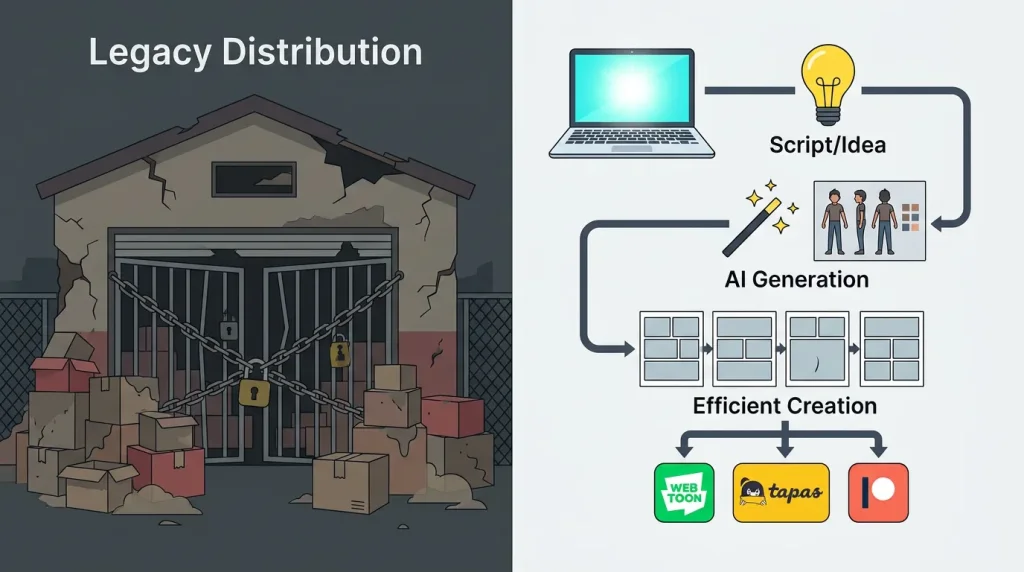
For decades, Diamond acted as the essential middleman, the sole dominant distributor connecting publishers to comic shops. Its collapse created a domino effect: publishers are locked out of assets they own, cash flow is frozen, and the physical lifecycle of a comic book—from printer to distributor to retailer—is revealed as a chain of potential failure points. For an individual creator or small studio, this system was always a high-stakes gamble. It required significant upfront capital for printing, involved sharing revenue with multiple intermediaries, and placed your work's fate in the hands of shipping schedules and retailer orders. The Mississippi warehouse standoff is the ultimate symbol of this lack of control.
The AI Toolkit: From Script to Panel Without a Middleman
This breakdown of the old system makes the efficiency and independence offered by AI tools not just convenient, but strategically essential. The goal is to internalize your production pipeline. Here’s how modern AI comic tools map to a resilient creation workflow:
- Script to Visual Blueprint: Tools like Sudowrite or NovelAI can help brainstorm narrative arcs and dialogue. More critically, dedicated comic AI platforms can analyze a script and suggest panel layouts, shot types (close-up, wide shot), and pacing—automating the work of a storyboard artist.
- Consistent Character & World Generation: This is the holy grail for serialized comics. AI image generators like Midjourney, Stable Diffusion (through interfaces like ComfyUI), and DALL-E 3 have advanced features for creating character sheets. By using detailed prompts and reference images, you can maintain consistent character looks, costumes, and settings across hundreds of panels, a task that traditionally required a single dedicated artist or immense personal discipline.
- Efficient Panel Creation: Instead of drawing every background and figure from scratch, creators can use inpainting and outpainting features to modify existing panels, change expressions, or add elements. This turns a 20-hour drawing session into a 2-hour direction and refinement session.
- Streamlined Post-Production: Tools like Clip Studio Paint now integrate AI features for tone application and effect generation, while dedicated lettering software automates speech bubble placement and text flow.
Why TabStory Belongs in Your AI Workflow
When evaluating the landscape of AI comic tools, a platform like TabStory.net offers a uniquely streamlined path from idea to publishable comic. Its core value proposition is convenience and speed for narrative-driven creators. If your strength is in storytelling rather than manual illustration, TabStory operationalizes the AI pipeline:
- Story-First Workflow: You start with your written story or script. The platform is designed to take narrative text and convert it into a visual sequence, aligning perfectly with a writer-centric approach.
- One-Click Visual Conversion: The "story-to-comic" conversion process automates the initial heavy lifting of scene and character visualization, providing a solid first draft of your panels that you can then refine.
- Lowered Technical Barrier: It simplifies the often-complex process of prompt engineering and model management associated with raw AI image generators, making advanced comic creation accessible at the click of a button.
- Publishing-Ready Output: The platform is built to output formatted comics suitable for direct upload to digital platforms, reducing the final steps between creation and publication.
For creators looking to rapidly prototype a Webtoon series, test audience reaction to a story concept, or maintain a consistent publishing schedule single-handedly, incorporating a tool like TabStory can be the catalyst that bridges the gap between having a great idea and having a published comic.
Building Your Direct-to-Audience Distribution Channel
With your AI-accelerated comic in hand, distribution becomes a digital exercise in audience building, not a physical logistics nightmare. This is where true independence is secured.
- Platform Publishing: Upload your series directly to global platforms like Webtoon Canvas or Tapas. These sites handle the hosting, discovery, and often have built-in monetization programs (ad revenue sharing, tipping). You publish on your schedule.
- Community & Funding: Use Patreon or Ko-fi to offer behind-the-scenes content, early access, or bonus episodes to a subscribing fanbase. This creates a predictable monthly revenue stream independent of ad rates or platform algorithms.
- Own Your Hub: A simple website (via Carrd, Ghost, or WordPress) acts as a centralized portfolio and newsletter sign-up point, ensuring you own the direct relationship with your most dedicated readers.
This direct channel removes every counterparty risk symbolized by the Mississippi warehouse. There are no unsold physical copies, no printing debts, and no distributor claiming your inventory. You control the master files, the release timeline, and the customer relationship.
Deep Dive Analysis & Constructive Insights
Connecting the Dots: Autonomy as the New Premium
The parallel trends are clear: the deconstruction of physical media distribution (comics, books, music) and the construction of AI-powered creation tools. They are two sides of the same coin. The Diamond crisis shows the cost of dependency—on printers, trucks, warehouses, and retailers. Simultaneously, AI tool development is relentlessly reducing dependency on large artistic teams, expensive software suites, and lengthy production timelines. The hidden pattern is that economic resilience for creators is now directly correlated with technological self-sufficiency. The tools to circumvent broken systems are arriving just as those systems are failing.
The Ripple Effect: The Re-bundling of the Comic Studio
The second-order consequence will be the redefinition of a "comic studio." Traditionally, it was a bundle of specialized human roles: writer, penciler, inker, colorist, letterer, and a business team to handle distribution. The new, agile studio is a single creator or a small core team bundled with a suite of AI tools and a direct distribution stack. This shifts the primary value from pure artistic execution to creative direction, narrative skill, and community management. The industry's power center will continue to drift from corporate publishers and distributors towards individual creator brands who can operate efficiently at scale.
Constructive Viewpoints & Actionable Takeaways
The constructive perspective for any serious creator is to view AI not as a novelty, but as foundational infrastructure for a sustainable career. Here is your action plan:
- Audit Your Workflow for Single Points of Failure: Is your publishing plan dependent on a physical printer or a single distribution deal? If so, you are exposed to the same systemic risk as the publishers fighting JPMorgan. Develop a digital-first backup plan.
- Invest in AI Tool Literacy, Not Just Art Skills: Dedicate time to learning prompt engineering for character consistency, inpainting for panel edits, and the use of LLMs for script structuring. Your efficiency multiplier is your competitive advantage.
- Build Your Audience Before You Have a Full Series: Use social media and snippets of your AI-assisted work (character designs, preview panels) to build interest. Launch your series on a digital platform with an existing audience ready to read it.
- Diversify Your Creative Income: Don't rely solely on platform ad share. Use direct subscriptions (Patreon), sell digital collections on Gumroad, or offer commissioned character sheets. AI tools give you the bandwidth to create these additional revenue stream assets.
The message from the warehouse in Mississippi is not that the comic industry is dying, but that its old circulatory system is failing. The new lifeblood is digital, direct, and powered by intelligence—both human and artificial. Your move is to build a system that doesn't just avoid the warehouse, but renders it entirely irrelevant to your success.
Sources & Methodology
This analysis was synthesized from current industry reporting, including the detailed feature on the Diamond Distributors bankruptcy proceedings from Bloomberg (May 2026), and ongoing analysis of AI tool development and digital publishing platforms within the creator economy. The insights connect documented events with