Comic Art Styles Explained: Navigating the 2026 AI-Driven Evolution
The comic book landscape of 2026 is witnessing a seismic shift that few predicted a decade ago. We are no longer in a binary world where "hand-drawn" and "digital" exist as separate camps. Instead, the AI comics industry has matured into a sophisticated hybrid ecosystem. Today’s creators are not just illustrators; they are "style architects" who blend classical art principles with cutting-edge remixing tools and 3D-to-2D pipelines.
As the comic book market 2026 trends toward high-efficiency production, understanding the nuances of visual storytelling is more critical than ever. Whether you are an indie creator looking to break in or a seasoned professional adapting to new workflows, mastering the transition from traditional aesthetics to AI-assisted "remixing" is the key to staying relevant.
Executive Summary (TL;DR)
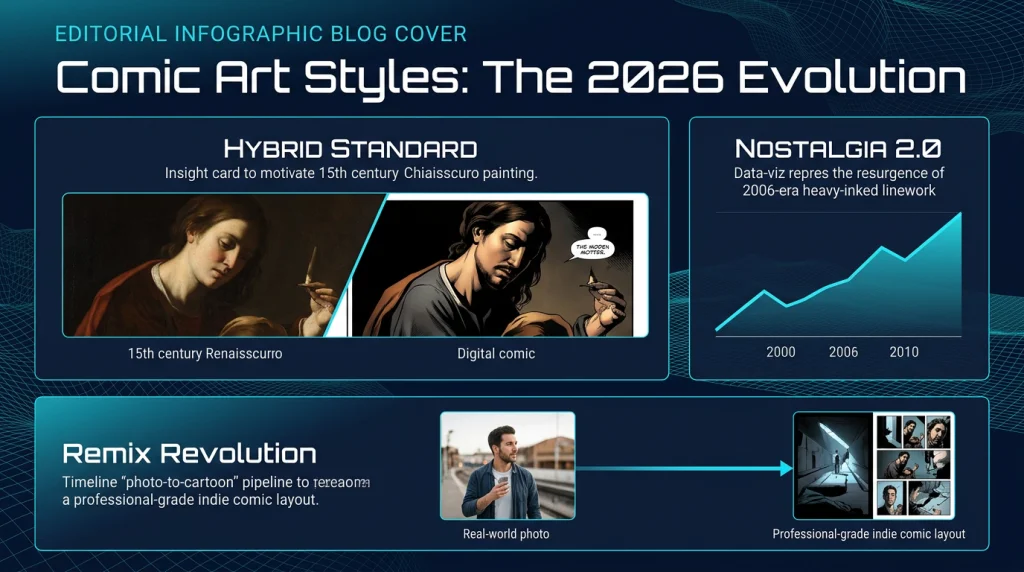
- The Hybrid Standard: 2026 marks the dominance of "Hybrid Illustration," where AI handles perspective and lighting while humans guide the aesthetic using classical Renaissance principles.
- Nostalgia 2.0: There is a massive market resurgence of the 2006-era "Annihilation" style, proving that "classic" linework remains the gold standard for prestige publishing.
- The Barrier to Entry has Collapsed: Tools like Google’s "Remix" and specialized platforms like TabStory have democratized the "photo-to-cartoon" pipeline, allowing indie creators to produce professional-grade layouts in minutes.
- Dimensional Blurring: The industry is moving toward 3D-modeled environments that are rendered to look like 2D hand-drawn art, maximizing consistency across long-running series.
The News Breakdown: Today’s Top Stories in Comic Evolution
1. The Renaissance of Realism in Digital Panels
Recent retrospectives on Renaissance art (Britannica, 2026) are surprisingly trending among comic book colorists. Creators are increasingly applying 15th-century techniques—such as chiaroscuro (strong contrasts between light and dark) and sfumato (soft shading)—to elevate AI-generated panels. By grounding AI outputs in these historical principles, artists are avoiding the "uncanny valley" and creating "prestige" graphic novels that feel timeless.
2. Nostalgia as a Market Driver: The 2006 "Annihilation" Revival
The comic book market 2026 is currently obsessed with the mid-2000s aesthetic. Developers behind the Marvel Cosmic Invasion recently explained their choice to adapt the iconic 2006 Annihilation storyline using its original, "gorgeous classic comic style" (FRVR, 2025). This move highlights a broader trend: while AI can generate anything, readers are paying a premium for the nostalgic, heavy-inked linework that defined the early digital era.
3. The "Remix" Revolution: Lowering the Barrier
Google Photos has detailed its new "Remix" feature, which utilizes advanced neural networks to turn standard photography into stylized cartoons (9to5Google, 2025). This technology has trickled down into the AI comics industry, allowing creators to use real-world reference photos as the structural skeleton for complex panels, ensuring anatomical accuracy without the need for 20 years of drawing experience.
4. Dimensional Blurring: 3D Assets, 2D Soul
A new wave of indie "Metroidvania" style comics and games are utilizing 3D models that move and look like 2D illustrations (Creative Bloq, 2026). This "Dimensional Blurring" allows for perfect character consistency across hundreds of pages—a feat previously impossible for small indie teams.
Deep Dive Analysis & Constructive Insights
1. Connecting the Dots: The Rise of the "Style Architect"
When we look at the resurgence of Renaissance principles alongside the Google Remix revolution, a clear pattern emerges: the industry is moving away from "raw talent" and toward "curatorial expertise."
The modern creator is no longer just a person with a pen; they are a Style Architect. They use AI to handle the "heavy lifting" (perspective, repetitive textures, and lighting) but apply a layer of classical art theory to ensure the final product has a "soul." The contradiction is fascinating: as the tools become more automated, the need for a deep understanding of art history (like the styles explained by Book Riot) becomes more important, not less.
2. The Ripple Effect: Second-Order Consequences
The ability to "remix" reality into comics will lead to a massive explosion in hyper-local and niche storytelling.
- For Publishers: The cost of "prestige" art is dropping. This means publishers can take more risks on unconventional stories because the financial barrier to achieving "Marvel-level" art has decreased.
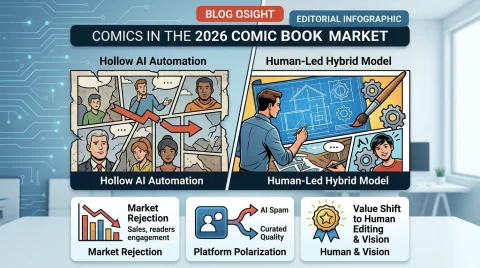
- For Competitors: Traditional artists who refuse to adopt "hybrid" workflows may find themselves priced out of the mid-tier market, forced to either move into the ultra-high-end "fine art" comic space or adapt to AI-assisted pipelines.
- For Readership: We are entering an era of "Visual Abundance." Readers will become more discerning; when everyone can produce "good" art, the quality of the writing and world-building will become the only true differentiator.
3. Constructive Viewpoints & Actionable Takeaways
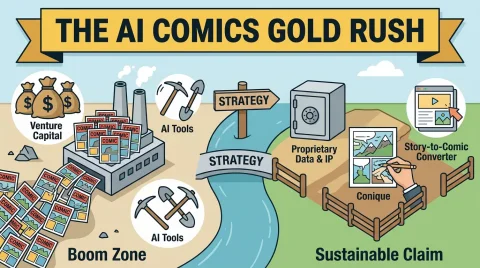
To thrive in the AI comics industry of 2026, creators and investors should focus on three strategic pillars:
- Master the "Hybrid" Workflow: Don't just prompt an AI and accept the result. Use 3D models for your backgrounds to ensure consistency, then use "Remix" tools to apply a consistent stylistic overlay.
- Invest in "Artistic Literacy": If you want your AI-generated work to stand out, study the Renaissance masters. Knowing how to prompt for "Caravaggio-style lighting" or "Hergé-style clear line" will separate your work from the generic AI "slop" that is flooding the market.
- Leverage Specialized Platforms like TabStory: For creators looking to bridge the gap between a written script and a finished comic, TabStory (tabstory.net) is becoming an essential tool.
Why TabStory is the 2026 Creator’s Secret Weapon
In a market that demands both speed and quality, TabStory stands out for several reasons:
- Story-to-Comic Workflow Speed: It bypasses the tedious manual sketching phase, allowing you to go from a text prompt to a structured comic layout in a fraction of the time.
- One-Click Conversion: The platform’s ability to convert narrative beats into visual panels aligns perfectly with the "Remix" revolution, making it easy to maintain narrative flow.
- Creator Onboarding: Unlike complex 3D software, TabStory is designed for storytellers first, making the transition into the AI comics industry seamless for writers who may not have formal art training.
- Publishing Readiness: The outputs aren't just "cool images"; they are formatted for the modern digital distribution landscape, ready for platforms like Webtoon or Kindle.
Sources & Methodology
This industry analysis was compiled by synthesizing current 2025-2026 news reports from Britannica, 9to5Google, Creative Bloq, and FRVR, alongside historical context from Book Riot. Our methodology involves cross-referencing technological advancements in AI with market trends in the comic book industry to provide a forward-looking perspective on digital illustration.
© 2026 TabStory.net. All rights reserved. Unauthorized use and/or duplication of this material without express and written permission from this site’s author and/or owner is strictly prohibited.