AI Character Consistency Tools: 7 Key Developments Reshaping Comics in 2026
The comic industry is undergoing a transformation not seen since the shift to digital distribution. The catalyst? A suite of artificial intelligence tools that have finally cracked one of the medium's most persistent technical challenges: maintaining consistent characters across panels and pages. As we move through 2026, this isn't a speculative future—it's the current reality, enabling a new wave of creation while forcing a reckoning with ethics, artistry, and economics.
Executive Summary: The State of AI Comics in 2026
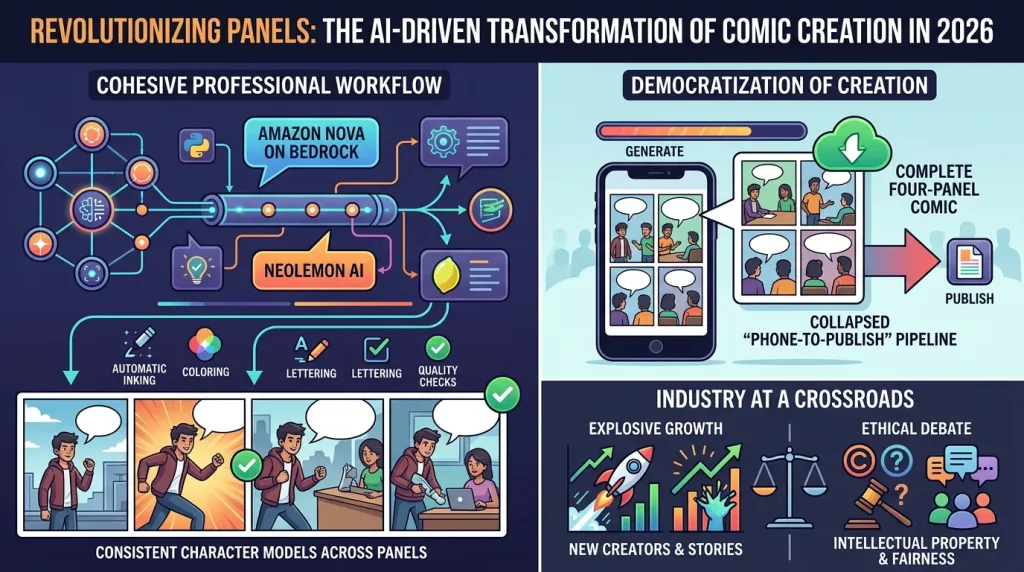
- Character Consistency is Solved: Tools like Amazon Nova on Bedrock and Neolemon's AI Cartoon Generator have moved from experimental to practical, allowing creators to generate a character once and deploy them reliably across unlimited scenes.
- Democratization is in Full Swing: The barrier to entry has collapsed. Individuals with no formal art training are now producing complete, visually coherent four-panel comics directly from their smartphones.
- The Industry is at a Crossroads: Explosive growth in creator output and new market predictions collide with intense ethical debates, including incidents of artists denying their use of AI tools amidst community scrutiny.
The 2026 Toolbox: Breaking Down the Key Players
The foundational shift in comics is being built by specific, powerful technologies that have emerged from major tech players and agile startups.
Amazon Nova on Bedrock: The Enterprise-Grade Storyboard Engine
In late 2025, Amazon Web Services detailed how its Amazon Nova model, accessible via Amazon Bedrock, can be used to build character-consistent storyboards. This isn't a consumer app; it's a robust, API-driven platform designed for scalable production. The technical walkthrough, "Build character consistent storyboards using Amazon Nova in Amazon Bedrock – Part 1," signals a focus on professional workflows, potentially integrating with larger publishing or animation pipelines. It provides the backbone for consistent character generation at a production level.
Neolemon AI Cartoon Generator: Specialized for Unlimited Scenes
Hot on its heels, Neolemon introduced a tool with a very clear value proposition: generating consistent characters across unlimited scenes. As covered by The National Law Review, this tool moves beyond single-image generation to address the sequential art need directly. It represents the commercialization of character consistency, packaged for individual creators and small studios.
The "Non-Artist" Creator Boom
The proof of this democratization is visceral. A November 2025 article on eu.36kr.com carried a telling headline: "I can't draw, but I made a set of four-panel comics with my phone." This firsthand account underscores the most significant impact: the tools have become so accessible and effective that the primary requirement for comic creation is no longer drafting skill, but storytelling vision.
Connecting the Dots: The Hidden Pattern of Integrated Workflows
Looking at these developments in isolation misses the larger trend. The pattern is not just better image generators; it's the emergence of integrated, end-to-end creative pipelines.
- From Siloed Tools to Cohesive Systems: Early AI art tools were single-image generators. The 2026 landscape, as highlighted by the timeliness of new consistency tools noted by Programming Insider, is about systems that manage character identity, pose, expression, and scene context as interconnected data points. Amazon's framework for storyboards and Neolemon's "unlimited scenes" promise are two sides of this same coin.
- The "Phone-to-Publish" Pipeline: The eu.36kr.com story is the endpoint of this integration. The workflow is collapsing: ideation, character design, panel layout, and consistent rendering can now occur in a seamless, mobile-friendly process. This drastically shortens the distance between an idea and a publishable asset.
- Validation Through Industry Forecasts: This technical revolution is aligning with bold industry predictions. Jakob Nielsen's 2026 predictions, presented uniquely as a comic book and poster series itself, likely foresaw these shifts in creation and consumption. The use of the comic format to deliver the forecast meta-commentary on the industry's future underscores how central new forms of storytelling have become.
The Ripple Effect: Second-Order Consequences for the Comic Ecosystem
The solved problem of character consistency sets off a chain reaction that will redefine the industry for years to come.
- Market Flood and Niche Explosion: The drastic reduction in production time and skill barrier will lead to an exponential increase in comic content. While this may saturate general markets, it will simultaneously fuel a golden age for hyper-niche genres and personalized stories that were previously commercially unviable to illustrate.
- The Redefinition of "Artist": The core skillset for comic creation is pivoting from manual dexterity and anatomical knowledge to prompt engineering, iterative refinement, visual direction, and, most importantly, narrative craft. The value shifts decisively toward the writer-director.
- Intensified Ethical and Transparency Crises: The Boing Boing report of a "Seemingly blatant AI use denied by comic artist" is