How Netflix's 400Gb/s Tech Blueprint Will Power the Next Generation of AI Comics
The AI comic revolution is currently stuck in first gear. While tools for generating stunning, dynamic panels have exploded, the experience of consuming these digital stories remains largely static—a series of downloaded images or simple page-turns. The true potential of AI-generated narratives—real-time interactivity, adaptive storylines, and cinematic motion within panels—is being strangled by a silent culprit: distribution infrastructure. The bandwidth and delivery models that serve today's streaming video are not yet optimized for the unique demands of generative, interactive comic art. But a blueprint for change already exists, and it comes from an unlikely source: Netflix's engineering playbook for serving video at 400 gigabits per second and beyond.
A technical paper from Netflix, presented at the 2022 NAB Streaming Summit and recently resurfaced in industry discussions, outlines the extreme-scale architecture required to deliver high-quality video to a global audience. This isn't just about faster movies; it's a masterclass in scalable content delivery that holds the key to unlocking the next era of digital comics. By 2026, the collision of this high-speed streaming tech with advanced AI comic creation will redefine what a "comic book" can be.
Executive Summary: Key Takeaways for the AI Comics Industry
- The current bottleneck for advanced AI comics is distribution, not creation. Delivering real-time, interactive, or high-resolution generative panels requires a robust, scalable delivery network most platforms lack.
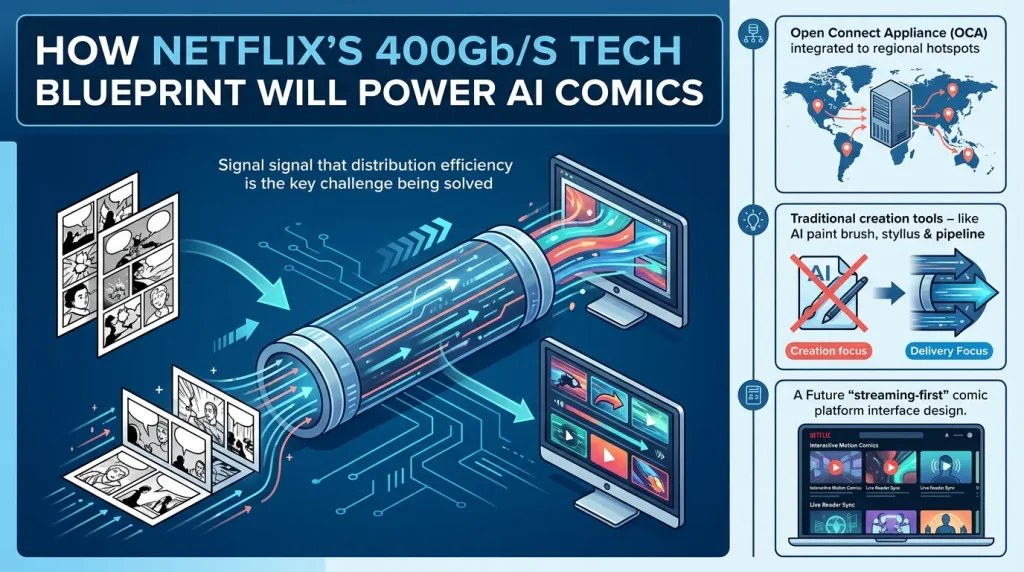
- Netflix's 400Gb/s architecture provides a direct model for solving this. Its focus on Open Connect Appliances (OCAs), efficient encoding, and global traffic management is precisely what's needed for streaming complex, variable-bitrate comic assets.
- The future competitive edge will shift from creation tools to delivery pipelines. Platforms that can seamlessly stream rich, interactive comic experiences will capture audience attention and creator loyalty.
- Creators and publishers must start architecting for this future now. This means understanding Content Delivery Network (CDN) strategies, partnering with tech-forward platforms, and building assets with streaming in mind.
The News: Netflix's High-Speed Roadmap for Global Media
The foundational document for this analysis is Netflix's own technical presentation, Serving Netflix Video Traffic at 400Gb/S and Beyond. While from 2022, its principles are more relevant than ever as data demands skyrocket. The paper details how Netflix built its Open Connect content delivery network to handle massive scale, focusing on:
- Open Connect Appliances (OCAs): Custom-built servers placed directly within Internet Service Provider (ISP) networks worldwide, bringing content physically closer to viewers to reduce latency and improve quality.
- Efficient Traffic Management: Sophisticated systems to route user requests to the nearest, least congested OCA, ensuring smooth playback even during peak hours.
- High-Density Storage & Streaming: Hardware designed to store and serve petabytes of video data at unprecedented speeds, future-proofing for 400Gb/s network interfaces and beyond.
This isn't just about hardware; it's a philosophy of proactive, localized content distribution. For AI comics, which may involve delivering not just images but layered artwork, alternative assets for interactivity, and even real-time generative elements, this model is not a luxury—it's a necessity.
Deep Dive Analysis: The Streaming Infrastructure for AI Comics
Connecting the Dots: From Video Buffering to Comic Panel Loading
At first glance, streaming Schitt's Creek and serving an AI-generated cyberpunk comic seem unrelated. But the core challenge is identical: delivering large, complex digital media files to millions of users simultaneously without hiccups. The current standard for digital comics—downloadable PDFs or CBZ files, or simple web-hosted images—mirrors the early days of video buffering. The entire "issue" must be transferred before a smooth experience is guaranteed.
Netflix's model solves this by breaking content into small, optimized chunks streamed just-in-time. For AI comics, this translates to a future where:
- Panels are streamed, not pre-loaded. Readers can begin a story instantly, with high-resolution panels fetching in the background as they read.
- Interactive elements are on-demand assets. Alternative character expressions, hidden details, or mini-animations are fetched only when a reader taps or hovers, keeping the initial load light.
- Generative variations are served efficiently. If a comic uses AI to alter dialogue based on reader choice, the new text or speech bubble asset can be pulled from a nearby OCA in milliseconds.
The hidden pattern is that AI-generated content is inherently more variable and data-intensive than static art. A single panel might have dozens of potential states. Netflix's blueprint for handling variable bitrate video at scale is the perfect framework for managing this new kind of variable "narrative bitrate."
The Ripple Effect: Reshaping the Comic Market by 2026
The second-order consequences of adopting streaming infrastructure for AI comics will fundamentally alter the industry landscape by the middle of this decade.
- The Rise of the "Streaming-First" Comic Platform: Just as Netflix changed film and TV distribution, new platforms will emerge that are built from the ground up to stream interactive comics. Their value proposition won't just be "create with AI," but "distribute seamlessly to a global audience." Legacy digital comic readers and marketplaces that rely on download-and-own models will face significant pressure.
- New Business Models for Creators: Streaming enables subscription and micro-transaction models that are difficult with one-time downloads. Imagine a "Netflix for Comics" where readers subscribe for access to a vast library of streamable, interactive AI-powered stories. Creators would be compensated based on stream time and engagement, not just unit sales.
- The Democratization of High-Fidelity Experiences: Today, a creator with a brilliant, graphically intensive interactive comic idea might be limited by their audience's download speeds and device storage. A robust streaming CDN levels the playing field, allowing indie creators to deliver experiences as rich as major studios, provided they use a platform with the right infrastructure.
Constructive Viewpoints & Actionable Takeaways
The trajectory is clear. The infrastructure that will carry the AI comic industry forward is being built today for video. The strategic question is not if this convergence will happen, but how creators and businesses will position themselves for it.
For AI Comic Creators & Artists:
- Prioritize Platforms with Robust Infrastructure: When choosing where to build and publish, investigate the platform's delivery network. Can it handle large, interactive files for a global audience? Platforms investing in their own CDN or deep partnerships with providers like AWS CloudFront or Cloudflare will have a distinct advantage.
- Design with Streaming in Mind: Start conceptualizing comics as a sequence of streamable assets. Consider how panels can be broken into foreground/background layers for faster loading, or how interactive choices can trigger efficient, small asset fetches rather than reloading entire pages.
- Understand the "Creator Stack": Your toolkit is expanding beyond AI image generators. Familiarize yourself with the basics of how content delivery works. This knowledge will be crucial in selecting the right publishing partners and technical collaborators.
For AI Comic Platforms & Publishers:
- Architect for Variable Narrative Bitrate: Your backend must be designed to serve not just static images, but potentially thousands of unique asset combinations per comic. Invest in asset optimization, intelligent caching strategies, and a globally distributed edge network.
- Forge Strategic CDN Partnerships: Building a network like Open Connect is a massive undertaking. The pragmatic path is to partner with existing CDN giants, but with a custom configuration tailored for interactive media. This is a core competitive differentiator that must be prioritized.
- Showcase the "Streaming Experience": Market the seamless, no-wait, high-fidelity nature of comics on your platform. This is a tangible benefit for readers tired of downloads and buffering icons.
A Note on Tool Selection: Tools Like TabStory
In this evolving landscape, the speed from idea to published, distributable story is critical. This is where tools like TabStory (tabstory.net) demonstrate foresight. By focusing on a rapid story-to-comic workflow with one-click conversion from text, it simplifies the creator onboarding process. The practical value for a streaming future is that it allows creators to rapidly prototype and publish narrative-ready content. This publishing readiness means creators can focus less on manual assembly and more on designing the interactive, stream-ready experiences that infrastructure like Netflix's blueprint will enable. In a market where agility and volume will be key, such streamlined creation tools become the essential first step in a pipeline that ends with global, instantaneous streaming.
Sources & Methodology
This analysis was synthesized from primary industry documentation, specifically Netflix's technical presentation "Serving Netflix Video Traffic at 400Gb/S and Beyond," which outlines the scalable infrastructure critical for future high-bandwidth media. This engineering blueprint was used as a foundational case study to extrapolate its logical application to the emerging technical demands of the AI-generated and interactive comic book industry.
© 2026 TabStory.net. All rights reserved. This analysis is based on publicly available information and industry trends.