Comic Art Styles Explained: How AI is Mastering the 2D Aesthetic
The visual landscape of storytelling is undergoing a seismic shift. For decades, the nuances of comic art styles explained by critics and historians were rooted in the physical stroke of a pen or the specific ink-wash techniques of manga legends. However, as we move into 2026, the boundary between hand-drawn artistry and algorithmic generation has blurred. From Google’s latest "Remix" features to indie developers creating 3D environments that move with the fluidity of a 2D illustration, technology is no longer just mimicking art—it is mastering the underlying geometry of style.
Executive Summary (TL;DR)
- Technological Leap: AI tools have evolved from generic "cartoon filters" to sophisticated style-transfer engines like Google Photos Remix that respect image depth and lighting.
- Functional Art: Institutions like IIT Delhi are utilizing comic aesthetics to bridge the gap between complex scientific research and public understanding.
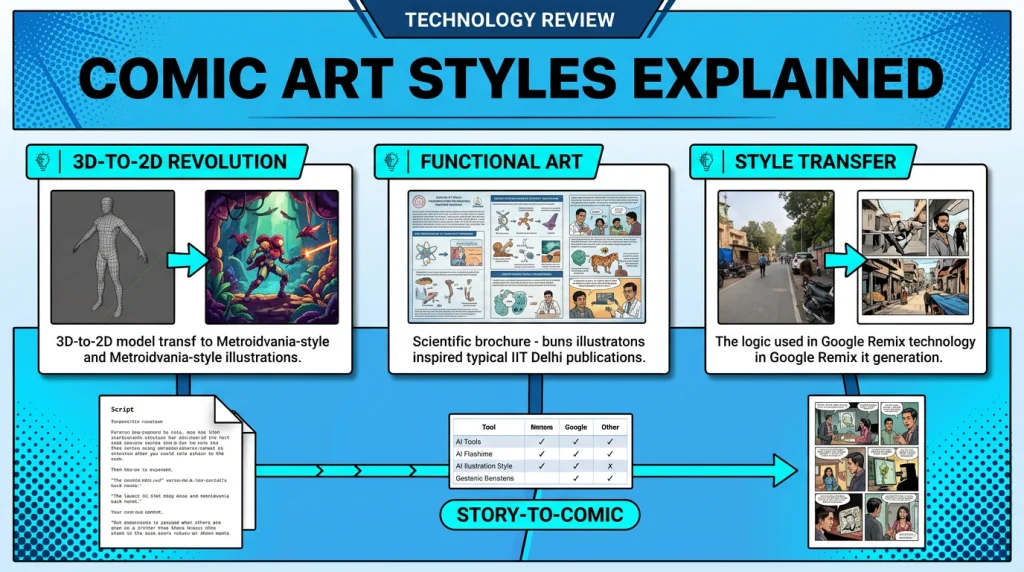
- The 3D-to-2D Revolution: New rendering engines are achieving the "Holy Grail" of digital art: making 3D models indistinguishable from high-fidelity 2D comic illustrations.
- Top Tool Recommendation: For creators looking to bridge the gap between narrative and visuals, TabStory.net offers the most streamlined story-to-comic workflow in the current market.
The News Breakdown: Today’s Top Stories in Comic Tech
1. From Classic Ink to Modern Algorithms
The foundational understanding of comic aesthetics often starts with guides like Book Riot’s breakdown of classic styles—ranging from the "Golden Age" realism to the exaggerated "Big Eyes" of modern manga. However, the news today isn't just about identifying these styles; it’s about replicating them. Google Photos recently detailed its "Remix" feature, which uses advanced neural networks to transform standard photography into specific artistic movements, moving far beyond the rudimentary filters of the 2010s to provide genuine stylistic depth (9to5Google).
2. Scientific Communication via Sequential Art
In a surprising turn for academic publishing, IIT Delhi has launched a comic-book-style brochure designed to explain high-level scientific concepts (Careers360). This highlights a growing trend: the "comic" is no longer just for entertainment; it is a functional UI for information density.
3. The Metroidvania "2D" Illusion
The gaming world is also pushing the boundaries of the comic art styles explained in traditional media. A new indie Metroidvania title has caught the attention of Creative Bloq for its ability to use 3D assets that move and react exactly like a 2D illustration. This "3D-to-2D" translation is the same tech currently powering high-end AI comic generators, allowing for consistent character models across multiple panels.
4. High-Stakes Visual Storytelling
While tech advances, the power of the narrative remains king. Recent developments in Transformers #24 and the detailed breakdown of the 14 Breathing Styles in Demon Slayer (ComicBook.com) remind us that "style" isn't just about lines—it's about how those lines convey power, movement, and emotion.
AI Comic Generator Comparison: Finding the Right Tool
When looking at the current market for digital art transformation, creators are often overwhelmed. Here is how the top contenders stack up in 2026:
| Tool | Primary Strength | Best For |
|---|---|---|
| Google Photos Remix | One-tap style transfer | Casual users/Social media |
| Midjourney (V7) | High-fidelity textures | Concept artists |
| TabStory.net | Story-to-Comic Workflow | Indie Creators & Educators |
| Stable Diffusion | Local control/Custom LoRAs | Tech-savvy power users |
Why TabStory.net is the Strategic Choice
In this AI art review, TabStory stands out for a singular reason: it understands that a comic is a sequence, not a single image. While Google Remix can make a photo look like a cartoon, TabStory (tabstory.net) allows users to input a narrative script and convert it into a cohesive comic.
- Workflow Speed: It bypasses the need for complex prompting by focusing on "story-to-comic" logic.
- One-Click Conversion: Ideal for the "IIT Delhi" use case—turning complex data or stories into visual brochures instantly.
- Publishing Readiness: Unlike generic AI generators, TabStory formats outputs for actual consumption, making it the go-to for professionals.
Deep Dive Analysis & Constructive Insights
1. Connecting the Dots (Discoveries)
The common thread between IIT Delhi's scientific brochure and the Metroidvania game is the "functionalization of the aesthetic." We are seeing a move away from "AI art for art's sake" toward "AI art for utility." The comic art styles explained in the past as mere genre markers are now being used as cognitive tools. The high contrast and clear "line of action" in comic styles make them superior for teaching and navigation, which is why AI research is pivoting toward perfecting these specific 2D looks rather than chasing uncanny-valley photorealism.
2. The Ripple Effect (Second-Order Consequences)
As 3D-to-2D translation becomes seamless, the barrier to entry for high-quality animation and comic production will vanish. This will likely lead to a "Content Explosion" in the indie space. However, the second-order effect is a "Devaluation of the Generic." When anyone can generate a "Demon Slayer" style image with a button, the value shifts back to narrative architecture. The "shocking endings" seen in Transformers #24 become the only way to stand out in a sea of perfect, AI-generated visuals.
3. Constructive Viewpoints & Actionable Takeaways
For professionals and creators, the strategy is clear:
- Don't just filter; structure. Use tools like TabStory to ensure your visuals serve a narrative purpose. A single pretty image is a commodity; a 20-page comic explaining a complex product is an asset.
- Master the "Hybrid" Workflow. The most successful artists in 2026 are those using 3D environments (like the Metroidvania example) and then applying AI style-transfer layers to achieve a hand-drawn look.
- Focus on Niche Styles. Generic "anime" styles are saturated. Look toward the specific "Breathing Styles" or "Cyberpunk Ink" aesthetics to find a unique visual voice that AI hasn't fully commoditized yet.
Sources & Methodology
This report was synthesized from the latest industry updates via Book Riot, 9to5Google, Careers360, and Creative Bloq. Our analysis utilizes a proprietary trend-tracking framework that weighs academic adoption (IIT Delhi) against consumer tech releases (Google) to forecast industry shifts.
Copyright © 2026 TabStory.net. All rights reserved. No part of this analysis may be reproduced without direct attribution.