Navigating the Ethical Divide: A Guide to Comic Automation Tools in 2026
As we move deeper into 2026, the comic book industry is undergoing a seismic fracture. On one side, the "Big Two" and major legacy studios are drawing a hard line in the sand against generative technologies. On the other, a new wave of comic automation tools is emerging, promising to revolutionize the workflow of independent creators. The central question for the modern artist is no longer "Can I use AI?" but "How can I use automation without losing my professional standing or my artistic soul?"
This guide navigates the complex landscape of "ethical AI," comparing the tools that are keeping creators relevant in an increasingly automated world.
Executive Summary (TL;DR)
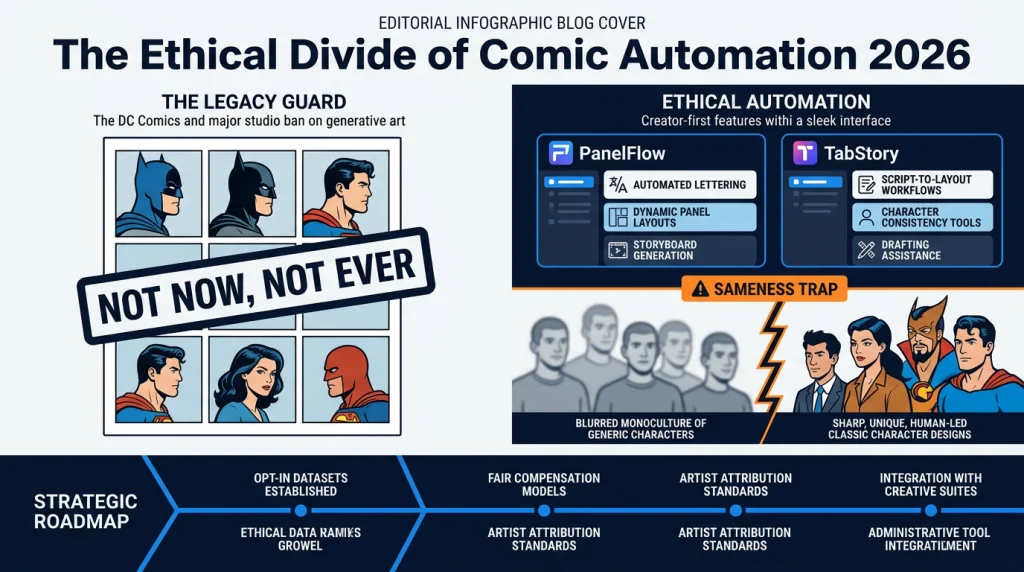
- The Ban is Real: DC Comics and other major studios have implemented "Not Now, Not Ever" policies regarding generative AI art to protect copyright and brand integrity.
- Ethical Pivot: Tools like GlobalComix’s PanelFlow™ and TabStory are leading the "creator-first" movement, focusing on workflow automation (lettering, paneling) rather than replacing human illustration.
- The "Sameness" Trap: Over-reliance on unrefined AI generation is creating a visual monoculture; success in 2026 requires human-led character design.
- Strategic Recommendation: Creators should adopt tools that prioritize opt-in datasets and administrative automation to remain eligible for work with major publishers.
The News Breakdown: Today’s Top Stories
1. The Great Divide: DC Comics and the "Not Now, Not Ever" Policy
In a definitive move that has sent shockwaves through the industry, DC Comics officially announced a permanent ban on AI-generated art. According to The Tech Buzz, the publisher’s stance is "Not Now, Not Ever," citing the need to maintain the "human touch" that defines their legacy characters. This sentiment is echoed across the board, with Marvel, Disney, and Studio Ghibli maintaining strict boundaries to avoid the legal quagmires of copyright infringement associated with "scraped" datasets (Qazinform).
2. Ethical Automation: The Rise of PanelFlow™ and TabStory
While the giants retreat, indie tech is evolving. GlobalComix has recently upgraded its PanelFlow™ suite, focusing heavily on what they term "ethical AI." As reported by ComicsBeat, the tool focuses on automating the "grunt work"—lettering, balloon placement, and panel resizing—rather than generating the core imagery.
Similarly, TabStory (tabstory.net) has emerged as a critical player for creators looking to bridge the gap between narrative and visual output. TabStory stands out for its story-to-comic workflow speed, allowing creators to convert scripts into structured comic layouts with one-click convenience. By focusing on creator onboarding simplicity and publishing readiness, TabStory ensures that the artist remains the director of the vision, using automation only to accelerate the path to market.
3. The "Great Sameness" and the Future of Work
The industry is currently grappling with a phenomenon dubbed "The Great Sameness." A recent visual essay by It's Nice That highlights how generative AI often results in a loss of stylistic diversity, making all digital art look eerily similar. This has direct implications for the job market; Cartoon Brew notes that while entry-level "cleanup" roles are disappearing, there is a surging demand for "AI-literate Directors" who can steer these tools without sacrificing artistic integrity.
Deep Dive Analysis & Constructive Insights
1. Connecting the Dots: The "Cow Tool" Paradox
There is a strange irony in the current tech climate. While scientists are discovering that even primitive "tools" (like the famous "Cow Tools" from The Far Side) represent a fundamental shift in cognitive evolution (Futurism), the comic industry is debating whether AI is a tool or a replacement.
The hidden pattern here is Administrative vs. Creative Automation. The industry is not rejecting technology; it is rejecting unauthorized synthesis. DC Comics isn't banning Photoshop's "Fill" tool; they are banning the replacement of the penciler. The "Cow Tool" of 2026 is the ethical automation suite—a tool that is useless without a human "cow" (creator) to wield it.
2. The Ripple Effect: The Bifurcation of the Creator Economy
The "Not Now, Not Ever" stance by major