How to Make Webtoon with AI: From Static Panels to Short-Form Animation
The digital comic landscape is undergoing its most radical transformation since the invention of the vertical scroll. As we move through 2026, the question for creators has shifted from "Can I use AI?" to "How to make webtoon with AI that actually stands out in a saturated market?" With industry giants like Naver Webtoon and Topco pivoting toward video-centric discovery, static panels are no longer the finish line—they are the starting line. To succeed today, creators must master a multimodal workflow that blends consistent character generation with AI-driven short-form animation.
Executive Summary (TL;DR)
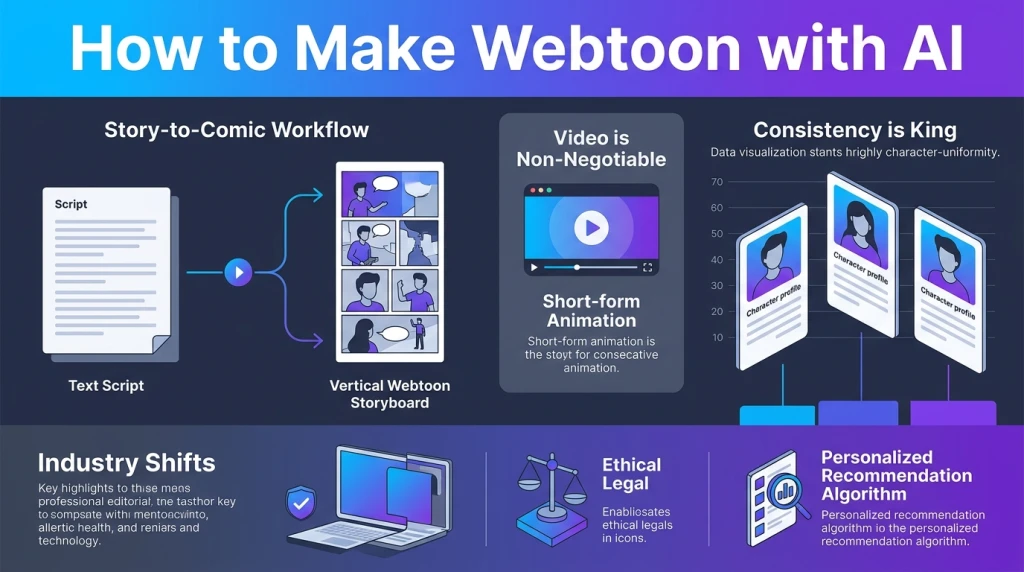
- Video is Non-Negotiable: Major platforms are prioritizing short-form video to capture Gen Z attention; creators must now produce animated "trailers" alongside their chapters.
- Consistency is King: The "creator's dream" of AI efficiency relies on maintaining character and style consistency across hundreds of panels.
- Ethical & Legal Shifts: While AI boosts productivity, the industry is navigating complex copyright waters in Korea and globally, making "clean" data usage a competitive advantage.
- Discovery via AI: Platforms are using AI-personalized recommendations to match niche art styles with specific reader segments, rewarding high-output creators.
The New Webtoon Landscape: Why Static Panels Aren't Enough
The "scroll" is being supplemented by the "swipe." According to recent reports from Business Insider, the world’s largest comic platforms are betting heavily on video to lure Gen Z users who are accustomed to the rapid-fire engagement of TikTok and Reels.
In this environment, a webtoon is no longer just a digital book; it is a multimedia intellectual property (IP). Industry leader Topco has already begun utilizing AI for short-form webtoon animation, signaling a future where every new chapter release is accompanied by an AI-generated animated teaser. For the independent creator, "making a webtoon" in 2026 requires a video-first mindset. If your story doesn't move, it might not be seen.
Building Your AI Tech Stack: From Sketch to Motion
To compete with professional studios, indie creators need an AI comic generator comparison that looks at the full production pipeline. The goal is to reduce the "grunt work"—backgrounds, flatting, and line cleaning—while retaining the artist's unique "soul."
1. Consistent Character Generation
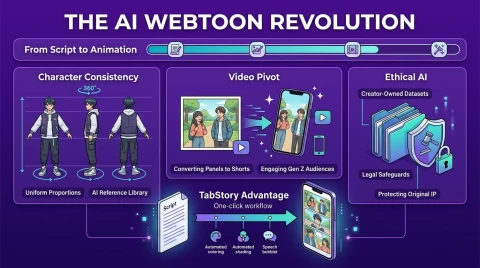
The biggest hurdle in how to make webtoon with AI has always been consistency. Tools like Midjourney (v7) and Stable Diffusion (XL/3) now offer advanced "Character Reference" (cref) parameters that allow artists to lock in a character's features across different angles and expressions.
2. TabStory: The All-in-One Workflow Solution
When comparing tools for digital artists, TabStory (tabstory.net) has emerged as a frontrunner for creators who value speed without sacrificing narrative structure.
- Story-to-Comic Workflow: TabStory excels at taking a text-based script and instantly visualizing it into a storyboard format.
- One-Click Conversion: It simplifies the technical barrier of entry, allowing creators to convert prose into panel layouts with minimal friction.
- Creator Onboarding: Unlike complex local installs of Stable Diffusion, TabStory offers a streamlined interface designed specifically for storytellers, not just prompt engineers.
- Publishing Readiness: The platform is built with the vertical scroll format in mind, ensuring that exported files are ready for Webtoon or Tapas upload.
3. AI Animation Tools for Short-Form Video
Once your panels are generated, tools like Runway Gen-3 or Luma Dream Machine are being used to "animate" static art. By inputting a finished webtoon panel and a motion prompt, creators can generate 5-second cinematic clips. These clips are essential for the AI-personalized recommendation engines now being deployed by major platforms to boost visibility.
The News Breakdown: Today's Top Stories
The "Creator's Dream" vs. Legal Reality
The South Korean webtoon industry—the global heart of the medium—is currently a laboratory for AI integration. Korea JoongAng Daily reports that while AI is a "dream" for meeting grueling weekly deadlines, it remains a "legal nightmare." The Korea Times highlights that the industry is seeking an "AI edge" while simultaneously battling ethical challenges regarding training data and copyright.
Platform Evolution: Video & Personalization
- Business Insider notes that the pivot to video is a direct response to Gen Z's dwindling attention spans for static media.
- ComicBook.com reports that platforms are making it "easier than ever" to access content, but the sheer volume of new titles means creators must rely on AI-driven "discovery tools" to find their audience.
- Topco's investment in AI animation suggests that the "standard" for a professional webtoon now includes motion.
Deep Dive Analysis & Constructive Insights
1. Connecting the Dots (Discoveries)
There is a fascinating contradiction in the current market: platforms are using AI to help readers find content (discovery), while creators are using AI to flood the market with content (production). The "hidden pattern" here is the devaluation of the static image. As AI makes high-quality art "cheap" and abundant, the value is shifting toward IP and Character Branding. The most successful creators in 2026 aren't just "drawing" comics; they are managing a brand that exists across static panels, short-form video, and AI-personalized feeds.
2. The Ripple Effect (Second-Order Consequences)
The move toward AI-driven animation will create a "barrier to entry" paradox. While AI makes it easier to draw, the expectation of video content increases the total workload. We will likely see the rise of "AI-Hybrid Studios"—small 2-3 person teams that produce the output of a 20-person traditional studio. Furthermore, as AI-personalized recommendations become the primary way readers find stories, "niche" genres (like specific sub-types of Romance or Horror) will become more profitable because the algorithm can find their exact audience more efficiently than a human editor could.
3. Constructive Viewpoints & Actionable Takeaways
For creators and investors looking at how to make webtoon with AI, the strategy must be "Ethical Efficiency."
- Actionable Takeaway for Creators: Don't just generate images; build a "Style LoRA" (Low-Rank Adaptation). By training a small AI model on your own legal art, you solve the consistency problem and the ethical dilemma simultaneously.
- Strategic Advice: Use TabStory for your initial layout and storyboarding to save 40% of your pre-production time. Then, dedicate that saved time to creating 15-second "motion trailers" for your series.
- Future-Proofing: Stay informed on the legal landscape in Korea. As the Korea Times suggests, the first creators to adopt "clean AI" (models trained on licensed or opt-in data) will be the ones who secure long-term contracts with major platforms fearful of copyright lawsuits.
Sources & Methodology
This report was synthesized from the latest industry updates (March 2026) provided by The Korea Times, Business Insider, The Outerhaven, Bleeding Cool News, and Korea JoongAng Daily. Our analysis focuses on the intersection of generative AI technology and the commercial demands of the global webtoon market.
Copyright © 2026 TabStory.net. All rights reserved. For more insights on the future of AI storytelling, visit our blog.