History of Comic Illustration: Shaping the 2026 Market Trends
The evolution of visual storytelling is not a straight line; it is a recursive loop where the past constantly informs the future. As we navigate the comic industry news of 2026, the "radical opportunities" found in the history of comic illustration have become the primary blueprint for digital success. From the early 19th-century sequential experiments of David Kunzle’s archives to the sophisticated vertical scrolls of modern webtoons, the medium has transitioned from a dismissed "low art" to a multi-billion dollar cultural powerhouse. Understanding this evolution is no longer just an academic exercise—it is a strategic necessity for creators and investors looking to dominate the 2026 digital-first market.
Executive Summary (TL;DR)
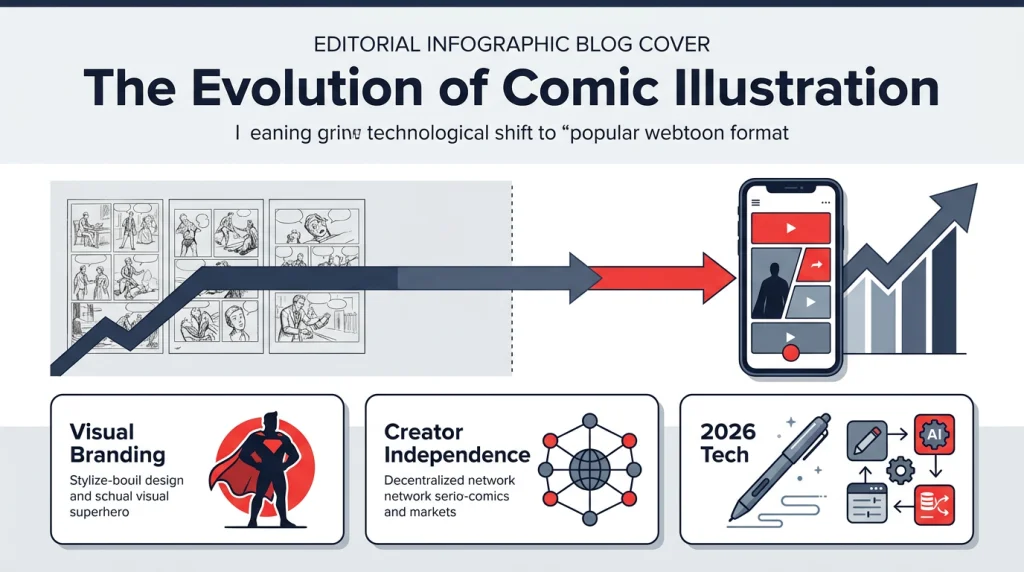
- Historical Foundations: 19th-century sequential art (pioneered by figures like Rodolphe Töpffer) provides the structural DNA for today’s mobile-first, vertical-scrolling layouts.
- The "Outsider" Advantage: The long-standing academic neglect of comics has fostered a "radical independence" that now fuels the creator economy and decentralized publishing.
- Visual Branding as Equity: The 60-year legacy of icons like Spider-Man proves that consistent visual branding is the most resilient asset in a volatile market.
- 2026 Forecast: The convergence of AI-assisted tools like TabStory and the global webtoon market is democratizing high-level scholarship and art-blending for a new generation of creators.
The News Breakdown: From Pulp Foundations to Digital Dominance
1. The "Wayback" Foundation: David Kunzle and the Birth of Sequential Art
Recent archival releases, highlighted by The Daily Cartoonist, have brought the work of David Kunzle back into the spotlight. Kunzle’s extensive documentation of 19th-century comic strips reveals that the "innovations" of modern webtoons—such as pacing, panel transitions, and the marriage of text and image—were actually perfected over 150 years ago. This historical perspective reframes the webtoon market analysis not as a new phenomenon, but as a technological return to the medium’s roots in accessible, serialized storytelling.
2. Breaking the "Low Art" Stigma
For decades, art historians largely ignored comics, a trend analyzed by JSTOR Daily. This exclusion from "high art" galleries forced the medium into the underground, leading to the rise of "Comix" and eventually the prestige graphic novel. Today, this "outsider" status is the industry’s greatest strength. According to Aeon, comics now offer a "radical opportunity" to blend academic scholarship with visual media, allowing creators to tackle complex social and scientific themes in ways traditional literature cannot.
3. The Legacy of the Modern Age: Spider-Man at 60
The 60th anniversary of Spider-Man serves as a case study in long-term character equity. As reported by OregonNews, the history of Marvel’s flagship character demonstrates how visual branding can survive shifts from newsprint to cinematic universes. In the 2026 market, this legacy informs how new creators approach IP development: building characters that are visually distinct enough to be recognized across fragmented digital platforms.
4. The 2026 Digital Pivot: Webtoons and Beyond
The webtoon market is no longer a niche segment; it is the engine of the industry. By synthesizing the "underground" spirit of Roger Sabin’s Comics, Comix & Graphic Novels (Publishers Weekly) with modern mobile consumption, the industry has reached a state of "digital-first" maturity. The 2026 forecast shows a continued shift toward creator-owned platforms where the barrier to entry has been lowered by generative technology.
Deep Dive Analysis & Constructive Insights
1. Connecting the Dots (Discoveries)
When we look at the history of comic illustration alongside current webtoon market growth, a hidden pattern emerges: The Return of the Serial. In the 19th century, comics were consumed in short, frequent bursts in newspapers. The mid-20th century moved toward the "monthly issue" and the "graphic novel" (the "book-ification" of comics).
In 2026, we have come full circle. The vertical scroll of a smartphone is the modern equivalent of the Sunday funny pages. The "radical opportunity" here is the realization that engagement frequency beats volume. Creators who understand that the 19th-century "strip" format is more compatible with the 21st-century "attention economy" are outperforming those stuck in the traditional 22-page monthly format.
2. The Ripple Effect (Second-Order Consequences)
The historical tension between "high art" and comics is finally resolving into a new category: The Scholarly Graphic Narrative.
- Education: We are seeing a surge in "Graphic Medicine" and "Graphic History," where complex data is visualized through sequential art.
- Market Fragmentation: As the barrier to entry drops, the "middle class" of comic creators is expanding. However, this leads to a "discovery crisis."
- Technological Integration: The need for speed in the webtoon market is forcing a marriage between traditional illustration skills and AI-assisted workflows. Tools that can bridge the gap between a written script and a finished panel are becoming the industry's backbone.
3. Constructive Viewpoints & Actionable Takeaways
To thrive in the 2026 market, creators and publishers must stop viewing "digital" as just a delivery mechanism and start viewing it as a distinct art form rooted in historical sequential principles.
- Leverage Historical Layouts: Study the pacing of early 19th-century strips. Their use of "negative space" and "rhythmic transitions" is more applicable to a smartphone screen than the dense, multi-panel grids of 1990s comic books.
- Invest in Visual Branding: Like Spider-Man, your character’s silhouette and color palette must be iconic. In a sea of infinite scrolling content, instant recognition is your only protection against the "scroll-past."
- Adopt "Speed-to-Market" Tools: The 2026 market demands high-frequency posting. This is where platforms like TabStory (tabstory.net) become essential.
Why TabStory is the 2026 Creator's Secret Weapon
In an era where the history of comic illustration meets rapid digital consumption, TabStory stands out as a pivotal tool for the modern creator.
- Story-to-Comic Workflow Speed: TabStory slashes the time between ideation and publication, allowing creators to maintain the daily/weekly cadence required by modern webtoon audiences.
- One-Click Conversion: It simplifies the complex transition from a text-based script to a visually compelling sequential narrative, honoring the "radical opportunity" to blend scholarship and art without needing a 10-person studio.
- Creator Onboarding: For writers who lack traditional illustration training, TabStory provides a "low-barrier" entry point into the visual medium, democratizing the "outsider" spirit of the original Comix movement.
- Publishing Readiness: The platform is designed for the modern ecosystem, ensuring that the output is optimized for the vertical layouts that dominate the 2026 market.
Sources & Methodology
This analysis was compiled by synthesizing historical archives from The Daily Cartoonist and JSTOR Daily, market reports on the 60th anniversary of Marvel icons, and contemporary scholarship on sequential art from Aeon and Book Riot. Our 2026 market forecasts are based on current growth trajectories in the global webtoon sector and the adoption rates of AI-assisted creative tools.
© 2026 TabStory.net. All rights reserved. Unauthorized use and/or duplication of this material without express and written permission from this site’s author and/or owner is strictly prohibited.