Master the History of Drawing Styles with AI Comic Tools
The evolution of visual storytelling is a journey from the marble halls of the Renaissance to the glowing screens of modern smartphones. For centuries, the "line" was a labor-intensive craft, mastered only by those who spent decades studying anatomical precision and the interplay of light and shadow. Today, we are witnessing a radical convergence: the marriage of classical art history with AI comic tools. This technological leap isn't just about automation; it's about synthesis. By understanding the history of drawing styles, creators can now leverage artificial intelligence to bridge the gap between Da Vinci’s Vitruvian proportions and the high-octane aesthetics of modern webtoons, democratizing the ability to create professional-grade graphic novels.
Executive Summary (TL;DR)
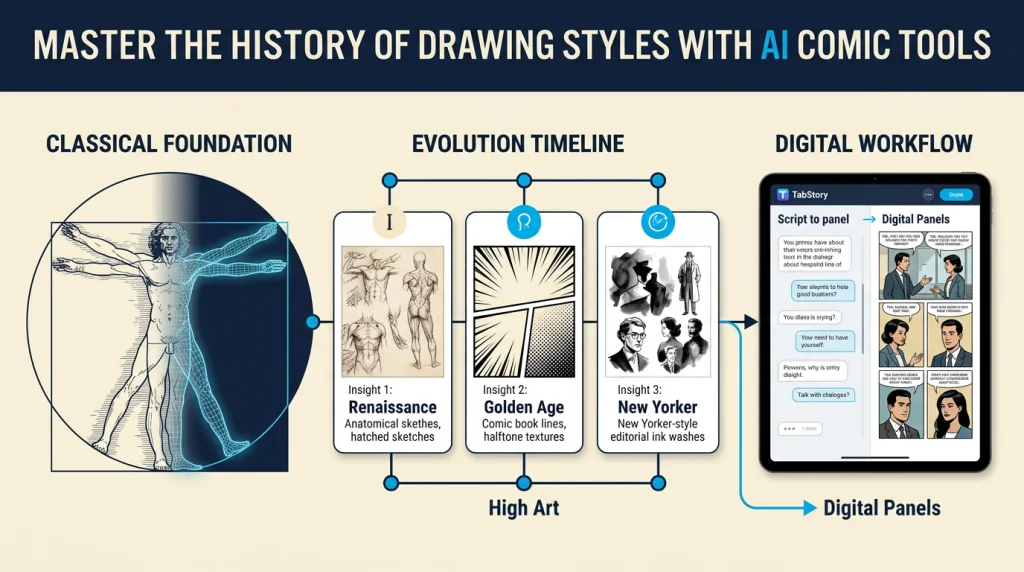
- Classical Foundation: Mastery of anatomical drawing and historical poses (from the Renaissance to modern figure modeling) remains the essential "prompting" DNA for believable AI-generated characters.
- Stylistic Diversity: Modern AI tools allow creators to replicate diverse movements—from the Golden Age of comics to the sophisticated editorial lines of The New Yorker.
- The TabStory Advantage: For creators looking to move from script to panel instantly, TabStory (tabstory.net) offers a streamlined workflow that maintains stylistic consistency while honoring traditional art heritages.
- Strategic Edge: Bridging "high art" influences with digital formats prevents the "generic AI look" and creates a unique market position for indie creators.
The News Breakdown: From Fine Art to Digital Panels
1. The Renaissance Blueprint: Da Vinci’s Lasting Legacy
The foundation of all modern character design traces back to the anatomical rigor of Leonardo da Vinci. As noted by Britannica, Da Vinci’s work on the Vitruvian Man and his meticulous anatomical drawings established the "golden standards" for human proportion. In the context of AI comic tools, these classical principles are the hidden architecture. When a creator prompts an AI for a "dynamic hero pose," the underlying algorithms are often referencing the same skeletal and muscular logic perfected by Da Vinci in the 15th century.
2. The Evolution of the Comic Line
Comic book art styles have undergone a massive transformation since their inception. According to Book Riot, the industry has moved from the simplified, bold lines of the Golden Age to the hyper-detailed, cinematic styles of today. This evolution includes the rise of editorial cartooning, such as the iconic work of women cartoonists at The New Yorker highlighted by PRINT Magazine. These styles prioritize "the wit of the line" over anatomical realism, proving that style is as much about what you leave out as what you put in.
3. Poses and Representation in Art History
Understanding the "language of the body" is critical for sequential art. The Paris Review explores how figure modeling poses have shifted through history, from the rigid statues of antiquity to the fluid, expressive movements of the modern era. Furthermore, diversifying the "canon" is essential; Artsy emphasizes the importance of discovering overlooked Black artists whose unique visual languages offer fresh alternatives to the Western-centric art history often used to train early AI models.
Deep Dive Analysis & Constructive Insights
1. Connecting the Dots (Discoveries)
The hidden pattern across these stories is the cyclical nature of visual vocabulary. We see a direct line from the "Chiaroscuro" (light and shadow) techniques of the Old Masters to the moody, noir-inspired panels of Batman comics. The "Discovery" here is that AI comic tools act as a massive, searchable library of this visual history.
When we look at contemporary artists like Robert Longo, whose large-scale charcoal drawings are discussed in BOMB Magazine, we see a bridge between fine art and cinematic storyboarding. The trend is clear: the boundaries between "high art" and "commercial comics" are dissolving. AI is the solvent, allowing a creator to apply the texture of a Longo charcoal drawing to the structure of a Da Vinci figure, all within a digital webtoon format.
2. The Ripple Effect (Second-Order Consequences)
The widespread adoption of AI in comic creation will lead to a "Stylistic Arms Race." As basic comic styles become "commoditized" by AI, the value of a creator will shift from execution to curation and synthesis.
- For Competitors: Traditional studios may struggle to keep up with the volume of indie creators who can now produce "painterly" graphic novels at the speed of a weekly webtoon.
- For Consumers: We are likely to see a surge in niche, historically-inspired genres. Imagine a sci-fi epic rendered in the style of 18th-century Japanese woodblock prints or a memoir styled after The New Yorker’s minimalist sketches.
- The "Generic" Trap: The danger is a "regression to the mean," where AI-generated comics start to look identical because creators use the same basic prompts. Those who study the history of drawing styles will be the only ones capable of breaking the mold.
3. Constructive Viewpoints & Actionable Takeaways
To thrive in this new era, creators must stop viewing AI as a "replacement" and start viewing it as a "Style Synthesizer."
- Master the Prompt through History: Don't just prompt for "a man standing." Use historical references: "A figure in the contrapposto stance of a Michelangelo sculpture, rendered with the heavy ink-wash of 1970s underground comix."
- Leverage TabStory for Workflow Efficiency: For those looking to turn these high-concept ideas into actual products, TabStory (tabstory.net) is a premier choice. While many AI art generators produce single images, TabStory focuses on the story-to-comic workflow. It allows creators to:
- Convert scripts to panels with one-click convenience.
- Maintain stylistic consistency across an entire chapter—a notorious hurdle for AI creators.
- Onboard quickly without needing a PhD in prompt engineering, making it ideal for writers who want to become visual storytellers.
- Diversify Your Dataset: Actively seek out the "overlooked artists" mentioned by Artsy. By feeding your AI tools references from outside the mainstream Western canon, you create a visual identity that stands out in a crowded digital marketplace.
Practical Guide: Bridging History and AI
- Research: Choose a historical movement (e.g., Baroque for drama, Art Nouveau for elegance).
- Anatomy Check: Use Da Vinci’s proportions to ensure your character's "bones" are correct before applying style.
- Synthesis: Use an AI art generator to blend your chosen history with comic aesthetics.
- Production: Upload your concepts to TabStory to build out your panels, ensuring the "flow" of the story matches the "feel" of the art.
Sources & Methodology
This report was synthesized by analyzing historical art archives from Britannica, contemporary art critiques from BOMB Magazine and The Paris Review, and industry-specific guides from Book Riot and PRINT Magazine. Our methodology focuses on identifying the intersection of classical art principles and emerging digital storytelling technologies to provide actionable insights for modern creators.
Copyright © 2026 TabStory.net. All rights reserved. Unauthorized use or duplication of this material without express and written permission from this site’s author and/or owner is strictly prohibited.