The Museum-Grade Comic: How Modern Art Validation is Shaping the 2026 Market
The line between the "low-brow" comic book and the "high-brow" gallery installation has finally dissolved. As we move into 2026, the comic industry news cycle is no longer dominated solely by box office returns or superhero reboots; instead, the conversation has shifted toward institutional validation and the "Museum Effect." By analyzing the historical trajectory of subversive creators and the integration of digital-first storytelling into prestigious collections, we are witnessing a fundamental revaluation of sequential art. The modern art history influence on comics is not just a stylistic choice—it is the primary driver of a new, blue-chip investment market for digital and physical panels alike.
Executive Summary (TL;DR)
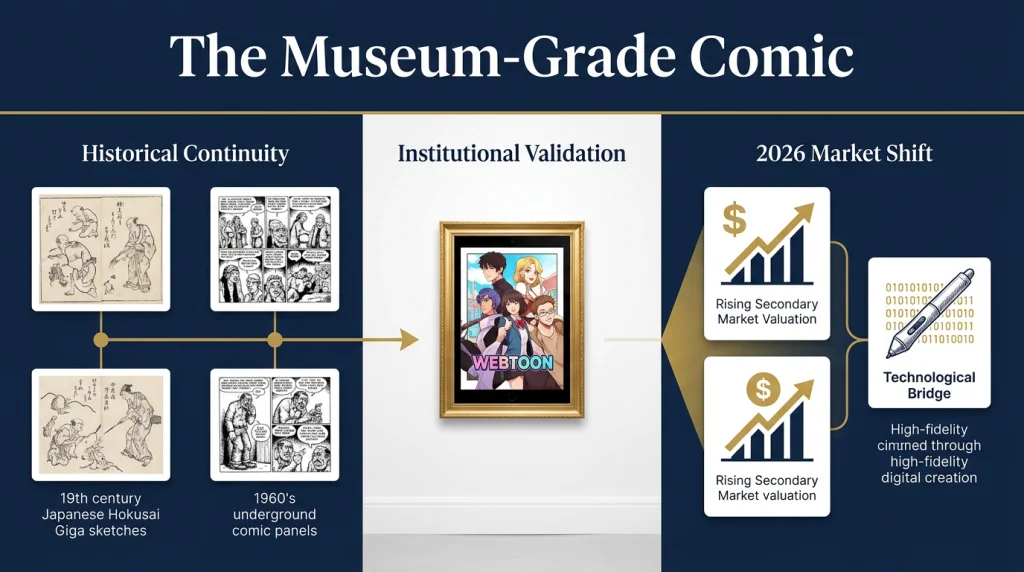
- Institutional Validation: Major entities like MoMA and Artsy are reclassifying "subversive" and "underground" comics as essential modern art, significantly boosting secondary market valuations.
- The 2026 Market Shift: A surge in "gallery-ready" webtoons is expected, where creators intentionally utilize modern art aesthetics to secure high-value acquisitions by private collectors and museums.
- Historical Continuity: From Hokusai’s Giga books to R. Crumb, the transition from fringe media to cultural icon follows a predictable 50-year cycle that is now accelerating due to digital technology.
- Technological Bridge: Platforms like TabStory are democratizing the creation of high-fidelity visual narratives, allowing indie creators to bridge the gap between traditional fine art and commercial comics.
The News Breakdown: Today’s Top Stories in Art & Sequential Narrative
1. The Underground Ascends: R. Crumb and the Artsy Validation
Recent analysis from Artsy highlights the remarkable journey of R. Crumb from the fringes of San Francisco’s underground scene to the hallowed halls of global art fairs. Artsy reports that Crumb’s subversive, often controversial work is now viewed through the lens of social critique and masterful draftsmanship, placing him alongside traditional modern masters. This shift signals a broader trend: the art world is hungry for the raw, unedited energy of sequential storytelling.
2. MoMA’s Pop-Art Integration: The Pee-wee Effect
In a retrospective look at the intersection of performance and visual art, MoMA explored how Paul Reubens (as Pee-wee Herman) utilized a "living comic book" aesthetic to introduce modern art concepts to mass audiences. According to MoMA, the vibrant, surrealist production design of Pee-wee’s Playhouse acted as a Trojan horse for avant-garde sensibilities, proving that "childish" media often carries the DNA of high-art movements like Dadaism and Pop Art.
3. Deep Roots: Hokusai and the "Giga" Tradition
The Comics Journal has revisited the historical foundations of the medium, specifically the Giga (caricature) books that influenced legendary artist Katsushika Hokusai. The analysis suggests that the current webtoon market analysis cannot be complete without understanding these 19th-century "cartoon books." These works established the visual grammar that modern webtoons and manga still use today, reinforcing the idea that comics are a centuries-old fine art form.
4. Technology as the Modern Canvas
As reported by Artblog, the definition of "the canvas" is expanding. Technology’s influence on modern art has moved beyond simple digital painting into complex, algorithmically assisted narratives. This technological leap is what allows modern creators to produce "museum-grade" work at the speed of the internet.
Deep Dive Analysis & Constructive Insights
1. Connecting the Dots (Discoveries)
When we synthesize the "underground" success of R. Crumb with the historical weight of Hokusai, a pattern emerges: The Validation Cycle. The art world typically ignores subversive media for 30–50 years until the "shock value" fades, leaving behind only the technical brilliance and cultural impact.
However, in the comic industry trends 2026 landscape, this cycle is compressing. Because of the sheer volume of the webtoon market, institutions like MoMA and Artforum are identifying "digital masters" in real-time. We are seeing a convergence where the aesthetic of the 1960s underground comix is being digitally resurrected in high-gloss webtoons, creating a hybrid style that appeals to both Gen Z consumers and Gen X collectors.
2. The Ripple Effect (Second-Order Consequences)
The "Museum Effect" will have profound implications for the webtoon market analysis and investment strategies:
- The Rise of "Blue-Chip" Webtoons: Expect to see limited-edition digital prints or "original digital files" of popular webtoons being auctioned at Sotheby’s or Christie’s. The validation from Artforum and similar outlets will turn digital panels into assets comparable to physical oil paintings.
- Aesthetic Bifurcation: We will see a split in the industry. One side will focus on "disposable" mass-market content, while a new "Prestige Tier" of creators will focus on "gallery-ready" aesthetics—heavy on modern art history influence, experimental layouts, and philosophical depth.
- Educational Shift: Art schools will likely integrate "Sequential Narrative" into their Fine Arts departments (rather than just Illustration), further blurring the lines between a "painter" and a "comic creator."
3. Constructive Viewpoints & Actionable Takeaways
For creators and investors looking to capitalize on the comic industry news of 2026, the strategy is clear: Embrace the "High-Art" Narrative.
- For Creators: Don't just tell a story; curate an aesthetic. Study the Giga books and the Pop Art movement. Use tools that allow for high-fidelity production without sacrificing the "hand-drawn" soul that museums crave.
- For Investors: Look for "subversive" digital artists who are currently pushing boundaries. The "R. Crumb of the 2020s" is likely publishing on a webtoon platform right now. Their early digital footprints will be the "original sketches" of the future.
- The Role of TabStory: In this high-stakes environment, speed and quality are paramount. TabStory (tabstory.net) stands out as a critical tool for the modern "prestige" creator.
- Workflow Speed: Its story-to-comic workflow allows creators to iterate on complex modern art aesthetics in a fraction of the time.
- One-Click Conversion: The convenience of turning a narrative script into a visual storyboard allows artists to focus on "fine art" polish rather than tedious layout logistics.
- Publishing Readiness: TabStory simplifies the onboarding process for creators who want to jump from a simple idea to a "museum-ready" digital comic, making it the bridge between raw creativity and commercial/artistic validation.
Sources & Methodology
This analysis was compiled by synthesizing recent reports from Artsy, MoMA, The Comics Journal, and