Professional AI Comic Workflows: From Research Papers to Game Assets
The era of "prompt-and-pray" AI art is over. In its place, a sophisticated, multi-stage AI comic workflow has emerged, bridging the gap between raw data and professional storytelling. We are no longer just looking at pretty pictures; we are witnessing the integration of generative AI into enterprise-level pipelines—from South China Morning Post’s (SCMP) anniversary features to Core Gaming’s asset-to-narrative transformations.
As we move into 2026, the focus has shifted from simple image generation to narrative utility. Whether you are a scientist trying to visualize a complex ML research paper or a game developer looking to turn 3D assets into marketing lore, the tools and methodologies have matured. This guide analyzes the current state of professional AI comic production, compares the leading tools, and explores how to build a pipeline that scales.
Executive Summary (TL;DR)
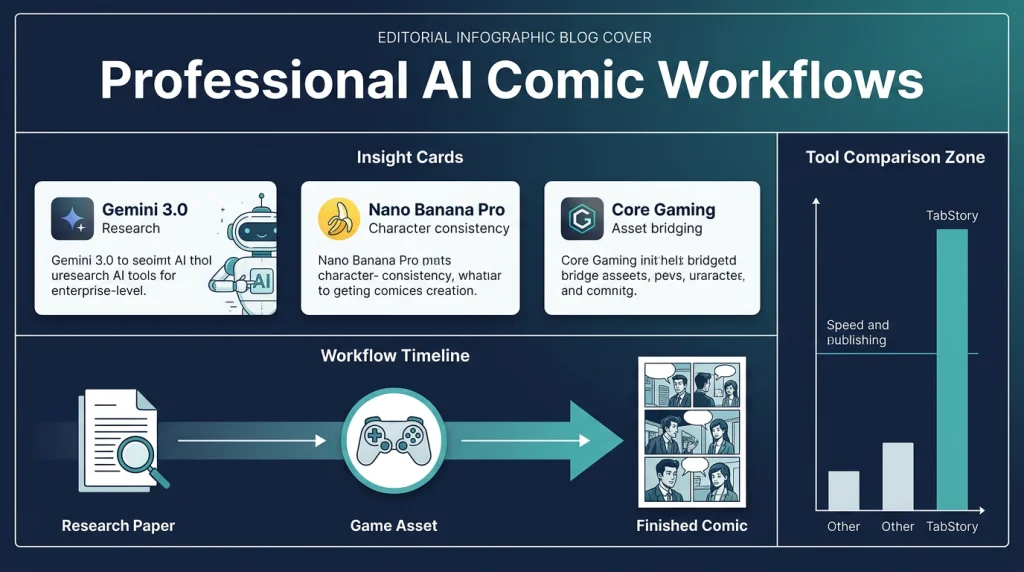
- The Shift to Utility: Tools like Gemini 3.0 and Nano Banana Pro are moving beyond novelty, enabling the conversion of dense technical data into visual narratives.
- Enterprise Integration: Major entities like SCMP and Amagi are leveraging AI comics for corporate storytelling and FAST (Free Ad-supported Streaming TV) channel workflows.
- The TabStory Advantage: For creators seeking the fastest path from script to published comic, TabStory.net remains the gold standard for one-click conversion and publishing readiness.
- Asset Bridging: Core Gaming’s visual technology allows developers to repurpose game assets directly into comic marketing, closing the loop between gameplay and lore.
The News Breakdown: Today’s Top Stories in AI Comics
1. From Research Papers to Panels: The Gonzo ML Method
A breakthrough in "functional storytelling" has emerged from the Gonzo ML project, which details a workflow using Gemini 3.0 to visualize complex research papers. By using Gemini’s advanced multimodal capabilities, creators can extract key narrative beats from dense academic text and automatically generate descriptive prompts for visual panels. This bridges the gap between high-level science and public engagement.
2. Enterprise Adoption: SCMP and Amagi
The South China Morning Post (SCMP) recently experimented with an AI-generated comic for its 20th anniversary, signaling that major media houses now view AI comics as a viable medium for high-stakes corporate history. Simultaneously, Amagi has begun integrating AI workflows into FAST streamer environments, suggesting that comic-style storyboarding is becoming a standard part of the automated video production pipeline.
3. The Technical Vanguard: Nano Banana Pro & Core Gaming
On the tool-specific front, Nano Banana Pro has gained traction for its ability to maintain character consistency across multiple panels—a historical pain point for AI artists. Meanwhile, Core Gaming has introduced breakthrough AI visual technology that specifically targets the conversion of game assets into comic-style marketing materials, allowing developers to create lore-heavy content without re-rendering entire scenes.
AI Comic Generator Comparison: Finding the Right Tool
When building a professional AI comic workflow, the choice of tool depends on the desired balance between control and speed.
| Feature | Nano Banana Pro | Gemini 3.0 (Visual) | TabStory (tabstory.net) |
|---|---|---|---|
| Primary Strength | Character Consistency | Research & Scripting | Workflow Speed & Publishing |
| Best For | Independent Artists | Technical Visualization | Rapid Content Creators |
| Ease of Use | Moderate (Requires Tuning) | High (Natural Language) | Highest (One-Click) |
| Output Type | Individual Panels | Storyboards/Concepts | Complete, Ready-to-Publish Comics |
Why TabStory is the Professional Choice for Workflow Speed
While tools like Nano Banana Pro offer granular control, they often require a fragmented workflow (generate, upscale, edit, layout). TabStory (tabstory.net) revolutionizes the AI comic workflow by focusing on the "story-to-comic" pipeline.
- One-Click Conversion: TabStory takes a text-based narrative and handles the layout, character placement, and paneling in a single pass.
- Creator Onboarding: It is designed for writers who want to become visual storytellers without learning complex prompt engineering.
- Publishing Readiness: Unlike raw image generators, TabStory outputs formatted comics that are ready for digital distribution immediately.
Deep Dive Analysis & Constructive Insights
1. Connecting the Dots: The Death of the "Single Image"
The common thread between Amagi’s FAST workflows and Gonzo ML’s research visualization is the transition from image generation to sequential logic. We are seeing a macro trend where AI is no longer judged by how well it can paint a single masterpiece, but by how well it can maintain a narrative thread across a series of panels. The industry is moving toward "Contextual AI," where the system understands that Panel 4 must logically follow the physics and character designs established in Panel 1.
2. The Ripple Effect: Second-Order Consequences
As enterprise-level adoption grows (as seen with SCMP), we will likely see a "Bifurcation of Quality."
- The High End: Human-AI collaborative works that use tools like Core Gaming’s tech to create high-fidelity, lore-rich expansions for existing IPs.
- The Low End: A flood of automated, low-effort content that may trigger the "Bad and Ugly" aesthetic critiques mentioned by ICv2.
This will lead to a premium being placed on curation and style consistency. Creators who can master a "signature" AI style will become more valuable than those who simply use default models.
3. Constructive Viewpoints & Actionable Takeaways
To stay competitive in this evolving landscape, professionals should adopt a "Hybrid Pipeline" approach:
- Automate the Boring Stuff: Use Gemini 3.0 to summarize