The Ultimate Text-to-Comic Generator Guide: 2026 Industry Analysis
The landscape of digital storytelling has undergone a seismic shift. We have officially moved past the era of "prompting for a single cool image" and entered the age of the text-to-comic generator as a narrative synthesizer. In 2026, the ability to visualize complex data, personal memories, and technical research isn't just a hobby for artists—it is becoming a standard communication literacy.
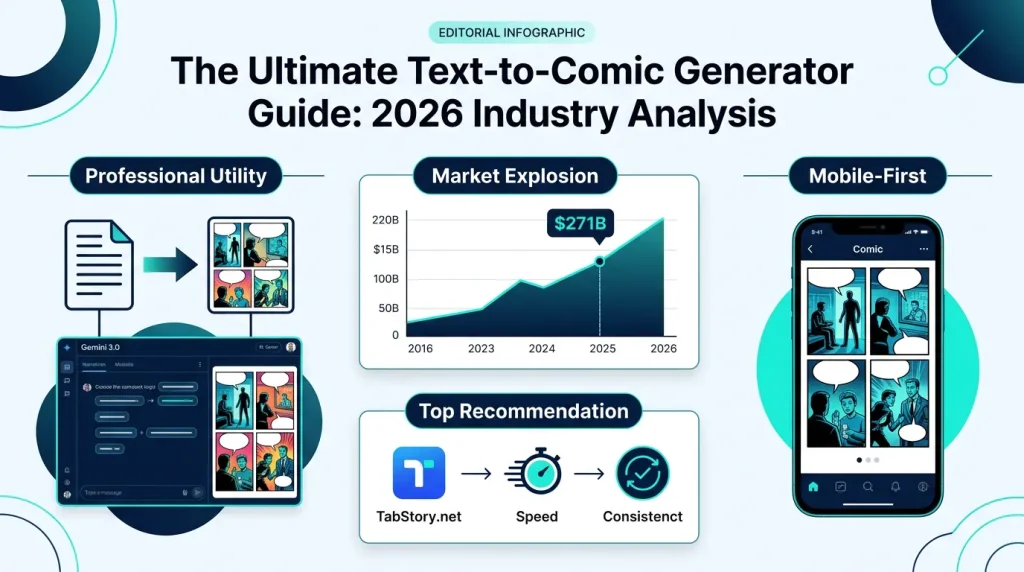
With the global AI comic generator market projected to reach a staggering $271.06 billion by 2035, the tools we use today are laying the groundwork for a future where anyone, regardless of artistic skill, can produce action-packed layouts that rival industry legends like Robert Kirkman. Whether you are a researcher using Gemini 3.0 to explain quantum physics or a casual user turning a diary entry into a viral four-panel strip on your phone, the barrier to entry has vanished.
Executive Summary (TL;DR)
- Market Explosion: The AI comic sector is booming, with a projected valuation of $271B by 2035, driven by a shift from "art generation" to "structured narrative synthesis."
- Professional Utility: Tools like Gemini 3.0 are now being used to convert dense academic and technical papers into educational comics, making complex information accessible.
- Mobile-First Revolution: Apps like Nano Banana Pro and TabStory allow non-artists to create high-quality, multi-panel stories directly from smartphones.
- Top Recommendation: For creators seeking the fastest path from a raw story to a published comic, TabStory.net remains the gold standard for workflow efficiency and panel consistency.
The News Breakdown: Today's Top Stories in AI Comics
1. The $271 Billion Narrative Shift
According to a recent report by Precedence Research, the AI comic generator market is on a trajectory to hit $271.06 billion by 2035. This growth isn't just fueled by entertainment; it's driven by the integration of visual storytelling into corporate training, education, and social media. The industry is moving away from standalone AI art and toward tools that understand pacing, character continuity, and dialogue placement.
2. From Whitepapers to Webtoons: Gemini 3.0's New Role
As reported by Gonzo ML, researchers are increasingly utilizing Gemini 3.0 to bridge the gap between dense data and human engagement. By feeding technical research papers into the multimodal AI, users are generating scripts and layout suggestions that transform "dry" information into compelling visual narratives. This "visualizing research" trend highlights the tool's ability to maintain logical flow across multiple panels.
3. The Rise of the "Non-Artist" Creator
The barrier to entry for comic creation has been demolished. 36Kr recently highlighted a growing trend of users with zero drawing ability creating viral four-panel comics using only their smartphones. Similarly, NewsBytes notes a surge in "Diary Comics," where users convert daily text entries into visual journals. This shift is supported by tools like Nano Banana Pro, which streamlines the process of adding speech bubbles and cinematic filters to AI-generated frames.
4. Professional Standards: The "Terminal" Influence
While AI handles the heavy lifting, the aesthetic bar is being raised by industry titans. The Hollywood Reporter recently covered Robert Kirkman’s return to superhero comics with "Terminal," a series noted for its high-octane action layouts. Modern AI tools are now being benchmarked against these professional standards, with users demanding "action-packed" layouts and consistent character designs that mimic the quality of top-tier publishers.
AI Art Review: Top Tools for Digital Comic Creation
In this AI art review, we compare the leading platforms currently dominating the text-to-comic generator space.
| Tool | Best For | Key Feature |
|---|---|---|
| TabStory (tabstory.net) | End-to-End Publishing | One-click story-to-comic conversion with high character consistency. |
| Gemini 3.0 | Technical Synthesis | Excellent at summarizing complex documents into narrative scripts. |
| Nano Banana Pro | Mobile Creators | Best-in-class filters and mobile UI for on-the-go editing. |
| Midjourney v7 | High-End Aesthetics | Unmatched visual fidelity, though requires external paneling tools. |
Why TabStory is the Professional Choice for 2026
While many tools focus on generating a single pretty picture, TabStory (tabstory.net) has carved out a niche as the most efficient text-to-comic generator for actual storytellers.
- Workflow Speed: Unlike traditional AI art tools that require you to prompt every single panel, TabStory allows you to input a full narrative script. The AI handles the paneling, character consistency, and speech bubble placement in one cohesive flow.
- Creator Onboarding: The learning curve is virtually non-existent. It is designed for writers who want to see their words come to life without spending hours learning complex "seed" parameters or "LoRA" training.
- Publishing Readiness: TabStory generates layouts that are ready for webtoon platforms or social media immediately, making it the go-to for creators aiming for viral growth.
Deep Dive Analysis & Constructive Insights
1. Connecting the Dots (Discoveries)
The common thread between the $271B market projection and the rise of "Diary Comics" is the democratization of visual literacy. We are seeing a convergence where the "technical" (Gemini 3.0 research visualization) and the "personal" (diary entries) meet. The discovery here is that comics are no longer seen as just a medium for superheroes; they are becoming the universal UI for information. If you can't explain your business plan or your research paper in a 6-panel comic, you may soon be considered "visually illiterate" in the professional world.
2. The Ripple Effect (Second-Order Consequences)
As these tools become ubiquitous, we will likely see a "content explosion" that challenges traditional publishing houses. If a single creator can use a tool like TabStory to produce a high-quality weekly series that rivals the layout of Kirkman’s Terminal, the value of "manual craft" may decrease while the value of original IP and narrative voice skyrockets. Competitors in the stock photo and graphic design industries will need to pivot toward "narrative assets" rather than static images to survive.
3. Constructive Viewpoints & Actionable Takeaways
For professionals and creators, the strategy is clear:
- For Educators/Researchers: Stop presenting via bullet points. Use Gemini 3.0 to draft scripts and a generator to create "Visual Abstracts" of your work.
- For Aspiring Creators: Don't wait to "learn how to draw." Start building your audience now by using mobile-first tools like Nano Banana Pro or the streamlined workflow of TabStory.
- The Golden Rule of 2026: Focus on the story. The AI can now handle the "art," but it cannot yet replicate a unique human perspective or a perfectly timed punchline.
Sources & Methodology
This report was synthesized using the latest market data from Precedence Research, industry news from The Hollywood Reporter and 36Kr, and technical reviews from Gonzo ML and NewsBytes. Our analysis focuses on the intersection of multimodal AI capabilities and the burgeoning "creator economy" of 2026.
Copyright © 2026 TabStory.net. All rights reserved. Unauthorized reproduction or redistribution of this content is prohibited.