AI Art Copyright Policy in Comics: Navigating the New Era
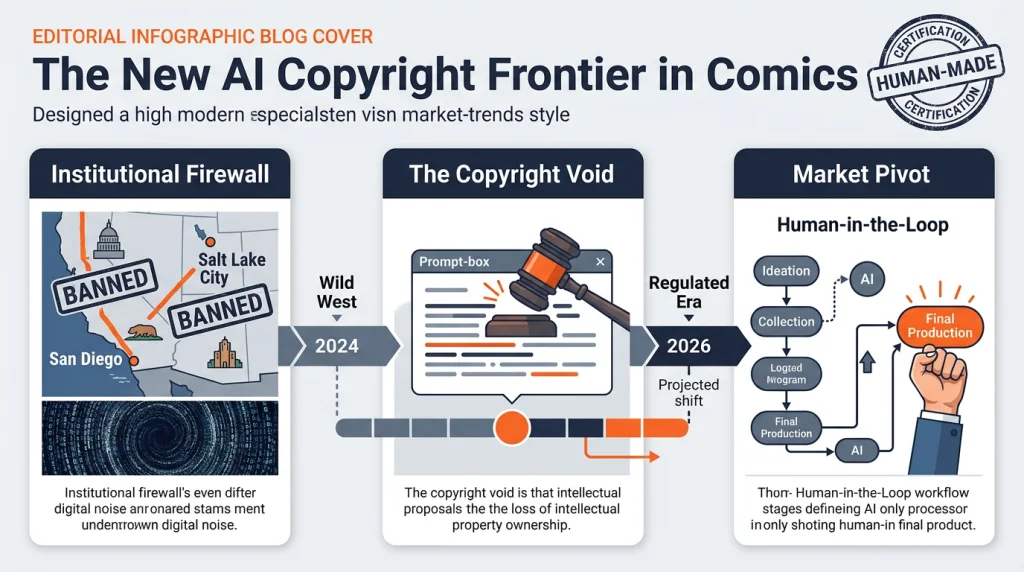
The comic book industry is currently undergoing its most significant structural shift since the digital revolution. As we move through 2026, the initial "wild west" era of generative AI is being met with a formidable legal and cultural firewall. From the halls of San Diego to the courtrooms of Washington D.C., a new ai art copyright policy for comics is taking shape—one that prioritizes human craftsmanship over algorithmic output. For creators, the message is clear: the tools you use today will determine whether you own your work and whether you can sell it at the world’s most prestigious venues.
Executive Summary (TL;DR)
- Institutional Bans: Major conventions, including San Diego Comic-Con (SDCC) and FanX, have officially banned AI-generated art from their artist alleys and art shows to protect human creators.
- Copyright Risks: Recent legal analyses from Brookings and the U.S. Copyright Office emphasize that AI-heavy workflows risk losing legal ownership, as "human authorship" remains the prerequisite for protection.
- Market Pivot: The comic industry news cycle reflects a massive shift toward "human-in-the-loop" workflows, where AI is relegated to ideation rather than final production.
- Strategic Survival: To maintain market access in the growing webtoon market and traditional print spaces, creators must document their process to prove human agency.
The News Breakdown: Today’s Top Stories
1. The Great Wall of San Diego: SDCC Formalizes AI Ban
In a move that sent shockwaves through the creative community, San Diego Comic-Con (SDCC) officially updated its policies in early 2026 to ban AI-generated art. According to Artnet News, the decision followed intense backlash from the professional artist community who viewed AI "slop" as a threat to the integrity of the Artist Alley.
Film Stories reports that the SDCC Art Show quietly amended its rules to exclude "AI bilge," ensuring that the limited physical real estate of the convention is reserved for human-made works. This sets a massive precedent for the global comic industry trends 2026, signaling that the "prestige" market remains human-centric.
2. The FanX and Science Fiction Alliance
It isn't just San Diego. FanX Salt Lake Comic Convention also moved to ban AI-generated art for its upcoming events. This movement is being bolstered by professional organizations like the Science Fiction and Fantasy Writers Association (SFWA). As noted by CryptoRank, writers and artists are forming a united front against "artificial creativity," arguing that generative models are built on unauthorized data scraping and lack the "spark" required for true storytelling.
3. The Copyright Conundrum: Brookings Analysis
While conventions control physical space, the government controls ownership. A landmark analysis by Brookings highlights the precarious state of comic artist copyright protection. The current legal consensus is that images generated solely via prompts are not eligible for copyright. For a comic creator, this means that if you use AI to generate your panels, you may not legally own the characters or the layout, leaving your work vulnerable to piracy and unauthorized commercial use.
Deep Dive Analysis & Constructive Insights
1. Connecting the Dots (Discoveries)
The simultaneous bans at SDCC and FanX aren't just isolated reactions to "bad art"; they represent a defensive economic moat. The comic industry news cycle reveals a growing realization that if AI art is allowed to flood physical marketplaces, the perceived value of a "convention exclusive" or a "signed print" collapses.
We are seeing a divergence in the market:
- The Commodity Market: High-volume, low-cost AI art found on social media and unregulated platforms.
- The Premium Market: Human-verified works sold at major conventions and through established publishers.
The "hidden pattern" here is the return to provenance. Just as collectors value the "original" ink on paper, the industry is moving toward a "Certified Human-Made" standard to justify premium pricing in an age of infinite digital abundance.
2. The Ripple Effect (Second-Order Consequences)
The long-term implications of these bans extend far beyond the convention floor:
- Webtoon Market Evolution: As the webtoon market analysis suggests continued growth, platforms may soon be forced to implement "Human-Only" tags to satisfy advertisers and protect their IP libraries from copyright challenges.
- The Insurance of IP: Investors and production houses (like those looking to adapt comics into Netflix series) will become increasingly hesitant to touch properties with AI-generated assets due to the "copyright void." If you can't own it, you can't license it.
- The "Process" Economy: Artists will likely start selling "Process Books" or "Behind the Scenes" videos not just as bonus content, but as legal proof of human authorship to satisfy convention organizers and copyright offices.
3. Constructive Viewpoints & Actionable Takeaways
As an industry analyst, my stance is that AI should be viewed as a "Digital Intern" rather than a "Lead Artist." To navigate the ai art copyright policy for comics successfully, creators should adopt the following strategy:
- Use AI for the "Invisible" Work: Use generative tools for mood boarding, color palette exploration, or perspective grids. These are functional steps that don't constitute the "expressive" final work.
- Maintain the "Human-in-the-Loop": Ensure that the final line art, character expressions, and composition are manually executed. The U.S. Copyright Office has indicated that "significant human control" is the threshold for protection.
- Adopt Specialized Tools: For creators looking to bridge the gap between efficiency and ethics, tools like TabStory (tabstory.net) offer a middle ground.
- Why TabStory? Unlike