The Comic Convention AI Ban: Navigating New Copyright Realities for Creators
The comic book industry is currently witnessing a tectonic shift in how technology intersects with creative labor. For several years, generative AI was the "elephant in the room" at major conventions—a source of both fascination and growing resentment. However, as we move through 2026, the era of "wait and see" has officially ended.
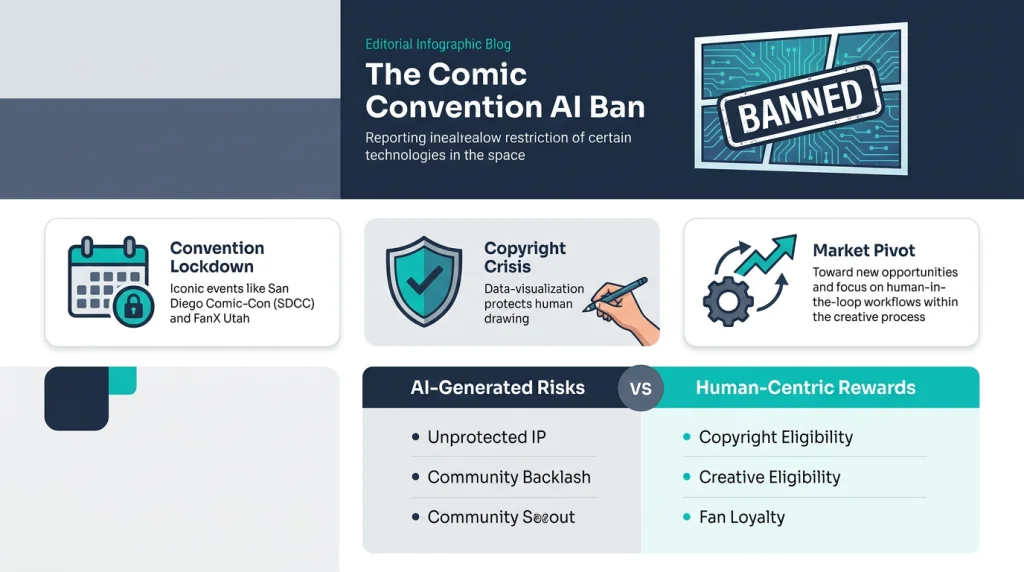
Industry giants like San Diego Comic-Con (SDCC) and FanX have moved to formalize strict bans on AI-generated submissions, signaling a massive regulatory pivot. This isn't just a cultural pushback; it is a strategic response to the ai art copyright policy comics landscape, where the lack of legal protection for non-human works is creating a "Copyright Catch-22" for publishers and independent creators alike. To survive in this new era, creators must move beyond pure generative tools and embrace workflows that are legally defensible and human-centric.
Executive Summary (TL;DR)
- The Great Ban: Leading conventions including SDCC and FanX have officially prohibited AI-generated art from their galleries and official shows to protect human creators and intellectual property.
- Copyright Crisis: The U.S. Copyright Office continues to deny protection for works created without significant "human authorship," making AI art a liability for professional publishers.
- Market Pivot: The "Webtoon market" and digital comic sectors are increasingly demanding "human-in-the-loop" documentation to ensure work is commercially viable and protectable.
- Strategic Path: Creators are turning to hybrid tools like TabStory that facilitate story-to-comic workflows while maintaining the human creative control necessary for copyright eligibility.
The News Breakdown: Today's Top Stories
1. The Great Lockdown: SDCC and FanX Formalize AI Bans
The most significant comic industry news of the year comes from the world’s largest stage. San Diego Comic-Con has officially updated its Art Show rules to ban AI-generated submissions. According to reports from Artnet News and Animation Magazine, the move follows intense pressure from the professional artist community.
Similarly, FanX Salt Lake Comic Convention implemented a ban on AI-generated art for its events, as noted by Deseret News. These bans aren't just about aesthetics; they are about maintaining the integrity of the "Artist Alley" and ensuring that paid floor space is reserved for creators who own the rights to their work.
2. Why "AI Bilge" Failed: The Community Backlash
The term "AI bilge" has become a rallying cry among critics who view mass-produced generative images as a threat to the craft. Film Stories reports that the rule changes were often made "quietly" at first but were later amplified by fans who refused to purchase prompts-as-art. This backlash highlights a fundamental truth in the webtoon market and traditional comics: fans value the personal connection and unique voice of the human creator.
3. The Copyright Catch-22
The legal foundation for these bans is rooted in a simple, harsh reality: AI-generated works cannot be copyrighted. A comprehensive analysis by Brookings explores how the U.S. Copyright Office’s stance—requiring human authorship—creates a massive risk for publishers. If a comic is created via AI, a competitor could theoretically "pirate" the characters and panels without legal recourse. This has forced major publishers to mandate "AI-free" clauses in creator contracts to protect their intellectual property (IP).
Deep Dive Analysis & Constructive Insights
1. Connecting the Dots (Discoveries)
When we look at the simultaneous bans from SDCC, FanX, and the vocal stance of Science Fiction and Fantasy Writers Association (SFWA) as reported by TechCrunch, a clear pattern emerges: The industry is prioritizing IP safety over production speed.
The "discovery" here is that the comic industry is moving toward a "Provenance-First" model. In 2026, a creator's portfolio is only as valuable as their ability to prove they made it. We are seeing a convergence where convention organizers, copyright lawyers, and fan communities are acting as a unified filter to purge "low-effort" generative content. This isn't just a trend; it's a structural fortification of the industry's economic borders.
2. The Ripple Effect (Second-Order Consequences)
The ban on AI art at major conventions will have significant second-order effects:
- The Rise of "Process Documentation": Creators will soon be required to provide "work-in-progress" (WIP) files, layers, and sketches as a standard part of convention applications and publishing contracts.
- A Premium on "Human-in-the-Loop" Tools: Pure generative AI (text-to-image) is becoming a professional dead-end. However, tools that assist in the workflow—such as AI-assisted coloring, lettering, or layout—will