The 2026 AI Comics Industry Pivot: SDCC Bans and Copyright Realities
The comic book world is currently navigating its most significant structural shift since the transition from newsstands to the direct market. In early 2026, the AI comics industry reached a definitive "watershed moment" as major cultural gatekeepers and legal bodies formalized their stance against purely generative content. What began as a heated online debate has solidified into institutional policy: if you want to sell at the world’s biggest conventions or own the legal rights to your characters, the era of "prompt-to-publish" is officially over.
Executive Summary (TL;DR)
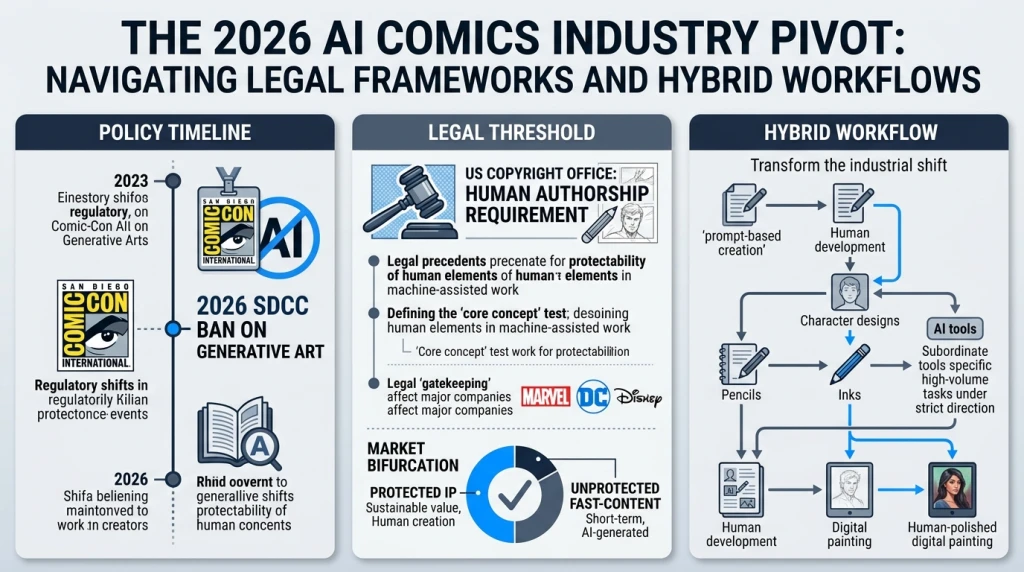
- SDCC Ban: San Diego Comic-Con has officially banned generative AI art from its Art Show and exhibition spaces for 2026, following intense industry backlash.
- Copyright Necessity: The US Copyright Office maintains that "human authorship" is the mandatory threshold for IP protection; purely AI-generated panels cannot be trademarked or copyrighted.
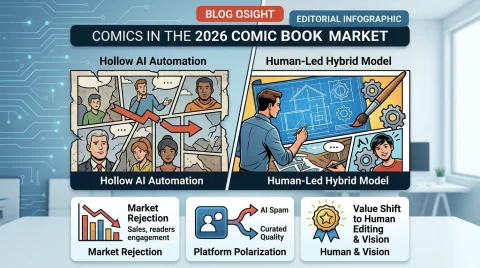
- The Hybrid Shift: The 2026 market is pivoting toward "AI-assisted" rather than "AI-generated" workflows, where creators use AI for backend efficiency but finalize art with human-led digital painting.
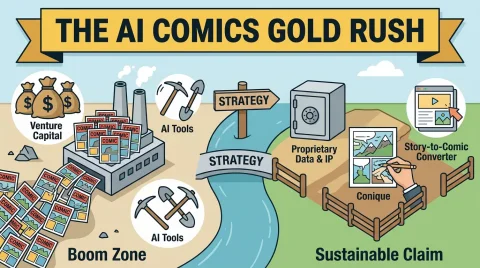
- Strategic Tooling: Platforms like TabStory are emerging as essential bridges, allowing creators to maintain narrative control and authorship while leveraging modern workflow speeds.
The News Breakdown: Today’s Top Stories
1. The SDCC Watershed: Banning the "Bilge"
The world’s most influential pop-culture event, San Diego Comic-Con (SDCC), has officially updated its rules for 2026 to prohibit AI-generated art. According to reports from Artnet News and Animation Magazine, the convention’s Art Show quietly revised its terms to exclude any work created primarily by generative algorithms.
This move follows a year of mounting pressure from professional illustrators and fans who labeled the influx of AI imagery as "bilge" that devalues the craftsmanship of Artist Alley. The ban is not just a local policy; it sets a precedent for the entire global convention circuit, signaling that "Artist Alley" will remain a space for human-created intellectual property.
2. Studio Gatekeeping: Marvel, DC, and Disney
While independent creators face strict bans at conventions, major studios are taking a more nuanced—yet equally protective—approach. As detailed by Qazinform, giants like Disney, Marvel, and DC are currently restricting the use of generative AI in their primary creative pipelines.
The motivation is twofold:
- Legal Risk: The inability to copyright AI-generated assets makes them a liability for multi-billion dollar franchises.
- Brand Integrity: Maintaining relationships with top-tier talent who are vocally anti-AI.
3. The Copyright Threshold: Human Authorship is King
The legal foundation for the comic book market 2026 is built on a single phrase: "Human Authorship." The Art Newspaper highlights that the US Copyright Office has doubled down on its stance: AI can be a tool, but it cannot be the "author." For a comic to be protected, the creator must demonstrate significant creative control over the final output, including layout, dialogue, and substantial manual editing of the imagery.
Deep Dive Analysis & Constructive Insights
1. Connecting the Dots: The End of the "Wild West"
The simultaneous bans from SDCC and the rigid stance of the Copyright Office reveal a hidden pattern: the industry is moving toward standardization through exclusion. In 2023 and 2024, AI was a novelty. By 2026, it has become a "compliance issue."
The contradiction here is that while AI is being banned from public-facing art shows, it is being integrated into private backend workflows (storyboarding, color testing, and script formatting). The industry isn't rejecting technology; it is rejecting the replacement of the artist. The "SDCC Watershed" proves that the comic community views the artist’s hand as the "product," not just the final image.
2. The Ripple Effect: Second-Order Consequences
The ban on AI art at major conventions will likely lead to a "bifurcation" of the comic market:
- The Protected Tier: High-end, human-authored comics that qualify for copyright and SDCC floor space. These will command higher prices and retain long-term IP value.
- The "Fast-Content" Tier: Purely AI-generated webcomics that exist on unregulated platforms. These will struggle with monetization because they cannot be legally protected from piracy or "cloning" by other AI models.
- The Rise of Verification: We will soon see "Human-Made" certification seals or "Proof of Process" requirements for digital artists to enter prestigious competitions.
3. Constructive Viewpoints & Actionable Takeaways
For creators, the path forward isn't to ignore AI, but to master the Hybrid Workflow. To stay relevant in the AI comics industry of 2026, you must prioritize tools that facilitate human authorship rather than replace it.
Strategic Advice for Creators:
- Use AI for the "Invisible" Work: Leverage AI for world-building bibles, character