AI Art Tools Pricing for Creators: 2026 Comic Industry Outlook
The intersection of generative AI and the comic industry has moved past the "novelty" phase and entered a period of high-stakes industrialization. As we move into 2026, the comic industry news cycle is no longer dominated by whether AI will be used, but rather how creators can afford it—and protect themselves from it. For comic book artists, webtoon creators, and digital illustrators, the cost of doing business is shifting from physical ink and expensive tablets to monthly API credits and "protection" subscriptions.
With the webtoon market projected for explosive growth through 2026, the financial barrier to entry is being redefined by AI art tools pricing for creators. This shift represents a fundamental change in the digital comics growth trajectory, where speed-to-market is becoming the primary competitive advantage.
Executive Summary (TL;DR)
- Widespread Adoption: Generative AI now influences the workflow of the majority of digital artists worldwide, transitioning from a niche experiment to a standard production requirement.
- Pricing Pressure: Creators are increasingly forced into premium subscription models to access high-fidelity outputs, with "protection tools" adding a secondary layer of necessary expense.
- Market Vulnerability: Despite the rise of "poisoning" or "cloaking" tools designed to protect artist styles, recent research indicates these defenses remain largely ineffective against advanced scrapers.
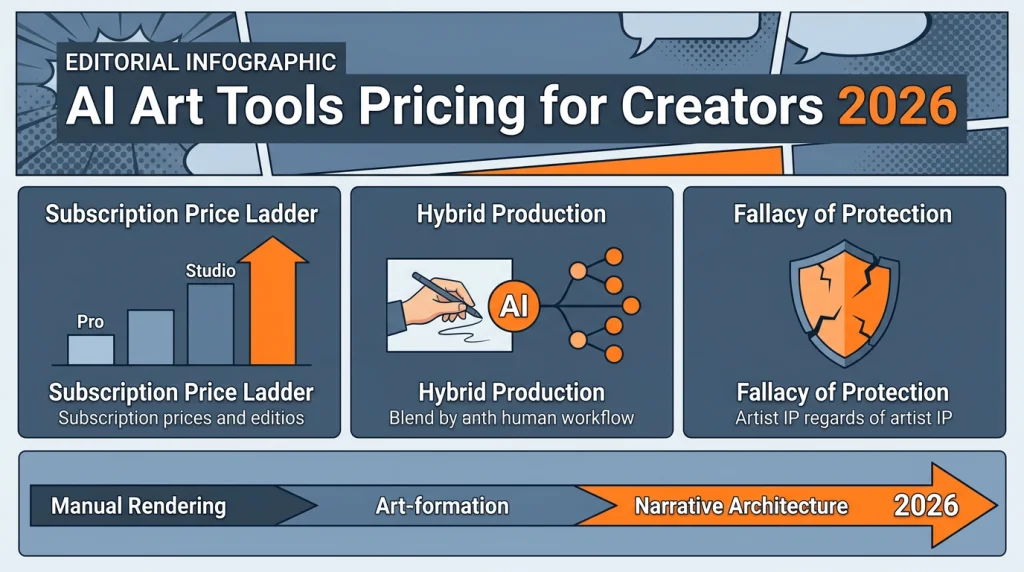
- Strategic Shift: The webtoon market analysis suggests that 2026 will be the year of "Hybrid Production," where the value shifts from manual rendering to high-level prompt engineering and narrative architecture.
The News Breakdown: Today's Top Stories
1. The Proliferation of Choice: 27 Major Players
According to a comprehensive report by Built In, there are now 27 top-tier AI art generators dominating the market. For comic creators, this saturation has created a fragmented pricing landscape. While entry-level tiers remain affordable, the features necessary for consistent character design—such as LoRA training and high-resolution outpainting—are increasingly locked behind "Pro" and "Studio" tiers ranging from $30 to $100 per month.
2. The Fallacy of Protection
A critical concern for the comic industry trends 2026 is the security of intellectual property. Reports from UT San Antonio Today and Tech Xplore highlight a sobering reality: AI art protection tools (like Nightshade or Glaze) still leave creators at significant risk. Researchers have demonstrated that these "cloaking" methods can often be bypassed by updated training algorithms, meaning creators are paying for a sense of security that may be mathematically temporary.
3. Subscription Psychology in Design
A Nature study recently analyzed the factors influencing why digital media designers subscribe to premium AI versions. The findings suggest that efficiency gains and perceived professional necessity outweigh the ethical concerns regarding data scraping. For the webtoon market, where artists must produce 60-100 panels per week, the "subscription tax" is becoming an unavoidable cost of maintaining a competitive output volume.
4. Transparency and Copyright Exposure
The battle over data usage has reached a fever pitch. The Guardian reports on new platforms designed to expose exactly how much copyrighted art is used by specific AI models. This transparency is forcing a divide in the market between "Ethical AI" tools (which carry a higher price tag due to licensing costs) and "Open-Scraped" models (which are cheaper but carry higher legal risks for commercial use).
Deep Dive Analysis & Constructive Insights
1. Connecting the Dots: The "Efficiency Trap"
When we look at the webtoon market analysis, a clear pattern emerges: AI is not reducing the workload; it is increasing the expected output. In 2022, a solo creator might have been praised for a bi-weekly update. In 2026, the prevalence of generative AI has shifted the baseline.
The "Efficiency Trap" occurs when the time saved by AI is immediately filled by higher editorial demands for more complex backgrounds and more frequent updates. This creates a cycle where creators must pay for premium AI subscriptions just to stay at the baseline. The comic industry news of 2026 is defined by this "Red Queen's Race"—running as fast as you can just to stay in the same place.
2. The Ripple Effect: Second-Order Consequences
The long-term implications for the digital comics growth sector are twofold:
- The Death of the "Middle-Tier" Artist: We are seeing a bifurcation of the industry. On one end, "A-list" creators with unique, un-copyable styles will thrive. On the other, "content farms" using AI to churn out generic webtoons will dominate the volume. The middle-tier artist—the one who is "good but not unique"—faces the highest risk of being priced out of the market as AI tools become more expensive and more capable.
- Legal Liability as a Service (LLaaS): As platforms expose copyrighted data usage, we expect to see a new tier of AI pricing: Indemnified Subscriptions. Companies like Adobe are already leading this charge, but in 2026, smaller comic-focused AI tools will likely charge a premium for "Legal Peace of Mind," where the tool provider agrees to cover legal costs if the creator is sued for copyright infringement.
3. Constructive Viewpoints & Actionable Takeaways
For creators and investors navigating the comic industry trends 2026, the strategy must shift from "avoidance" to "strategic integration."
- For Creators: Stop viewing AI art tools as a replacement for drawing. View them as a 3D Asset Pipeline. The most successful creators in 2026 are using AI to generate 3D reference models and perspective grids, then hand-drawing the character expressions and "soul" of the work. This "Hybrid Model" protects you from being a generic AI-clone while maintaining the speed required by the webtoon market.
- For Investors/Studios: Focus on Proprietary Data Sets. The value of a comic studio in 2026 is not just its IP, but its "Style Library." Training a private model on your own back-catalog of 10,000 panels is the only way to ensure a consistent, legally defens