AI Assisted Comic Production: The Indie Creator’s Roadmap for 2026
The comic book industry is currently caught between two tectonic plates: the rapid, high-praise adoption of generative technology in Asian markets and a fierce, protective pushback from traditional artist communities in the West. As we move through 2026, the term ai assisted comic production has evolved from a controversial buzzword into a complex survival strategy for indie creators. While major US comic-cons are tightening restrictions on purely AI-generated art, global powerhouses like Netflix and BurdaVerlag are proving that a "hybrid" approach is not just viable—it’s the new industry standard. For the independent creator, the challenge is no longer whether to use AI, but how to integrate it as a "digital apprentice" without losing the human soul that readers demand.
Executive Summary (TL;DR)
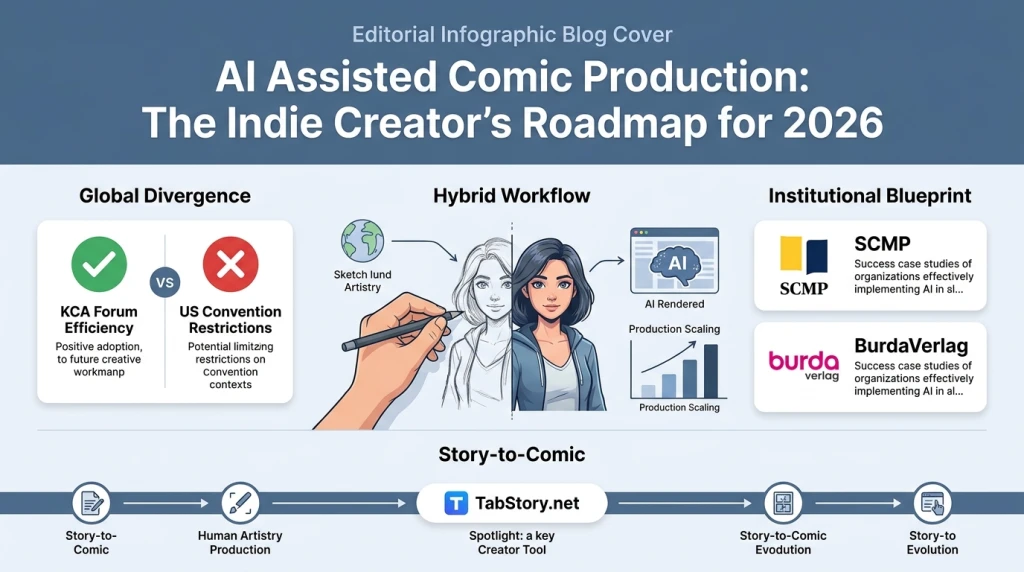
- The Hybrid Shift: Successful creators in 2026 are moving away from "prompt-to-image" and toward "human-in-the-loop" workflows, using AI for labor-intensive tasks like color flats and background consistency.
- Global Divergence: While the KCA Forum in Korea praises AI's efficiency, US conventions are implementing strict disclosure rules, making transparency the most valuable currency for indie artists.
- Institutional Validation: Case studies from South China Morning Post (SCMP) and BurdaVerlag provide a blueprint for using AI to scale production without sacrificing brand identity.
- The TabStory Advantage: Platforms like TabStory.net are emerging as essential tools for indie creators, offering a streamlined story-to-comic workflow that prioritizes creator control.
The News Breakdown: Today’s Top Stories
1. The Great Divide: KCA Praise vs. Comic-Con Restrictions
The global sentiment toward AI in comics is currently split by geography. At the recent KCA Forum, industry leaders offered positive praise for generative AI, highlighting its potential to lower the barrier to entry for new storytellers. Conversely, major US comic-cons have begun restricting AI art following intense creator backlash. This tension forces indie artists to adopt a "transparent hybrid" model to remain eligible for physical artist alleys while staying competitive in digital marketplaces.
2. Lessons from the Giants: BurdaVerlag and SCMP
Two major case studies have recently redefined the "professional" AI workflow. BurdaVerlag, in partnership with Black Forest Labs, published a joint case study on AI-supported comic generation, focusing on maintaining character consistency across panels—a traditional pain point for AI. Similarly, the South China Morning Post (SCMP) experimented with AI comics for their 20th anniversary, demonstrating how legacy media can use the tech to revitalize archival content.
3. The "K-Wave" and Netflix’s Integration
Netflix is leaning heavily into the aesthetic of the "K-Wave," utilizing AI integration for titles like ‘KPop Demon Hunters’. According to Cartoon Brew, this move isn't just about cost-cutting; it's about achieving a specific high-fidelity anime style that was previously too time-consuming for episodic television. This sets a new visual standard that indie comic creators must now meet to capture the attention of streaming scouts.
Deep Dive Analysis & Constructive Insights
1. Connecting the Dots (Discoveries)
The overarching pattern in 2026 is the death of the "unfiltered" AI comic. The initial wave of low-effort, purely prompted comics has failed to gain market traction, leading to the current backlash at US conventions. However, the success of the BurdaVerlag and SCMP projects reveals a hidden middle ground: AI is moving from being the creator to being the infrastructure.
The discovery here is that the market doesn't hate AI; it hates the lack of human intentionality. When AI is used for "invisible" tasks—like generating 3D-consistent backgrounds or automating the tedious process of "flatting" colors—the audience remains receptive. The "K-Wave" influence from Netflix further suggests that AI is being used to bridge the gap between static comics and dynamic animation, creating a "2.5D" aesthetic that is becoming the preferred look for Gen Z consumers.
2. The Ripple Effect (Second-Order Consequences)
The long-term implication of these shifts is a radical change in the indie comic artist's job description. By 2027, the role will likely shift from "illustrator" to "creative director."
- For Competitors: Traditional publishers who refuse any AI integration may find themselves unable to keep up with the weekly release schedules demanded by webtoon platforms.
- For Consumers: We are entering an era of "Hyper-Niche Content." Because AI lowers the production time, we will see a surge in comics catering to extremely specific sub-cultures that were previously not "commercially viable."
- For the Industry: The "US vs. Asia" divide in AI adoption could lead to a talent drain, where Western artists who want to use these tools migrate to platforms and publishers based in more AI-friendly regions like Seoul or Singapore.
3. Constructive Viewpoints & Actionable Takeaways
As an analyst, my stance is clear: Hybridization is the only sustainable path forward. To succeed as a comic creator in 2026, you must treat AI as your