Mastering AI Comic Character Consistency: From Phone Sketches to 6-Page Sagas
The "Continuity Curse" has long been the final boss for digital creators. For years, AI could generate a stunning single image, but the moment you asked for a second frame, your protagonist’s hair color shifted, their outfit morphed, and the art style drifted into the uncanny valley. In 2026, that barrier has finally crumbled.
We are witnessing a "Pinecone Moment" in the industry—a term coined by Bleeding Cool News to describe the explosion of AI-driven 6-page comic stories. Today, the value of a creator has shifted from the mechanical ability to draw a line to the editorial ability to direct a narrative. Whether you are starting with a rough sketch on a smartphone or a complex prompt in a professional suite, ai comic character consistency is no longer a luxury—it is the standard.
Executive Summary (TL;DR)
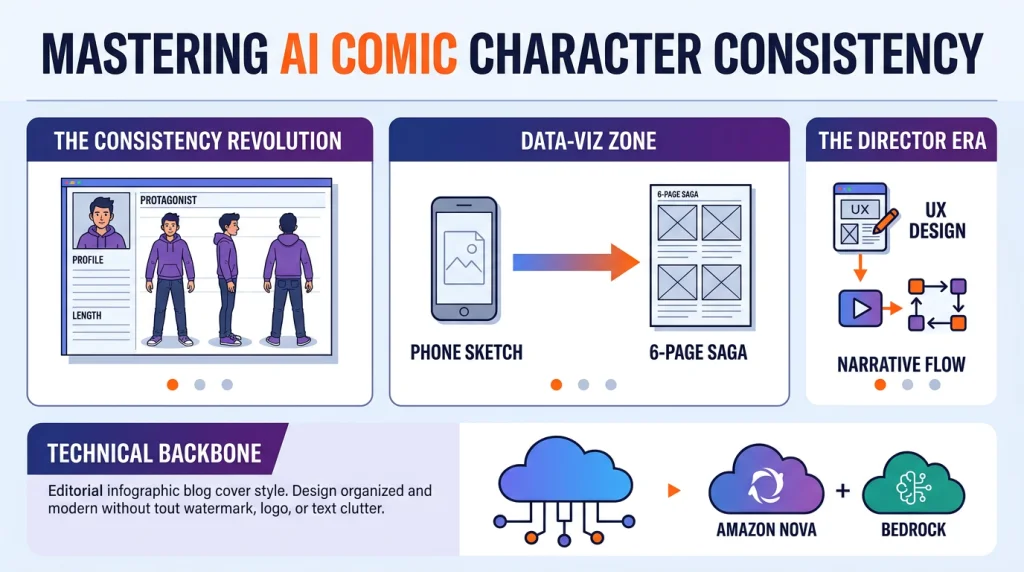
- The Consistency Revolution: New models like Amazon Nova and platforms like TabStory allow creators to lock in character seeds, ensuring visual continuity across hundreds of frames.
- Mobile-First Creation: High-end comic production has moved to the phone, enabling "non-artists" to produce market-ready four-panel strips in minutes.
- The Director Era: Successful creators in 2026 focus on "narrative flow" and "UX design" rather than manual inking, as predicted by industry veterans like Jakob Nielsen.
- Scaling Up: The industry is moving from single-panel experiments to 6-page "Sagas," powered by automated storyboarding tools in Amazon Bedrock.
The News Breakdown: Today’s Top Stories in AI Comics
1. The "Pinecone Moment" and the 6-Page Boom
According to Bleeding Cool News, the comic market is experiencing a massive influx of indie content. The primary driver? AI's newfound ability to maintain coherence over extended lengths. Creators are no longer limited to "one-off" images; they are building entire 6-page sagas that maintain the same character design from the first panel to the cliffhanger.
2. Amazon Nova: The Technical Backbone of Continuity
Amazon Web Services (AWS) has introduced Amazon Nova within the Bedrock ecosystem. This tool allows artists to build character-consistent storyboards by utilizing "reference seeds" and style-tuning. This technical leap solves the "creative continuity challenges" that previously plagued the industry, as noted by The Jerusalem Post.
3. The Rise of the "Non-Artist" Creator
A fascinating report from 36 Kr highlights a creator who, despite having no traditional drawing skills, produced a viral four-panel comic series entirely on a smartphone. This democratizes the medium, shifting the focus from "hand-eye coordination" to "storytelling and UX."
4. UX and the Future of Visual Narrative
UX pioneer Jakob Nielsen has released a 2026 prediction series in comic book format, emphasizing that the future of web and app interaction will be increasingly visual and narrative-driven. His work suggests that AI cartoon generators are not just for entertainment but are becoming essential tools for professional communication and user experience.
Deep Dive Analysis & Constructive Insights
1. Connecting the Dots: The Convergence of Mobile and Enterprise AI
The hidden pattern here is the closing gap between "casual mobile creation" and "enterprise-grade production." In 2025, you needed a powerful GPU and complex LoRA (Low-Rank Adaptation) training to keep a character consistent. In 2026, the logic of Amazon Nova (enterprise) is being distilled into user-friendly interfaces like TabStory (consumer).
The "Consistency Revolution" is essentially the commoditization of identity. By treating a character as a set of data points (a "seed") rather than a drawing, AI allows for the same character to appear in a 3D-rendered storyboard, a 2D manga, or a 3D-style cartoon without losing their "soul."
2. The Ripple Effect: The Death of the "Inker" and the Birth of the "Showrunner"
The long-term implication for indie comic artists is profound. The traditional pipeline—writer, penciler, inker, colorist, letterer—is collapsing into a single role: the AI Director.
- Impact on Competitors: Traditional publishers (Marvel/DC) are being forced to pivot. If an indie creator can produce a high-quality, 6-page consistent saga in a weekend, the "slow-burn" monthly release cycle of major houses looks increasingly obsolete.
- Consumer Impact: We are entering an era of hyper-niche content. If you want a comic about a Victorian detective who is also a cybernetic cat, you no longer have to wait for a publisher to greenlight it. You can create it—or follow an indie creator who does.
3. Constructive Viewpoints: How to Win in the 2026 Comic Market
To stay relevant, creators must stop fighting the "AI isn't art" battle and start mastering the "Consistency Workflow."
- Actionable Takeaway for Creators: Focus on Character Sheets. Before generating a single panel, use tools like Amazon Nova or TabStory to define your character from 360 degrees. Lock the seed. This is your "digital actor."
- Strategic Advice: Leverage TabStory (tabstory.net) for your workflow. Why? While AWS Bedrock is powerful, it is built for developers. **