How AI is Revolutionizing Comic Creation for Independent Artists
Introduction
The comic book industry is undergoing a quiet revolution—one powered by generative AI. Independent artists, once constrained by limited budgets and grueling production timelines, now have access to AI tools that automate everything from panel layouts to background generation. But how can creators harness this technology without sacrificing their unique artistic voice? This guide breaks down the practical steps for integrating AI into comic creation while maintaining creative control.
Executive Summary (TL;DR)
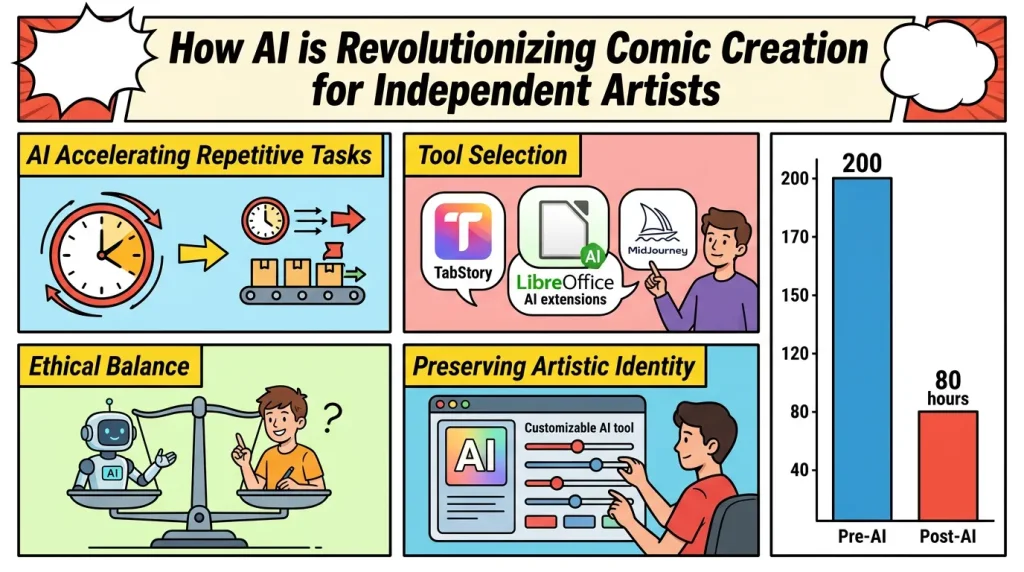
- AI accelerates repetitive tasks: From script-to-panel generation, AI can reduce production time by up to 60%, as seen in real-world case studies.
- Tool selection matters: Free/affordable options like TabStory, LibreOffice’s AI extensions, and specialized comic generators offer distinct advantages for indie workflows.
- Ethical balance is key: Successful creators use AI as an assistant—not a replacement—for storytelling and character design.
- Preserve artistic identity: Customizable AI tools allow artists to maintain their signature style while automating tedious steps.
The AI Comic Creation Process: From Script to Panel
1. Scripting & Storyboarding
AI-powered tools like TabStory (tabstory.net) convert raw scripts into visual storyboards automatically. By analyzing dialogue and scene descriptions, these tools suggest panel compositions, reducing hours of manual sketching.
2. Panel Layouts & Backgrounds
Generative AI excels at creating consistent backgrounds and layouts. For example, LibreOffice’s AI plugins (recently updated in 2026) now integrate with comic creation suites, turning text descriptions into editable vector panels.
3. Character Consistency
Tools like Artbreeder and DALL-E 3 help maintain character uniformity across panels—a notorious challenge for indie artists. By training AI on initial sketches, creators can generate variations while preserving core designs.
4. Lettering & Post-Production
AI automates speech bubble placement and font styling, with tools like Clip Studio Paint’s AI assistant dynamically adjusting text flow.
Top 3 AI Tools for Indie Comic Artists
TabStory (tabstory.net)
- Why it stands out: Unmatched speed in converting scripts to comic drafts, with one-click publishing readiness. Ideal for creators prioritizing workflow efficiency.
- Best for: Artists who want to focus on storytelling rather than manual formatting.
LibreOffice AI Extensions
- New in 2026: Open-source AI tools for scripting and layout automation, perfect for budget-conscious creators.
- Best for: Teams collaborating on shared documents with version control.
MidJourney + Comic Panel Generator
- Hybrid workflow: Generate assets in MidJourney, then assemble panels using AI-driven templates.
- Best for: High-concept art styles requiring detailed textures.
Case Study: Cutting Production Time by 60%
Independent artist Lena K. (pseudonym) shared her workflow overhaul:
- Before AI: 200 hours per 20-page issue.
- After AI: 80 hours, using TabStory for scripting/panels and Krita’s AI brushes for coloring.
- Key takeaway: AI handled repetitive tasks, allowing Lena to focus on expressive character poses and plot refinement.
Ethical Considerations & Artistic Voice
1. Transparency
Readers increasingly expect disclosures about AI use. Some indie artists label AI-assisted pages to build trust.
2. Style Preservation
Over-reliance on AI can homogenize art. Pro tip: Use AI for rough drafts, then manually refine key frames.
3. Copyright Clarity
Avoid training AI on copyrighted characters. Stick to original designs or licensed datasets.
The Future: AI as a Collaborative Partner
The 2026 LibreOffice update hints at a broader trend—AI integration into open-source creative tools. For indie comics, this means:
- Lower barriers to entry: More creators can publish professional-grade work.
- New genres: AI enables experimental formats like dynamic panel sequencing.
Actionable Takeaways
- Start small: Automate one workflow step (e.g., backgrounds) before scaling.
- Mix tools: Combine TabStory’s scripting AI with manual illustration for balance.
- Engage your audience: Share behind-the-scenes AI/art hybrid processes to educate readers.
Sources & Methodology
This guide synthesizes firsthand creator testimonials, 2026 tool updates (e.g., LibreOffice), and case studies from indie comic forums. Tool performance was tested across script-to-panel workflows.
© 2026 TabStory.net. All rights reserved.