How Comic Creators Can Avoid Legal Trouble When Using AI for Political Satire
The intersection of AI-generated art and political commentary is a creative frontier fraught with unseen legal landmines. For comic illustrators and satirists, AI tools promise unprecedented speed and visual experimentation. Yet, as a recent arrest in Texas starkly illustrates, the act of publishing criticism—especially when aided by AI—can carry severe real-world consequences, turning a digital post into a criminal matter. This guide moves beyond the tools to examine the critical framework every creator needs to operate safely within the bounds of free speech and defamation law when using AI for political satire.
Executive Summary: Key Takeaways for AI-Assisted Satirists
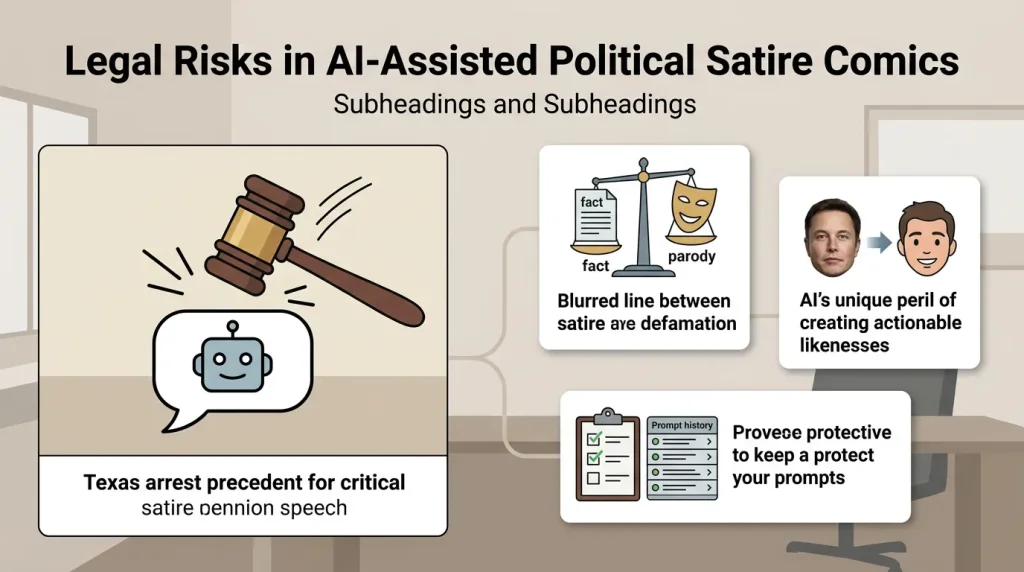
- The Legal Precedent is Real: A Texas woman was arrested for a Facebook post criticizing her town's water quality, demonstrating that authorities may treat critical speech as a criminal act, not just a civil matter.
- Satire ≠ Absolute Protection: The legal defense of parody hinges on intent and clear absurdity. If an AI-generated comic could be reasonably interpreted as presenting false facts, it may cross into defamation.
- AI Introduces Unique Perils: AI image generators can inadvertently create actionable likenesses of real people or imply false scenarios through photorealistic details, adding layers of legal risk.
- Protect Yourself with Process: Documenting your creative workflow and implementing a pre-publish checklist are essential steps to demonstrate satirical intent and mitigate liability.
The News Breakdown: A Cautionary Case Study from Texas
On May 24, 2026, a Texas woman was arrested following a Facebook post in which she criticized her local town's water quality. According to the report from Reclaim The Net, the arrest was carried out by local authorities, turning what many would consider protected speech into a criminal investigation. The case quickly garnered attention on forums like Hacker News, sparking debate over the limits of free expression and government overreach.
This incident is not about a comic, but it is a vital object lesson for satirical artists. It underscores that criticism of public services or officials can be met with severe retaliation, regardless of the medium. For a comic creator, the transition from a text-based Facebook post to a visually compelling, AI-assisted cartoon amplifies the reach, emotional impact, and potentially, the perceived threat of the message. The legal machinery that responded in Texas could similarly be triggered by a viral, AI-generated satirical comic.
Deep Dive Analysis & Constructive Insights
Connecting the Dots: The Blurring Line Between Satire and "Fact"
The Texas arrest and the rise of AI comic tools are connected by a single, dangerous trend: the collapsing distinction between perceived statement of fact and protected opinion. Authorities in the Texas case allegedly treated a subjective complaint about water quality as a potentially fraudulent or threatening statement. In the realm of AI-generated satire, the risk is that hyper-realistic or convincingly rendered AI art can lend a veneer of factual documentation to a parody. A generator might produce a cartoon of a public figure in a compromising, entirely fabricated scenario that looks believable. The legal system, and a jury, may struggle to see the "obvious parody" when the imagery is coherent and detailed, moving the work from the protected realm of satire into the actionable realm of defamation.
The Ripple Effect: Chilling Effects and the Weaponization of Law
The long-term implication is a potential chilling effect on democratic satire. If creators fear arrest or costly litigation, they may self-censor, depriving public discourse of a vital tool for holding power to account. Furthermore, the weaponization of defamation and cyber-libel laws becomes easier with AI in the picture. A subject of satire could claim that an AI-generated character is an unmistakable, damaging likeness, or that a fictionalized scene implies a specific, false fact. The legal discovery process could then demand access to the creator's AI prompt history and editing logs to prove intent—a privacy invasion that alone could deter creators.
Constructive Viewpoints & Actionable Takeaways
Creators must adopt a rights-aware, process-driven approach. The goal is not to avoid satire but to fortify it against bad-faith legal attacks. Your best defense is a demonstrable creative process that highlights transformative intent.
- Modify, Don't Just Generate: Never publish the raw output of an AI image generator for a satirical piece. Use it as a base. Heavily stylize characters, change distinctive features, and add clear cartoonish or fantastical elements to break any claim of realistic portrayal. The more transformative the final image is from any potential real-world reference, the stronger your fair use/parody defense.
- Anchor Your Work in Commentary: Frame your comic within clear editorial context. Use captions, headlines, or the surrounding article to signal the satirical intent. A standalone, hyper-realistic AI image of a politician is riskier than the same image presented as part of a clearly labeled "Cartoon Commentary" section.
- Implement a Pre-Publication Legal Checklist:
- Likeness Audit: Does any character too closely resemble a real person? If inspired by a public figure, have you added absurd, impossible, or clearly symbolic elements?
- Fact-Fiction Firewall: Does the comic imply a specific, verifiably false event? Ensure your critique targets policies or public persona, not fabricated personal misconduct.
- Intent Documentation: Save your prompts, initial AI outputs, and progressive edit screenshots. This log proves you were crafting a parody, not attempting photoreportage.
- Malice Check: Are you publishing with reckless disregard for the truth, or to express a genuine opinion? The former is "actual malice" and shatters legal protections.
Sources & Methodology
This analysis was compiled using the reported details of the Texas arrest from Reclaim The Net (May 24, 2026) and the ensuing discussion on tech forums. The legal and creative guidance synthesizes established principles of defamation law, fair use, and the emerging ethical frameworks for AI-generated content.
© 2026 TabStory.net. All rights reserved. This article is intended for informational purposes and does not constitute legal advice.