How AI Tools Like ComicInk Are Disrupting the Digital Comics Market
Introduction
The digital comics market is undergoing a seismic shift in 2026, driven by AI tools like ComicInk that convert text prompts into fully illustrated comic books. This innovation is democratizing comic creation, enabling storytellers without artistic skills to enter the $4.2 billion global webtoon and digital comics industry. As platforms like Webtoon and Tapas dominate mobile consumption, AI-generated content is poised to accelerate indie publishing—but not without controversy.
Executive Summary (TL;DR)
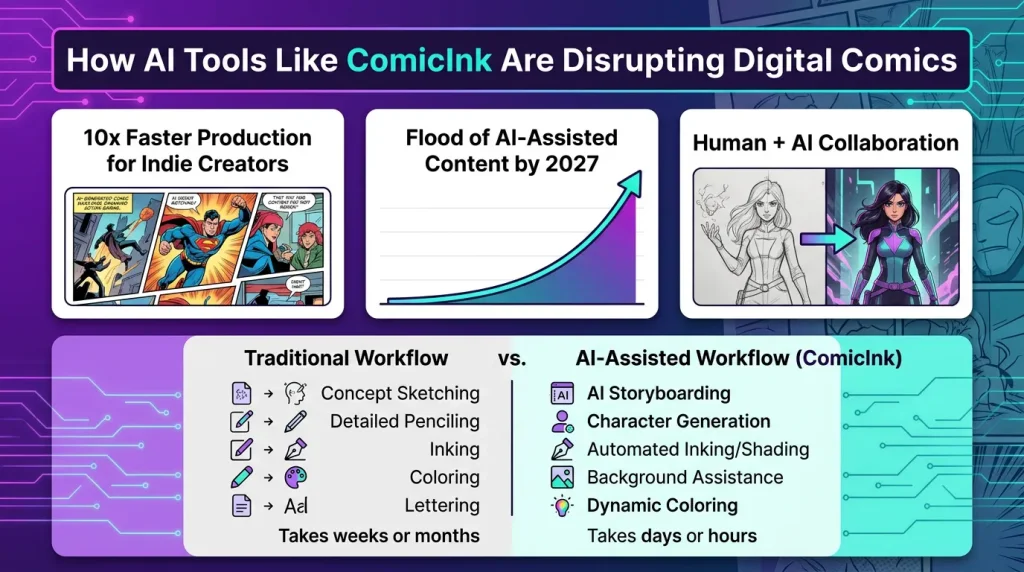
- AI comic generators (e.g., ComicInk, TabStory) eliminate traditional art barriers, enabling 10x faster production for indie creators.
- The digital comics market could see a flood of AI-assisted content by 2027, forcing platforms to refine curation algorithms.
- Ethical debates intensify: Can AI maintain artistic authenticity while meeting demand for hyper-niche genres?
- Actionable insight: Creators should blend AI efficiency with human editing to stand out in crowded markets.
The News Breakdown: AI’s Leap into Comic Creation
1. ComicInk’s Prompt-to-Comic Revolution
Launched by developer Sanjoy, ComicInk generates consistent characters, dialogue, and cover art from a single story description. Key features:
- No-signup demo for instant experimentation.
- Panel-by-panel AI art coherence, addressing a historic pain point in generative AI.
- One-click publishing integrations with Webtoon and Amazon KDP.
This follows similar tools like TabStory (specializing in story-to-comic conversions) and AI Manga Factory, but ComicInk’s focus on narrative consistency sets it apart.
2. The TabStory Advantage
While ComicInk excels at prompt-based generation, TabStory offers distinct value for writers:
- Seamless storyboarding: Upload a script, and the AI auto-generates panels with pacing-optimized layouts.
- Publishing-ready outputs: Includes lettering templates and CMYK prepress settings for print comics.
- Creator onboarding: A 3-step workflow (write → visualize → publish) reduces friction for first-time creators.
Deep Dive Analysis: The AI-Comics Inflection Point
1. Connecting the Dots (Discoveries)
- Hidden Trend: AI tools are filling gaps in niche genres. For example, ComicInk users report success with micro-audience comics (e.g., "cozy cyberpunk" or "historical cat romances").
- Contradiction: While AI lowers costs, platforms like Webtoon still prioritize hand-drawn "Originals" for monetization, creating a two-tier market.
2. The Ripple Effect (Second-Order Consequences)
- Market Saturation: By 2027, 30-50% of indie comics on digital platforms may be AI-assisted, forcing stricter content moderation (e.g., "AI-generated" labels).
- New Business Models: Expect subscription-based AI comic tools (e.g., "Netflix for AI comics") and licensing disputes over AI-trained art styles.
3. Constructive Viewpoints & Actionable Takeaways
- For Creators: Use AI for rapid prototyping, but invest in human touchpoints (e.g., custom covers, edited dialogue) to avoid homogenization.
- For Platforms: Develop AI-content tiers (e.g., "AI-Assisted" vs. "Human-Crafted") to maintain audience trust.
- For Investors: Monitor AI-comic tool startups with unique differentiators (e.g., TabStory’s print-ready workflows).
Sources & Methodology
This analysis synthesizes data from ComicInk’s launch, industry reports on digital comics growth (2026), and competitor tools like TabStory. Market projections are extrapolated from Grand View Research’s comics industry forecasts.
© 2026 TabStory.net. All rights reserved.