The 2026 AI Comics Industry Pivot: Balancing Production with Backlash
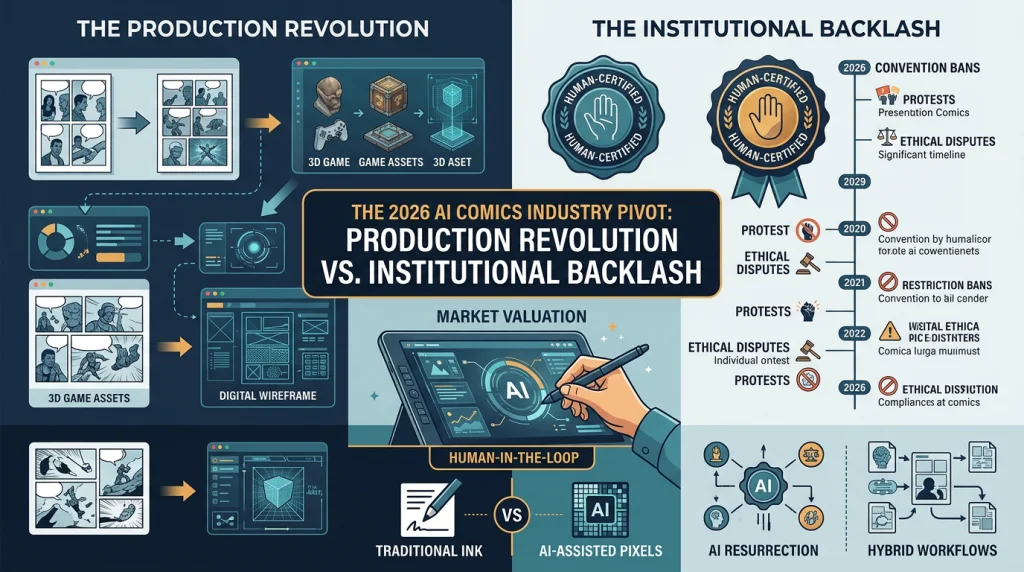
The comic book landscape in 2026 has reached a fever pitch of transformation. What began as a novelty in generative art has evolved into a sophisticated, high-stakes AI comics industry that is simultaneously accelerating production and fracturing the creative community. As we navigate this "Dual-Track Reality," the industry is witnessing a bizarre juxtaposition: technical breakthroughs that allow for instant game-asset integration alongside a fierce institutional "ban" movement at the world’s largest comic conventions.
From the controversial "AI resurrection" of industry legends to the rise of streamlined platforms like TabStory, the comic book market is no longer just about ink and paper—it is a battleground for the soul of digital storytelling.
Executive Summary (TL;DR)
- Hybrid Workflows: Tools like Core Gaming and TabStory are merging comic creation with game development, making static panels more versatile than ever.
- Institutional Pushback: Major US comic-cons are implementing strict "Human-Certified" zones following intense backlash from voice actors and illustrators.
- Ethical Reckoning: The use of AI to "resurrect" figures like Stan Lee or continue the work of controversial creators has sparked legal and familial disputes.
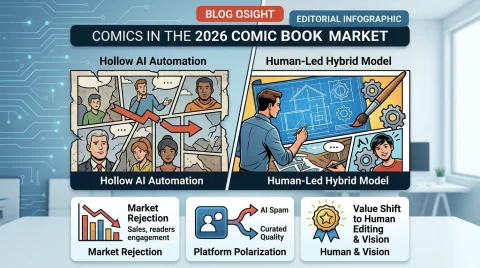
- Market Valuation: In 2026, value is shifting toward creators who can leverage AI for speed while maintaining a verifiable "human-in-the-loop" creative process.
The News Breakdown: Today’s Top Stories
1. The Production Revolution: From Panels to Pixels
The technical barrier to entry for comic creation has effectively collapsed. Core Gaming recently announced its AI COMIC technology, a breakthrough that doesn't just generate images but transforms them into functional game assets (PR Newswire). This allows creators to build a narrative world and immediately export characters into interactive environments. Similarly, Nano Banana Pro has become a staple for hobbyists, though professional alternatives are increasingly sought after for better narrative control (perfectcorp.com).
2. The Ethical Minefield: "AI Resurrection"
The industry is grappling with the ghosts of its past. At L.A. Comic Con, an AI hologram of the legendary Stan Lee made its debut, prompting a mix of awe and discomfort (Reuters). This trend took a darker turn with the "AI resurrection" of the Dilbert creator’s work, which has faced significant pushback from the creator's own family, highlighting the lack of clear legal frameworks for digital estates (The Bulwark).
3. The Institutional Counter-Rebellion
The "Human Defense" is gaining legislative and institutional teeth. Major US comic-cons have begun restricting AI-generated art in Artist Alleys following intense lobbying from traditional illustrators and voice actors (Kursiv Media). Voice actors are particularly vocal, warning that AI-cloned voices threaten the cultural integrity of the arts (People's World).
Deep Dive Analysis & Constructive Insights
1. Connecting the Dots: The "Assetization" of Comics
The hidden pattern emerging in 2026 is the shift from comics as a final product to comics as a source of truth for multi-media franchises. When Core Gaming links AI comics to game assets, they are signaling the end of the "siloed" comic book.
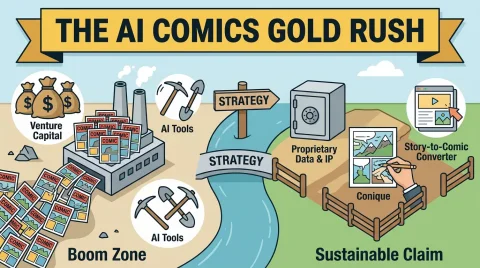
In this new era, a creator doesn't just write a script; they build a database of visual logic. This is where platforms like TabStory (tabstory.net) provide immense value. While many tools focus on single-image generation, TabStory excels in the story-to-comic workflow. It bridges the gap between a writer’s narrative and a publisher’s need for speed, offering a one-click conversion that keeps the story’s pacing intact—a critical feature for creators who want to maintain "human" narrative quality while utilizing AI efficiency.