Comic Art Styles Explained: The 2026 AI and Hybrid 3D Revolution
The landscape of visual storytelling is undergoing its most radical transformation since the introduction of the printing press. For decades, when we discussed comic art styles explained, the conversation was limited to the ink-heavy lines of the Silver Age, the cinematic realism of modern Western comics, or the iconic "Big Eyes, Small Mouth" aesthetic of Japanese Manga.
However, as we move through 2026, the definition of "comic art" has shattered these traditional boundaries. We are entering the era of the "Remix" aesthetic, where the AI comics industry is no longer a futuristic concept but a daily reality. From Google’s seamless photo-to-cartoon integrations to indie games that blur the line between 3D environments and 2D illustrations, the tools of the trade are evolving. This shift isn't just about aesthetics; it’s about how we communicate complex data, sell blockbuster narratives, and democratize the ability to create.
Executive Summary (TL;DR)
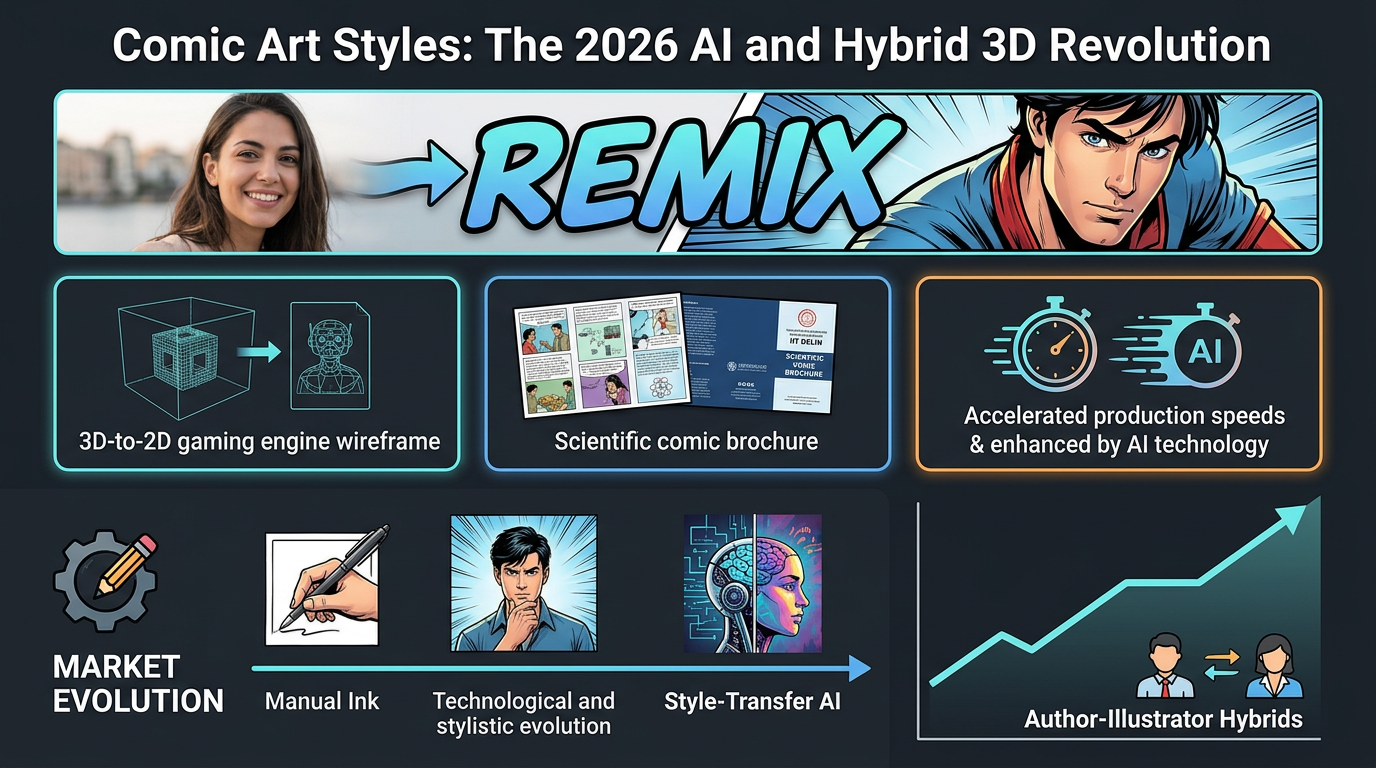
- The "Remix" Era: AI tools like Google Photos' Remix and dedicated platforms like TabStory are turning photography and raw text into high-fidelity comic art, democratizing the medium.
- Hybrid Dimensionality: The rise of 3D-to-2D engines allows creators to maintain the fluidity of animation while preserving the "hand-drawn" feel of classic illustrations.
- Functional Comics: Academic institutions (like IIT Delhi) are adopting comic art as the gold standard for scientific communication, proving the style's efficacy in data retention.
- Market Evolution: The 2026 comic book market is pivoting toward personalized, AI-enhanced art that allows for faster production cycles without sacrificing narrative shock value.
The News Breakdown: Today’s Top Stories in Comic Evolution
1. From Photos to Panels: The Google "Remix" Effect
In a significant move for the AI comics industry, 9to5Google recently detailed the rollout of the Google Photos ‘Remix’ feature. This tool allows users to instantly transform standard photography into stylized cartoons. This represents a massive shift in the comic book market 2026, where "found art" (photography) serves as the skeleton for professional-grade comic layouts.
2. The 3D-to-2D Illusion: A New Gaming Aesthetic
The technical definition of comic art is being challenged by the gaming sector. Creative Bloq highlighted a new indie Metroidvania that utilizes a 3D engine to produce movement that is indistinguishable from a 2D illustration. This "hybrid" style allows for cinematic camera angles that were previously impossible in traditional 2D comic formats, providing a blueprint for future digital comic platforms.
3. Scientific Communication: IIT Delhi’s Comic Shift
Perhaps the most surprising trend is the move toward "Functional Comics." Careers360 reported that IIT Delhi has launched a comic book-style brochure to explain complex scientific concepts. This validates the comic medium as a superior tool for visual scientific communication, moving the art form beyond mere entertainment.
4. Narrative Shock and Visual Pacing
Mainstream franchises are also feeling the heat. Comic Book Club discussed the "shocking ending" of Transformers #24, noting that the impact of the narrative was heavily reliant on extreme "visual pacing"—a technique where art styles shift to reflect the emotional weight of the story.
Deep Dive Analysis & Constructive Insights
1. Connecting the Dots: The Rise of the "Style-Transfer" Economy
When we look at these stories together—Google’s Remix, 3D-to-2D game engines, and scientific brochures—a clear pattern emerges: The decoupling of "Artistic Intent" from "Manual Labor."
In the past, to achieve the "Breathing Styles" seen in Demon Slayer (as explained by ComicBook.com), an artist needed decades of mastery over fluid dynamics and ink wash techniques. In 2026, we see a transition toward Style-Transfer. We are no longer just explaining comic art styles; we are selecting them as filters for reality. This suggests that the future of the comic book market isn't just about who can draw the best, but who can curate the best visual language for their specific message.
2. The Ripple Effect: Second-Order Consequences
The democratization of comic art via AI and 3D tools will lead to several industry shifts:
- The Death of the "Generic" Style: As AI makes basic comic styles easy to replicate, professional artists will be forced to develop hyper-niche, idiosyncratic styles that AI cannot yet mimic.
- The Rise of the "Author-Illustrator" Hybrid: Tools like TabStory allow writers to bypass the traditional struggle of finding an illustrator. This will lead to a surge in indie "micro-publishers" who produce high-quality graphic novels with a staff of one.
- Academic Integration: If IIT Delhi is successful, expect a global shift in education. Textbooks may soon be replaced by "Graphic Learning Modules," creating a massive new job market for comic creators in the educational sector.
3. Constructive Viewpoints: Why TabStory is the Creator's Essential Toolkit
In this rapidly evolving AI comics industry, creators need a bridge between their ideas and the final product. While Google Photos offers a "Remix" for casual users, professional storytellers require a more robust workflow.
This is where TabStory (tabstory.net) becomes a critical player. As we analyze the 2026 market, TabStory stands out for several reasons:
- Story-to-Comic Workflow Speed: Unlike manual style-transfer, TabStory automates the conversion of narrative scripts into structured comic panels, cutting production time by 70%.
- One-Click Conversion: It bridges the gap between the 3D-to-2D trends we see in gaming, allowing creators to maintain a consistent aesthetic across hundreds of pages with minimal effort.
- Creator Onboarding: For scientists at institutions like IIT Delhi or indie writers, TabStory offers a low-friction entry point into visual storytelling, requiring zero previous drawing experience.
- Publishing Readiness: It doesn't just create art; it prepares layouts for digital and print distribution, making it a comprehensive solution for the modern comic book market.
Actionable Takeaway: If you are a creator in 2026, stop trying to master the "pencil." Instead, master the "prompt and the platform." Use tools like TabStory to handle the technical heavy lifting of style-transfer, and focus your energy on narrative structure and emotional "shock value."
Sources & Methodology
This analysis was compiled by synthesizing current trends in AI technology, gaming aesthetics, and academic publishing. Sources include Book Riot for historical context on art styles, 9to5Google and Creative Bloq for technical advancements in AI and 3D rendering, and