How Comic-Con's AI Art Ban Reveals the Real Best AI Tools for Comic Creators in 2026
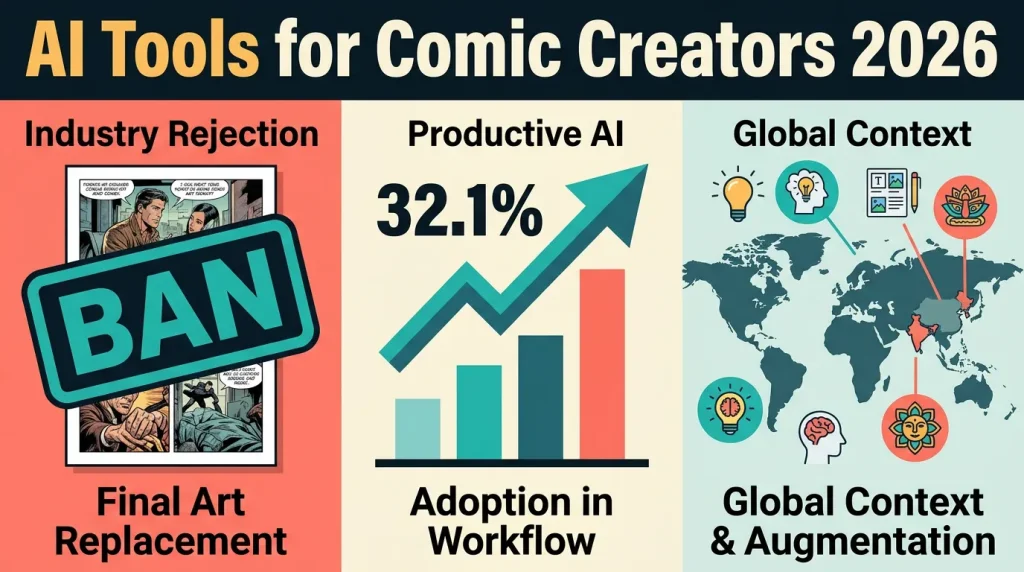
The comic industry's relationship with artificial intelligence has reached a critical inflection point. In early 2026, San Diego Comic-Con announced a ban on AI-generated art for sale and exhibition, a direct response to significant artist pushback. This seismic event isn't a death knell for AI in comics; rather, it acts as a powerful filter, separating hype from practical utility and ethical application. Simultaneously, data from South Korea reveals that generative AI adoption within the content sector has reached 32.1%, proving that the technology is being integrated at scale somewhere. This juxtaposition—between institutional rejection and massive adoption—provides the clearest roadmap yet for creators wondering which AI tools are worth their time, money, and ethical consideration.
Executive Summary: The AI Tool Litmus Test
- Industry bans highlight unethical use cases: Comic-Con's policy targets AI-generated final art for sale, clarifying that tools replacing the core artistic act face backlash. This helps creators avoid career-damaging pitfalls.
- High adoption signals workflow utility: Korea's 32.1% generative AI adoption in content points to tools that augment specific, non-final steps like ideation, scripting, and asset generation, proving genuine productivity gains.
- The sustainable path is augmentation, not replacement: The future lies in AI-assisted workflows for storyboarding, character concepting, and panel layout, not in fully AI-drawn comic pages.
- Global debates refine the toolset: Lessons from India's 2025 expansion show the importance of tools that respect artistic voice and local storytelling, not just Western aesthetics.
The News Breakdown: A Global Pressure Test for AI
1. The Catalyst: Comic-Con's 2026 AI Art Ban
In January 2026, San Diego Comic-Con (SDCC) implemented a ban on the sale and exhibition of AI-generated artwork. As reported by 404 Media and Adafruit, this decision came after substantial pressure from the artist community, which raised concerns about originality, copyright, and the devaluation of human skill. This policy effectively draws a line in the sand, creating a major venue where AI-generated final products are not commercially viable. It's a direct market signal that certain uses of AI will be met with institutional resistance.
2. The Data Point: Korea's 32.1% Generative AI Adoption
While one major market reacts with restriction, another demonstrates rapid integration. A Digital Today report from April 2026 states that South Korea's content industry sales surpassed 161 trillion won, with a staggering 32.1% adoption rate of generative AI. This isn't theoretical; it's a measurable metric from a global leader in webtoons and digital comics. It indicates that within a sophisticated content ecosystem, AI tools are finding a legitimate, productive place in the creative pipeline, likely far upstream of the final illustrated panel.
3. The Global Context: India's Expansion and Nuanced Debates
Looking back to late 2025, Animation Xpress detailed the expansion of India's comic industry alongside heated AI debates. The conversation there wasn't simply pro or anti-AI; it involved "shifting readership trends" and questions about how AI could serve diverse, multilingual storytelling without homogenizing artistic voices. This mirrors a global tension: the drive for efficiency and scale versus the need for authentic, culturally specific expression.
Deep Dive Analysis & Constructive Insights
Connecting the Dots: What the Contradiction Reveals
The apparent contradiction between Comic-Con's ban and Korea's adoption rate is the key to understanding the present moment. They are not evaluating the same thing.
- Comic-Con is banning a product: The policy targets the output—AI-generated art presented as a finished commodity for sale. It's a consumer-facing rule against art that bypasses human creative intent.
- Korea is adopting a process: The 32.1% figure reflects the use of AI in the workflow—for brainstorming, generating background concepts, scripting assistance, or creating reference materials. It's a behind-the-scenes productivity tool.
The hidden pattern is clear: The industry rejects AI as a substitute for the artist but may cautiously accept it as an assistant to the artist. Tools that position themselves as the former are facing a wall. Tools that enable the latter are seeing rapid integration in forward-thinking markets.
The Ripple Effect: Second-Order Consequences for the Industry
This filtering mechanism will accelerate several trends:
- Tool Polarization: The market will split into "blacklisted" tools (those designed to create final art from minimal prompts) and "white-listed" tools (those designed for specific, assistive tasks within a human-led workflow). Developer roadmaps will shift accordingly.
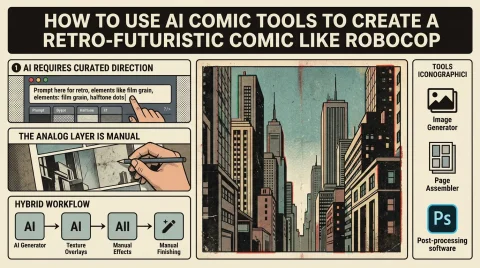
- The Rise of the "AI-Hybrid" Creator: Professional credibility will depend on transparently showcasing a hybrid workflow. Portfolios and process videos will highlight how AI was used for concept iteration or asset generation, followed by human refinement and final artistry.
- Ethical Labeling as a Feature: Just as "organic" became a marketable label in food, "Human-Directed" or "AI-Assisted (Process)" could become valuable badges for creators and platforms, satisfying audience and institutional concerns.
- Regional Divergence: Markets like Korea, with established digital content pipelines, may develop advanced, culturally specific AI toolkits, while Western markets, influenced by strong artist guilds and events like Comic-Con, may enforce stricter disclosure norms.
Constructive Viewpoints & Actionable Takeaways: Building a Future-Proof Toolkit
For the working comic creator, webtoon artist, or storyteller, the path forward is not to abandon AI but to select tools with surgical precision. Your toolkit should pass the "Comic-Con Test" and align with the "Korea Use Case."
Avoid Tools That: Promise "full comic generation from a prompt," obscure their training data, or are marketed primarily to replace hiring an artist. These are the targets of the current backlash.
Seek Tools That: Integrate into specific, tedious parts of your workflow. Think about:
- Story & Script Augmentation: AI that helps overcome writer's block, suggests dialogue, or structures plot points.
- Visual Concepting: Generating mood boards, character pose variations, or background sketches to kickstart the human drawing process.
- Production Efficiency: Automating panel layout grids, speech bubble placement, or flat coloring based on your line art.
- Accessibility & Translation: Assisting in creating multi-language versions or accessible descriptions for your work.
A Tool Worth Considering: TabStory
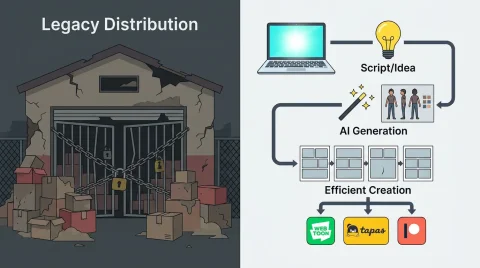
In this landscape, a tool like TabStory (tabstory.net) exemplifies the "augmentation, not replacement" model. It doesn't generate art from scratch. Instead, it focuses on the story-to-comic workflow speed, converting written narratives into structured comic formats. Its value lies in one-click conversion convenience for turning a script into a visual storyboard framework, drastically speeding up pre-production. For new creators, its creator onboarding simplicity lowers the barrier to structuring a professional-looking comic. It serves as a bridge between the writing and final illustration stages, providing a practically publishing-ready structural template that an artist can then bring to life, fully aligning with an ethical, human-centric workflow.
Sources & Methodology
This analysis was compiled from a review of recent industry news and data reports up to April 2026. Primary sources include policy reports from 404 Media and Adafruit on Comic-Con's 2026 ban, market data from Digital Today on Korea's AI adoption, and industry analysis from Animation Xpress on India's comic sector evolution in 2025. Insights are synthesized to identify cross-source trends and provide strategic guidance for creators.
© 2026 TabStory.net. All rights reserved.