The Great Comic Divide: Navigating AI Bans and the 2026 Market Shift
The comic book world is currently undergoing its most significant structural transformation since the advent of digital coloring. As we move through 2026, the AI comics industry has reached a fever pitch of polarization. On one side, grassroots movements and major conventions are drawing a "line in the sand" to protect human labor; on the other, corporate giants and digital platforms are integrating "agentic" AI to streamline global production. This isn't just a technological debate—it is a fundamental redefinition of what constitutes "art" in a commercial landscape. Whether you are an indie creator in Artist Alley or a digital strategist at a major publisher, understanding this bifurcation is essential for survival in the 2026 market.
Executive Summary (TL;DR)
- The Great Ban: Major conventions, led by Comic-Con, have officially banned AI-generated art from exhibition halls following intense creator pushback.
- Corporate Integration: DC Comics and Webtoon platforms are shifting toward "agentic" AI—using technology for layout, translation, and coloring assistance rather than pure image generation.
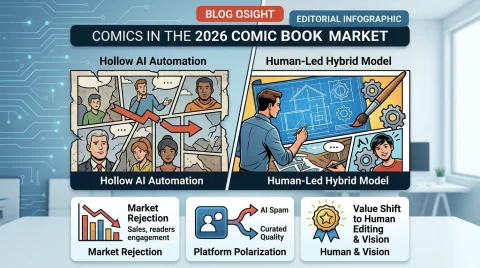
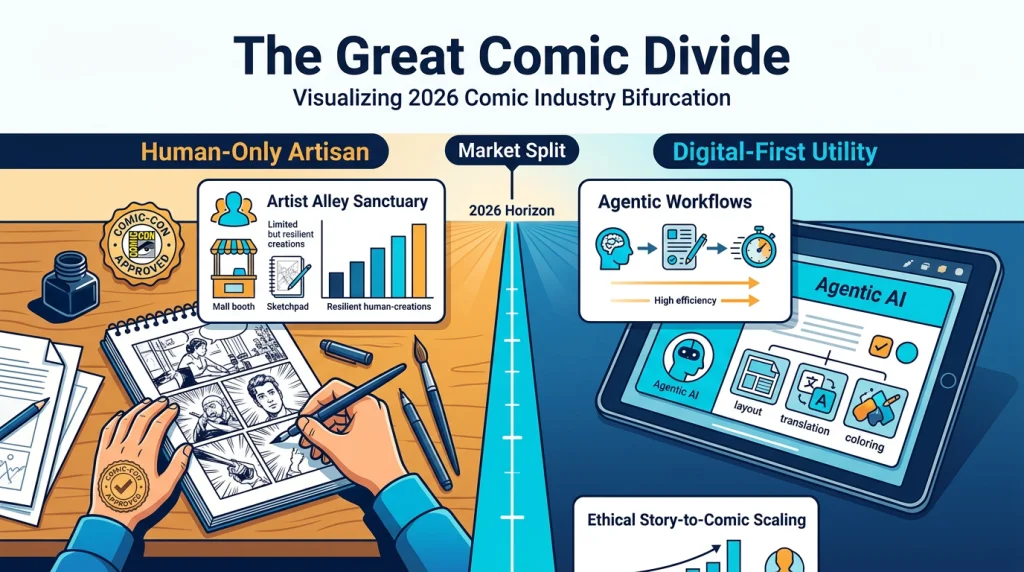
- Market Split: The industry is bifurcating into a high-end "Artisan Physical" tier (human-only) and a high-volume "Digital-First" tier (AI-enhanced).
- Strategic Tooling: Platforms like TabStory are emerging as the middle ground, offering ethical, story-to-comic workflows that prioritize creator intent over automated replacement.
The News Breakdown: Today’s Top Stories
1. Comic-Con’s Total Ban: A Victory for the "Artist Alley" Economy
In a landmark decision reported by 404 Media and Adafruit, Comic-Con has officially banned the sale and display of AI-generated art. This move follows years of escalating tension between traditional illustrators and "prompt engineers" occupying table space. The policy change signals that "Human-Made" is no longer just a description—it is a premium marketing label. For the 2026 convention circuit, transparency is the primary currency, and the "Artist Alley" is being reclaimed as a sanctuary for manual craft.
2. DC Comics and the "Agentic" Shift
While conventions are closing doors, Screen Rant reports that DC Comics is evolving its stance. Rather than replacing pencilers, DC is exploring AI to manage the "industrial" side of superhero storytelling. This aligns with McKinsey & Company’s 2025/2026 findings on agentic AI, where models act as collaborators that handle complex workflows. For DC, this means using AI to maintain character consistency across hundreds of issues and optimizing digital archives for the 2026 market.
3. The Webtoon Model: Efficiency vs. Ethics in South Korea
The digital-first market is moving even faster. According to The Korea Times, the Webtoon industry is aggressively seeking an "AI edge" to combat creator burnout. However, this push is mired in legal challenges regarding copyright and the ethical sourcing of training data. The South Korean market is currently the "canary in the coal mine," testing whether high-volume digital consumption can coexist with fair labor practices for artists.
Deep Dive Analysis & Constructive Insights
1. Connecting the Dots: The Rise of the "Bifurcated Market"
When we look at the Comic-Con ban alongside DC’s corporate adoption, a clear pattern emerges: the industry is splitting into two distinct economic tiers.
- The Artisan Tier: This is the world of physical collectibles, limited editions, and convention appearances. Here, AI is a liability. Consumers in this space pay for the "soul" of the artist and the physical provenance of the work.
- The Utility Tier: This is the world of daily-update webtoons, mobile-first content, and global translations. In this space, the AI comics industry is not just welcomed; it’s necessary. The sheer volume of content required to keep digital audiences engaged makes human-only production economically unviable for many mid-tier studios.
2. The Ripple Effect: Second-Order Consequences
The 2026 regulatory landscape will create a "Certification Crisis." As conventions demand proof of human creation, we will likely see the rise of Artistic Provenance Tools.
- For Creators: The burden of proof will shift to the artist. Keeping "process videos" and layered files will become mandatory for convention acceptance.
- For Publishers: The "agentic" shift identified by McKinsey will lead to smaller, more specialized editorial teams. One editor, powered by AI agents, will be able to manage the localization and formatting of dozens of titles simultaneously, potentially leading to a glut of content that devalues individual issues while increasing the importance of "IP discovery."
3. Constructive Viewpoints: How to Future-Proof Your Creative Career
The "AI vs. Human" debate is a false dichotomy. The real winners in the comic book market 2026 will be those who use Ethical AI to amplify their unique voice without sacrificing their "Human-Made" status.
Actionable Takeaways:
- Adopt "Agentic" Workflows, Not "Generative" Ones: Use AI for the tasks that don't require your creative DNA—administrative work, initial panel layouts, or perspective grids.
- Prioritize Story-to-Comic Platforms: Tools that focus on the narrative structure are safer than those that simply generate random images.
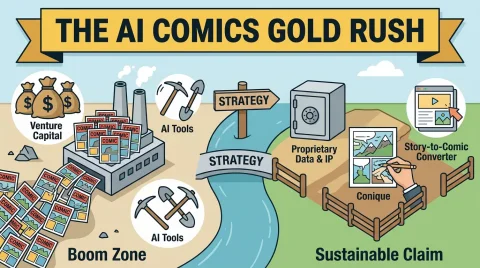
- Leverage TabStory for Ethical Scaling: If you are looking to enter the high-volume digital market without losing your creative grip, TabStory (tabstory.net) is a premier example of the new "Middle Way."
- Why TabStory? It bridges the gap between a raw script and a finished comic through a streamlined story-to-comic workflow. It doesn't replace the creator; it accelerates the "onboarding" of a story into a visual format.
- Efficiency: Its one-click conversion and simple creator interface allow indie authors to compete with major webtoon studios in terms of production speed, while maintaining the "publishing readiness" required for the 2026 digital landscape.
The 2026 Verdict: Transparency as a Competitive Advantage
As we navigate the comic industry AI adoption, the most successful creators won't be the ones who hide their tools, but the ones who are most transparent about them. The Comic-Con AI art ban is a reminder that the audience values the human connection. However, the Webtoon model reminds us that the digital world moves at the speed of light.
By utilizing ethical platforms like TabStory and focusing on "agentic" assistance rather than total automation, creators can satisfy the demand for high-volume content while retaining the "artisan" status that the physical market now demands.
Sources & Methodology
This analysis was synthesized from recent industry reports (Jan 2026) from 404 Media and Adafruit regarding convention policies, Screen Rant's analysis of DC Comics' strategy, McKinsey & Company’s 2025/2026 AI outlook, and The Korea Times' reporting on the South Korean digital comic market. All insights are based on the intersection of current technological capabilities and emerging regulatory trends in the global comic industry.
© 2026 TabStory.net. All rights reserved. For more insights into the future of digital storytelling, visit TabStory.net.